


























Views
Downloads


Sound Words Worksheet | Essential Grade 1 Science
Paste this activity's link or code into your existing LMS (Google Classroom, Canvas, Teams, Schoology, Moodle, etc.).
Students can open and work on the activity right away, with no student login required.
You'll still be able to track student progress and results from your teacher account.
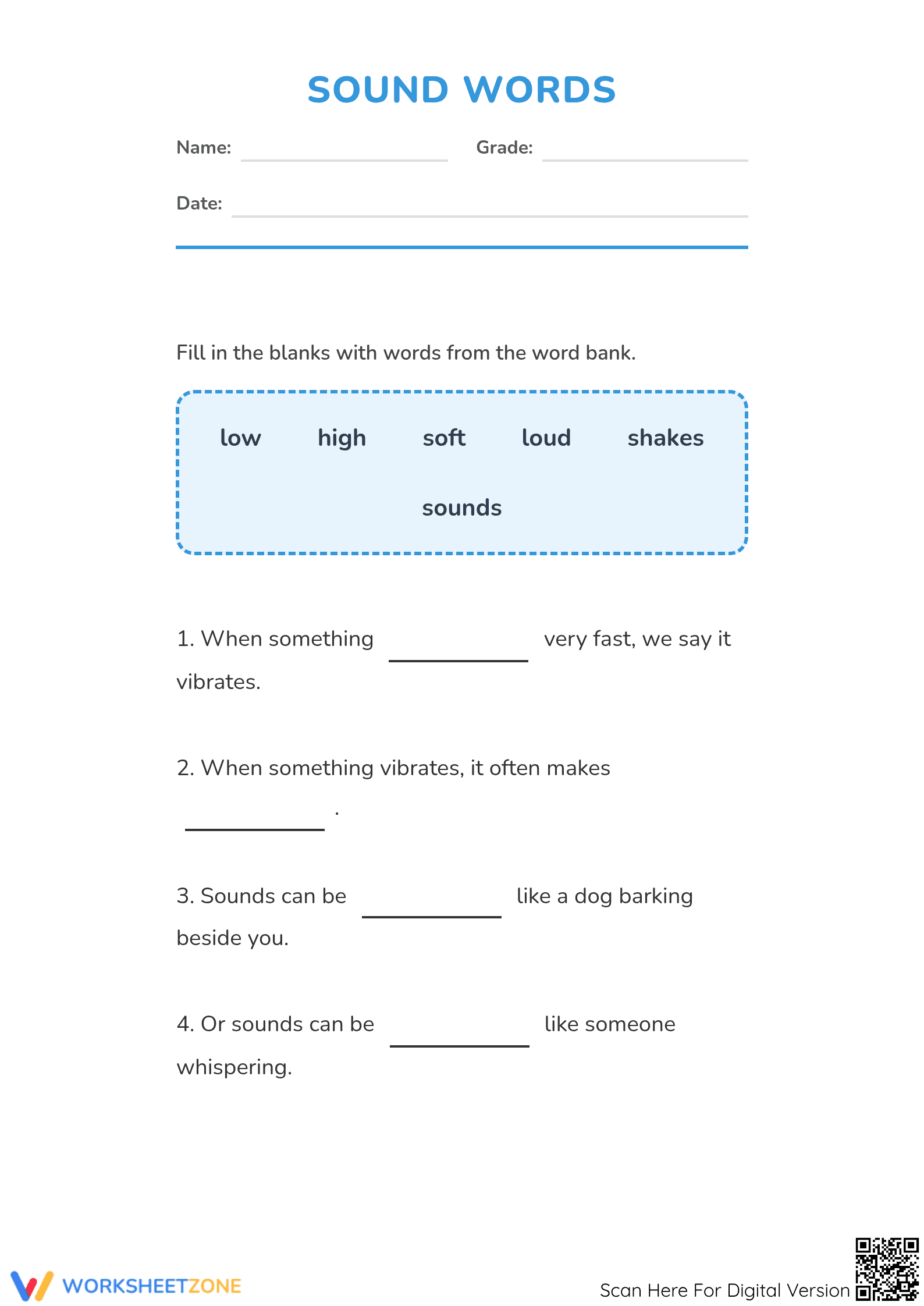
This Grade 1 science worksheet helps students master the vocabulary of acoustics by identifying and describing different sound properties. Students learn to distinguish between volume and pitch while connecting the physical concept of vibration to the sounds they hear daily. It provides a clear path for young learners to articulate scientific observations using precise terminology.
At a Glance
- Grade: 1 · Subject: Science
- Standard:
1-PS4-1— Provide evidence that vibrating materials can make sound- Skill Focus: Sound vocabulary and properties
- Format: 2 pages · 10 problems · Answer key included · PDF
- Best For: Introduction to physical science units
- Time: 15–20 minutes
What's Inside
This two-page resource features a structured layout designed for early readers. The first page includes a helpful word bank containing terms like vibrates, loud, and high to support sentence completion. The second page introduces the Sound Detective section, where students apply their knowledge to real-world scenarios, such as a fire truck siren or a kitten meowing. A complete answer key is provided for quick grading.
Zero-Prep Workflow
- Print: Select the two-page PDF and print enough copies for your class in less than 30 seconds.
- Distribute: Hand out the worksheets during your science block; the word bank ensures students can work with minimal teacher intervention.
- Review: Use the included answer key to conduct a 5-minute whole-group review to reinforce the connection between vibration and sound.
Total teacher preparation time is under 2 minutes, making this an ideal choice for sub plans or busy mornings.
Standards Alignment
This resource is primarily aligned with 1-PS4-1, which requires students to understand that vibrating materials produce sound. It also supports ELA standard CCSS.ELA-LITERACY.L.1.5.A by encouraging students to sort and categorize words based on their attributes. Both standard codes can be copied directly into lesson plans, IEP goals, or district curriculum mapping tools.
How to Use It
Use this worksheet as a formative assessment after a hands-on demonstration with tuning forks or rubber bands. Observe if students can correctly pair the term vibrates with the action of shaking fast. It also functions well as a science center activity where students listen to recorded sounds and then record their descriptions on the page. Expected completion typically takes 15 to 20 minutes.
Who It's For
This worksheet is designed for first-grade students but is also highly effective for second-grade review or English Language Learners (ELLs) who need visual and context-clue support for science vocabulary. It pairs naturally with an anchor chart displaying Loud vs. Soft and High vs. Low visual aids to support diverse learners.
The Sound Words worksheet directly addresses the 1-PS4-1 standard by requiring students to define the relationship between physical movement and auditory output. By focusing on specific descriptors like pitch and volume, the activity builds the foundational literacy required for later inquiry-based science. Research by Fisher & Frey (2014) emphasizes that providing students with structured word banks and sentence frames during initial science instruction significantly improves the retention of domain-specific vocabulary. This worksheet applies those principles by scaffolding the transition from observing a phenomenon to describing it with scientific accuracy. With 10 targeted tasks across two pages, the resource ensures that Grade 1 learners move beyond simple identification toward a conceptual understanding of how sound functions in the physical world. This alignment with evidence-based instructional strategies makes it a reliable tool for achieving early elementary science mastery.


