


























Views
Downloads

Printable Word Problems Worksheet | Grade 1 Math Addition
Paste this activity's link or code into your existing LMS (Google Classroom, Canvas, Teams, Schoology, Moodle, etc.).
Students can open and work on the activity right away, with no student login required.
You'll still be able to track student progress and results from your teacher account.
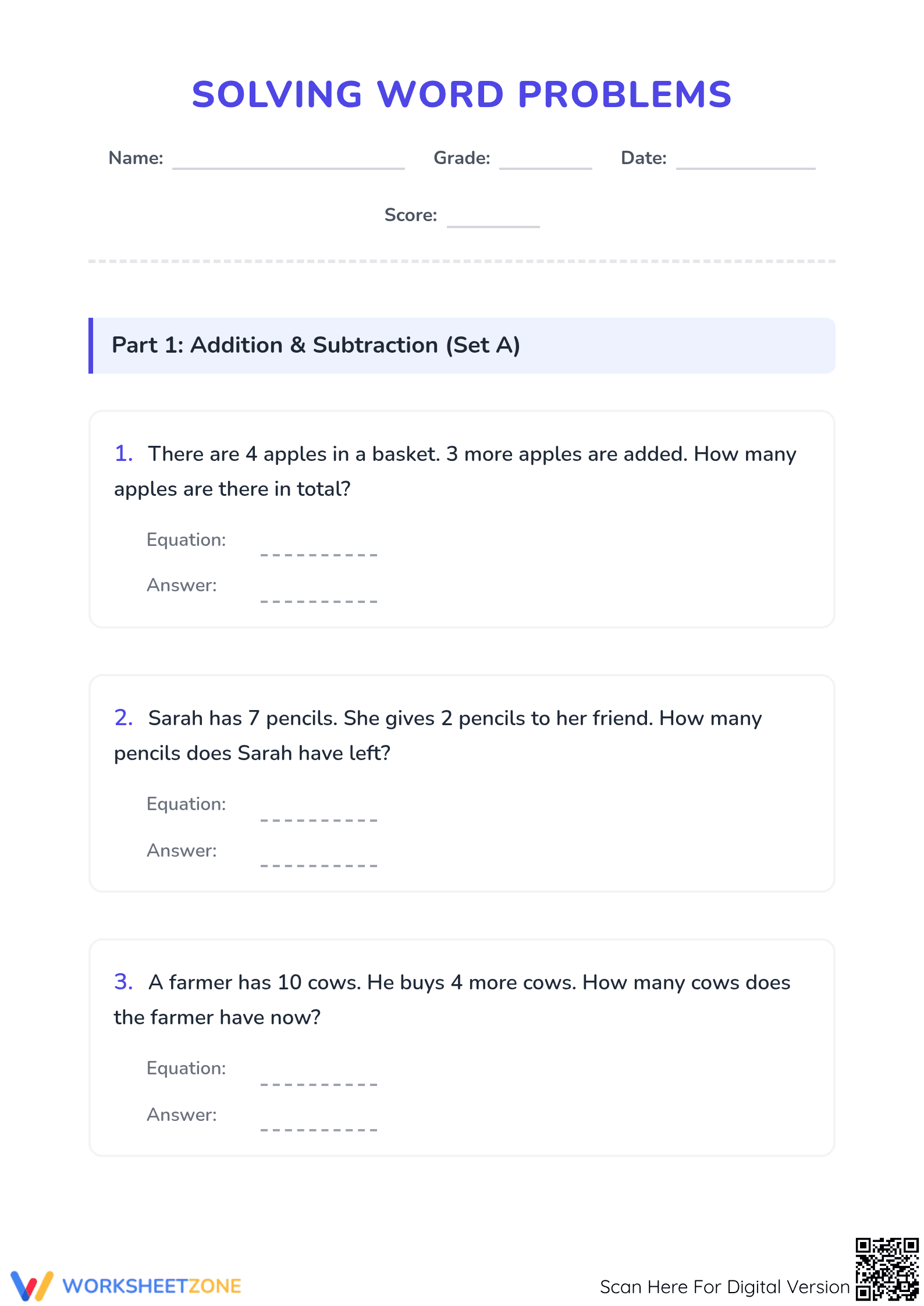
Help students master the fundamental skill of translating real-world scenarios into mathematical equations. This Grade 1 math worksheet focuses on solving simple addition and subtraction word problems, providing students with structured practice to build confidence and accuracy in their early arithmetic journey. By engaging with these relatable stories, learners develop the critical thinking required for higher-order math.
At a Glance
- Grade: 1 · Subject: Math
- Standard:
CCSS.MATH.CONTENT.1.OA.A.1— Use addition and subtraction within 20 to solve word problems- Skill Focus: Addition and Subtraction Word Problems
- Format: 3 pages · 9 problems · Answer key included · PDF
- Best For: Individual practice or formative assessment
- Time: 15–20 minutes
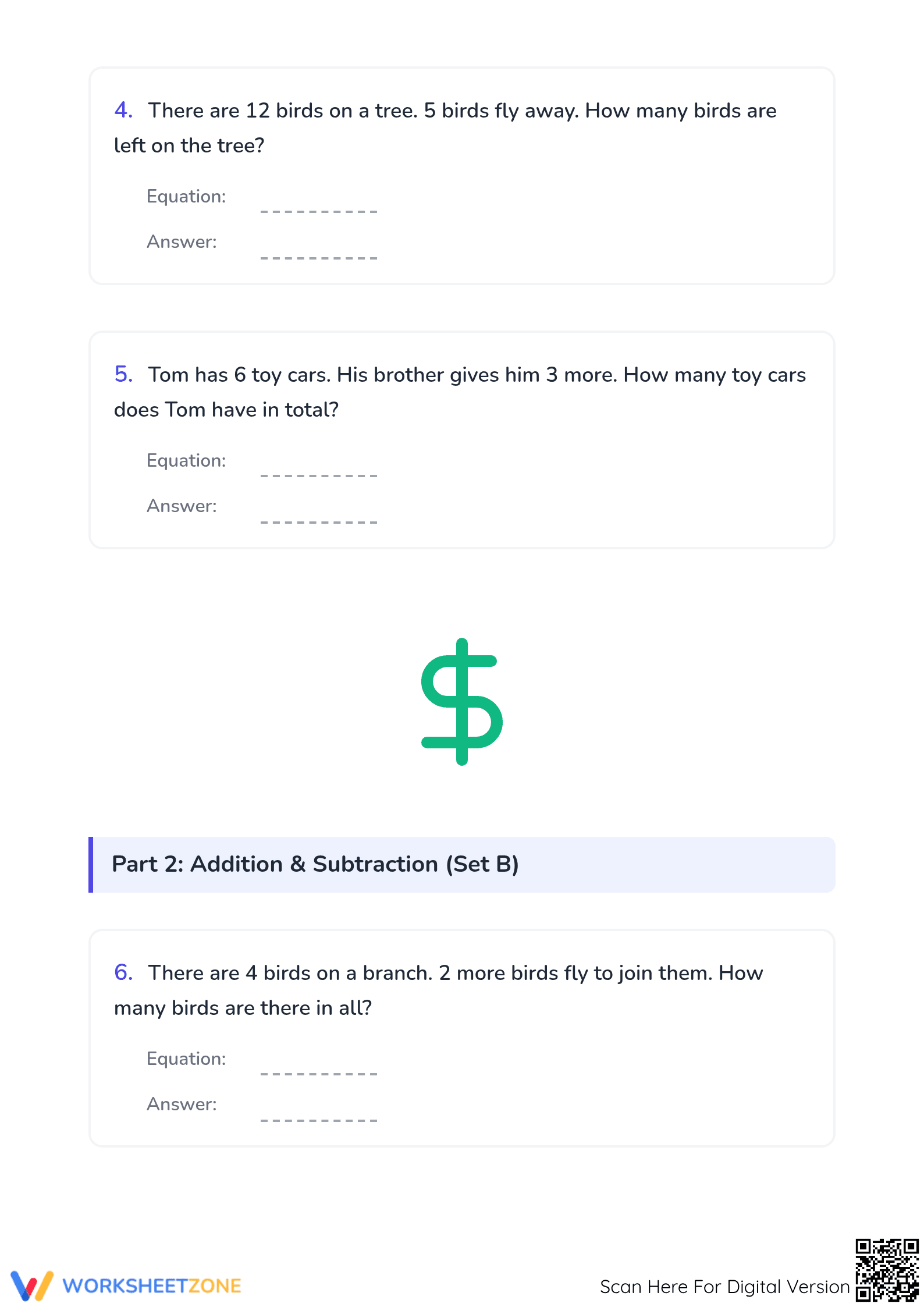
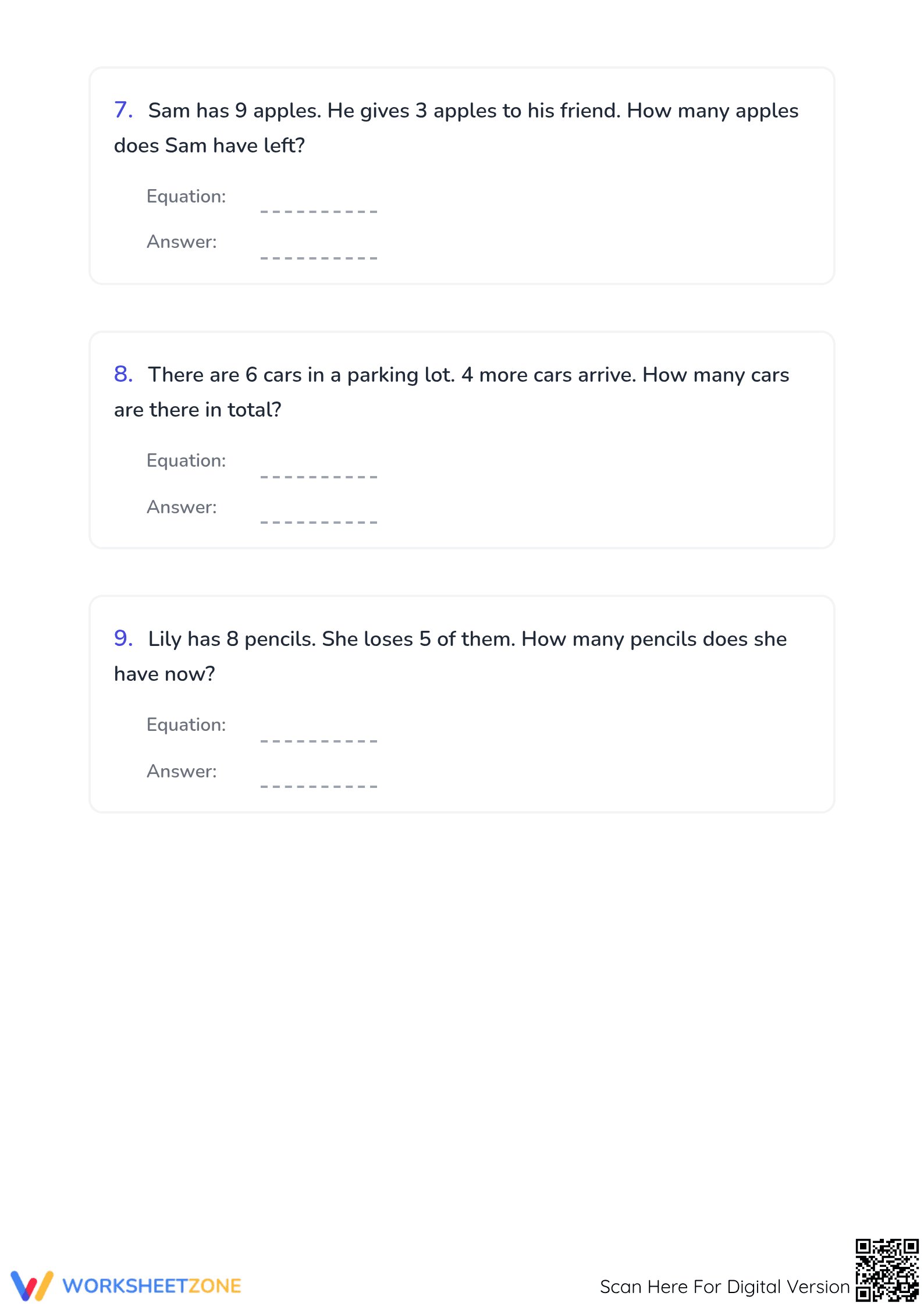
This resource contains three pages of focused practice, totaling nine unique word problems. Each problem is presented in its own box with dedicated space for students to write the corresponding equation and the final answer. The worksheet covers both "adding to" and "taking from" situations using numbers within 20. A complete answer key is included for quick and easy grading.
- Guided Practice: The first three problems introduce basic scenarios with small numbers, allowing students to map simple stories to addition and subtraction operations with teacher support.
- Supported Practice: Problems 4 through 6 increase the complexity slightly, using different contexts like birds and toy cars to ensure students can generalize their skills across various situations.
- Independent Practice: The final set of problems challenges students to read, interpret, and solve equations independently, reinforcing the gradual-release model of instruction and building mathematical stamina.
This sequence ensures a smooth transition from basic comprehension to independent application of arithmetic skills.
Standards Alignment
This worksheet is directly aligned with CCSS.MATH.CONTENT.1.OA.A.1, which requires students to use addition and subtraction within 20 to solve word problems. The tasks specifically address situations of adding to and taking from, with results in the unknown position. Both standard codes can be copied directly into lesson plans, IEP goals, or district curriculum mapping tools.
How to Use It
Use this worksheet during the independent practice portion of a lesson on operational word problems. It works well as a "check for understanding" after direct instruction. For a formative assessment tip, observe whether students are drawing pictures or using counters to represent the numbers before writing the equation. Expect most students to complete the 9 tasks in approximately 20 minutes.
Who It's For
Designed for Grade 1 students, this resource is also suitable for Grade 2 review or as intervention material for older learners. It pairs naturally with a number line anchor chart or a "keywords for operations" reference sheet to support students who are still developing their reading comprehension skills alongside their math fluency.
According to the CCSS.MATH.CONTENT.1.OA.A.1 standard, solving word problems is a critical milestone in early math development, requiring students to interpret language and apply arithmetic logic. Research from EdReports 2024 highlights that high-quality materials must provide multiple opportunities for students to engage with diverse problem types to achieve operational fluency. This worksheet addresses that need by presenting nine distinct scenarios requiring students to distinguish between addition and subtraction. By providing dedicated space for both the equation and the answer, the resource encourages students to show their mathematical thinking, a practice that Fisher & Frey (2014) argue is essential for building conceptual understanding. Using these structured practice sets helps bridge the gap between abstract calculation and concrete application, ensuring students are ready for more complex multi-step problems.


