


























Views
Downloads

Solar System Coloring Worksheet | Essential Grade 1
Paste this activity's link or code into your existing LMS (Google Classroom, Canvas, Teams, Schoology, Moodle, etc.).
Students can open and work on the activity right away, with no student login required.
You'll still be able to track student progress and results from your teacher account.
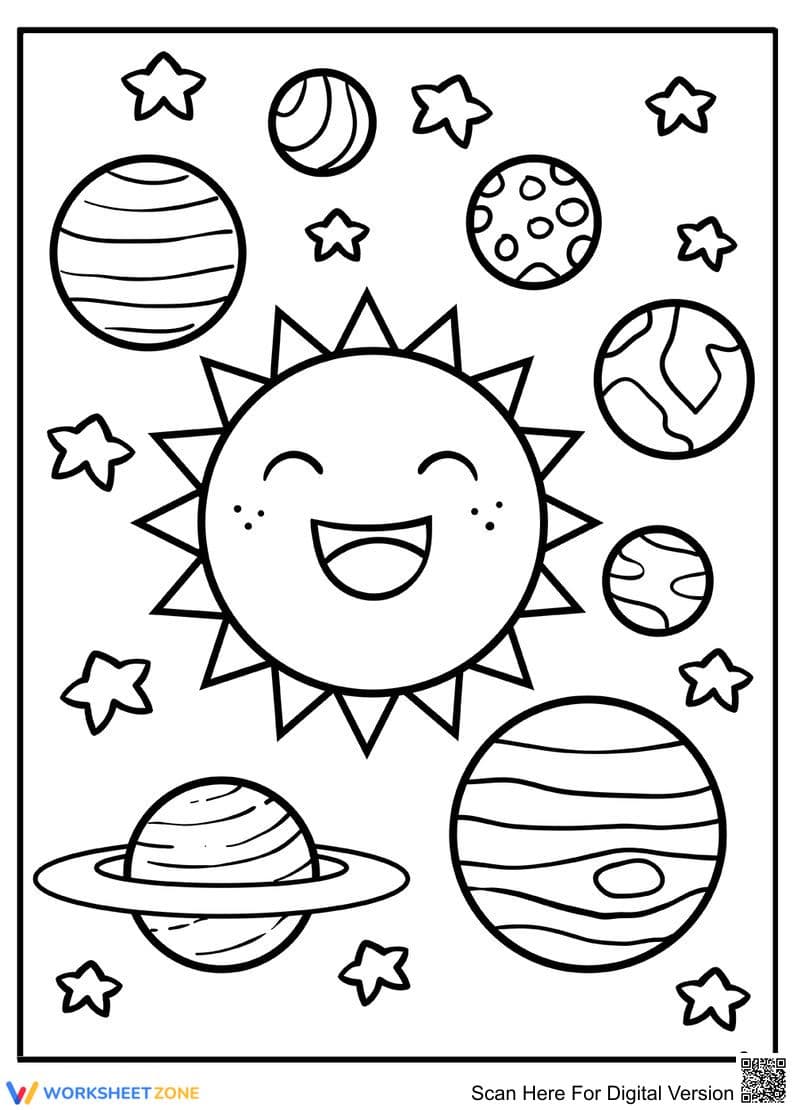
This Grade 1 solar system coloring worksheet provides a creative way for students to engage with space science. By coloring the sun, planets, and stars, learners build visual recognition of celestial objects while developing fine motor control. It serves as an excellent introductory activity for young astronomers exploring the patterns of our universe.
At a Glance
- Grade: 1 · Subject: Science & Art
- Standard:
1-ESS1-1— Use observations of the sun, moon, and stars to describe patterns- Skill Focus: Celestial object identification
- Format: 1 page · 1 task · No answer key needed · PDF
- Best For: Early finisher science center activity
- Time: 15–20 minutes
This resource features a single, high-quality illustration of the solar system, including a central smiling sun, various planets with distinct features like rings, and multiple stars. The clear, bold outlines are designed for young learners, ensuring a frustration-free coloring experience that reinforces vocabulary related to space and the night sky.
The zero-prep workflow is designed for maximum efficiency. First, print the single-page PDF (30 seconds). Second, distribute the sheets to students along with crayons or colored pencils (1 minute). Third, facilitate a brief discussion as students color, asking them to point out the sun or specific planets (5 minutes). Total teacher prep time is under 2 minutes.
This worksheet aligns with 1-ESS1-1, which requires students to observe and describe patterns of objects in the sky. While primarily an artistic activity, it supports the foundational understanding that the sun and stars are distinct components of our universe. This standard code can be copied directly into lesson plans, IEP goals, or district curriculum mapping tools.
Use this worksheet as a hook at the beginning of a unit on Earth's place in the universe. It is also effective as a quiet-time activity following a read-aloud about the planets. Teachers should observe if students can distinguish between the sun and the smaller stars, providing a quick formative assessment of their spatial vocabulary.
This printable is ideal for Kindergarten through 2nd-grade students, particularly those who benefit from tactile and visual learning. It pairs naturally with a classroom anchor chart showing the order of the planets or a picture book about the sun's role in our solar system.
According to Fisher & Frey (2014), visual representations and creative engagement are vital for early childhood science literacy. This solar system worksheet utilizes the 1-ESS1-1 standard to bridge the gap between abstract astronomical concepts and concrete student observations. By focusing on the sun and stars, the activity reinforces the pattern-recognition skills necessary for meeting NGSS performance expectations. Research from the NAEP suggests that early exposure to science vocabulary through integrated arts activities improves long-term retention of complex topics. This 1-page resource provides a low-stakes environment for students to practice fine motor skills while internalizing the basic structure of our cosmic neighborhood. The inclusion of recognizable features, such as Saturn's rings, allows for natural inquiry and discussion, making it a valuable tool for diverse classroom settings and early intervention programs focused on science and literacy.


