


























Views
Downloads
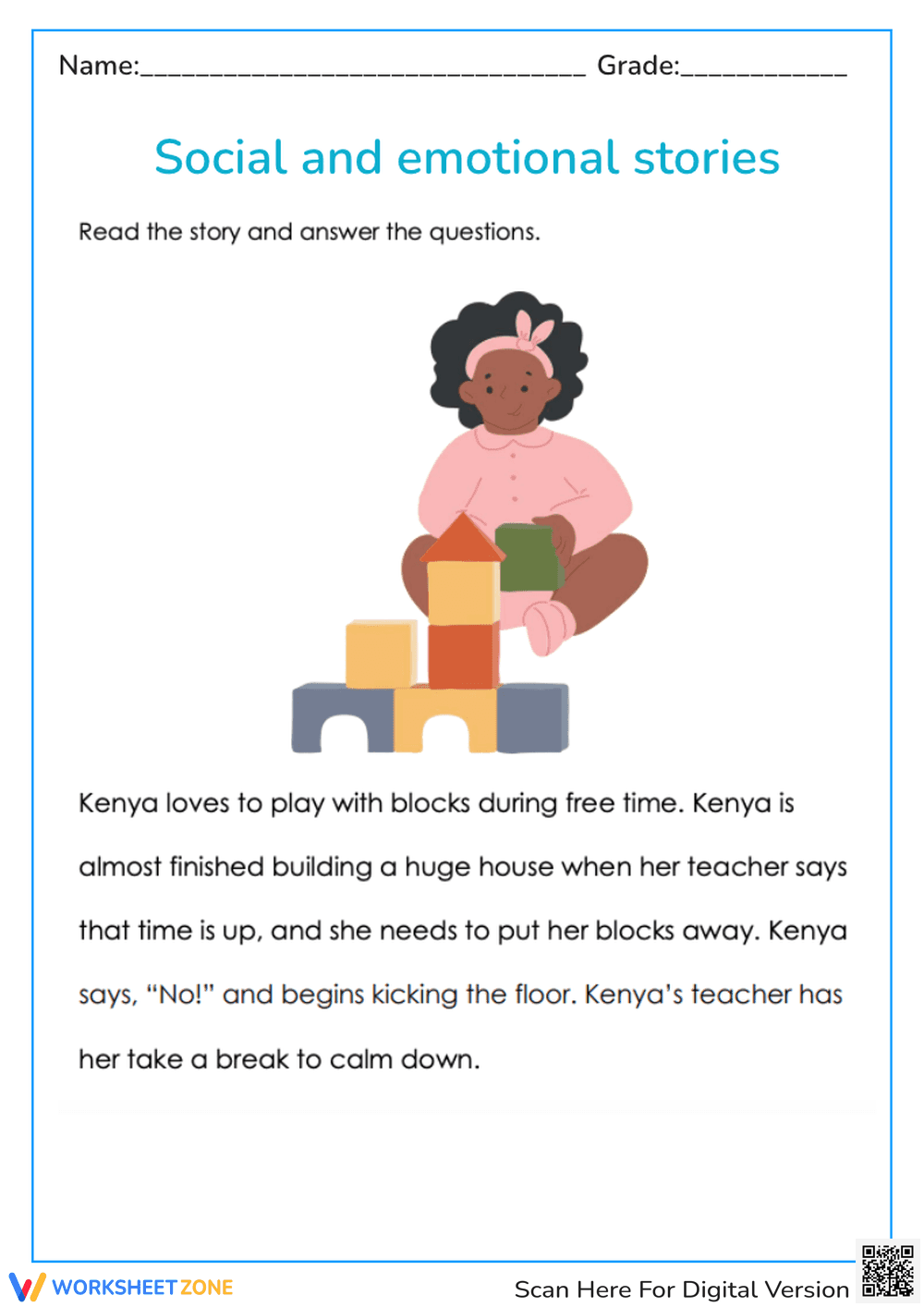


Social and Emotional Stories | Grade 2 Essential Worksheet
Paste this activity's link or code into your existing LMS (Google Classroom, Canvas, Teams, Schoology, Moodle, etc.).
Students can open and work on the activity right away, with no student login required.
You'll still be able to track student progress and results from your teacher account.
Overview
This social-emotional learning worksheet helps students identify and process common classroom frustrations through the story of Kenya and her building blocks. By analyzing a character's reaction to a difficult transition, students learn to recognize emotional triggers and brainstorm positive behavioral alternatives. This resource bridges the gap between reading comprehension and real-world self-regulation skills.
At a Glance
- Grade: 2 · Subject: Social Emotional Learning
- Standard:
CCSS.ELA-LITERACY.RL.2.3— Describe how characters in a story respond to major events and challenges- Skill Focus: Emotional Regulation
- Format: 2 pages · 3 problems · Answer key included · PDF
- Best For: Morning meeting or small group SEL
- Time: 15–20 minutes
What's Inside
The worksheet features a relatable 2-page layout designed for early elementary learners. Page one introduces Kenya, a student who struggles when her playtime is interrupted. Page two provides three targeted assessment tasks: two multiple-choice questions focusing on problem identification and conflict resolution, followed by a short-answer reflection. The clear font and simple illustration ensure the content remains accessible for developing readers.
Zero-Prep Workflow
This resource is designed for immediate classroom implementation with a total teacher prep time of under 2 minutes. First, print the two-page PDF for your roster. Second, distribute the sheets during a transition period or dedicated SEL block. Finally, review the answers as a whole group to facilitate a discussion about calm down strategies. Its self-explanatory nature makes it an ideal choice for unexpected sub plans.
Standards Alignment
This activity is primarily aligned with `CCSS.ELA-LITERACY.RL.2.3`, which asks students to describe how characters in a story respond to major events and challenges. By evaluating Kenya's choice to kick the floor versus asking for more time, students demonstrate mastery of character analysis. Both standard codes can be copied directly into lesson plans, IEP goals, or district curriculum mapping tools.
How to Use It
Use this worksheet during a morning meeting to set a positive tone for classroom transitions. It serves as an excellent formative assessment; observe if students can identify the prosocial choice in question two to gauge their understanding of conflict resolution. The expected completion time is 15 to 20 minutes, making it a perfect bell-ringer or wrap-up activity for a lesson on feelings.
Who It's For
While optimized for Grade 2, this resource is highly effective for students in Grades 1 through 5 who require support with emotional regulation or perspective-taking. It is particularly useful for students with IEP goals related to social skills or for use in a calm down corner. Pair this worksheet with a picture book about feelings or an anchor chart detailing different ways to ask for help.
This resource aligns with CCSS.ELA-LITERACY.RL.2.3 by requiring students to analyze how a character responds to a specific challenge—in this case, the transition from play to cleanup. By identifying the problem and proposing prosocial solutions, students practice the plain-English skill of describing character reactions to events. According to Fisher & Frey (2014), using short, relatable narratives allows students to build empathy and cognitive flexibility through scaffolded questioning. This worksheet provides that structure by moving from identifying the conflict to evaluating alternative behaviors. Research indicates that explicit instruction in social-emotional scenarios improves classroom climate and individual self-regulation. Educators can use this 2-page tool to bridge the gap between reading comprehension and behavioral expectations. The inclusion of an open-ended reflection question ensures that students move beyond simple recall into higher-order perspective-taking, which is a critical component of early childhood development and literacy mastery.


