


























Views
Downloads


Snow Day Numbers: Essential Kindergarten Counting Worksheet
Paste this activity's link or code into your existing LMS (Google Classroom, Canvas, Teams, Schoology, Moodle, etc.).
Students can open and work on the activity right away, with no student login required.
You'll still be able to track student progress and results from your teacher account.
This Kindergarten counting worksheet uses a seasonal winter theme to help students master the relationship between numbers and quantities. By counting familiar objects in a snowy scene—like snowmen, ice skaters, and deer—learners develop strong cardinality skills. This resource provides clear visual support for students practicing one-to-one correspondence for numbers up to 20.
At a Glance
- Grade: Kindergarten · Subject: Math
- Standard:
K.CC.B.4— Understand the relationship between numbers and quantities; connect counting to cardinality.- Skill Focus: Visual counting and one-to-one correspondence (0–20)
- Format: 3 pages · 7 problems · Answer key included · PDF
- Best For: Independent practice or seasonal math centers
- Time: 15–20 minutes
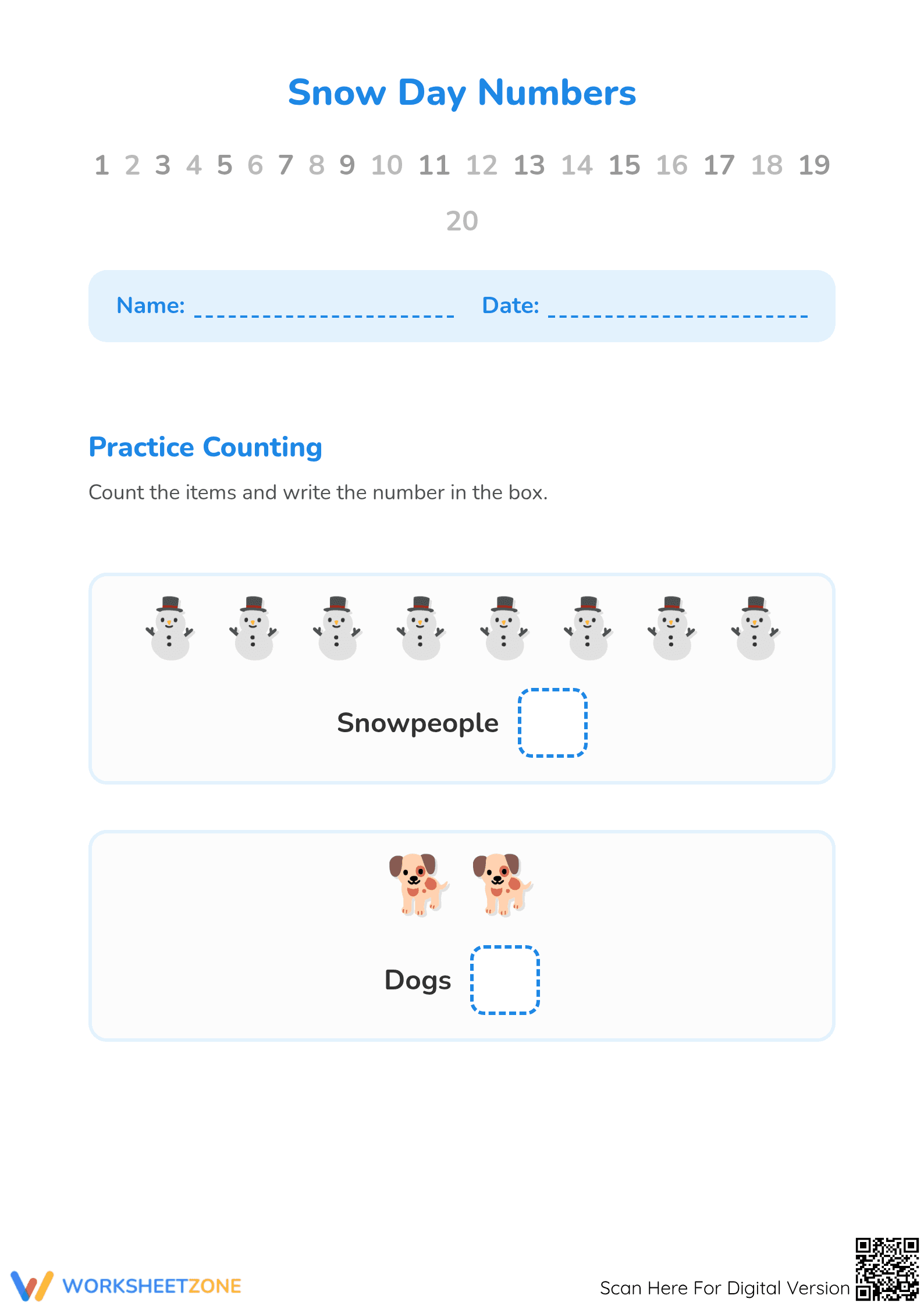
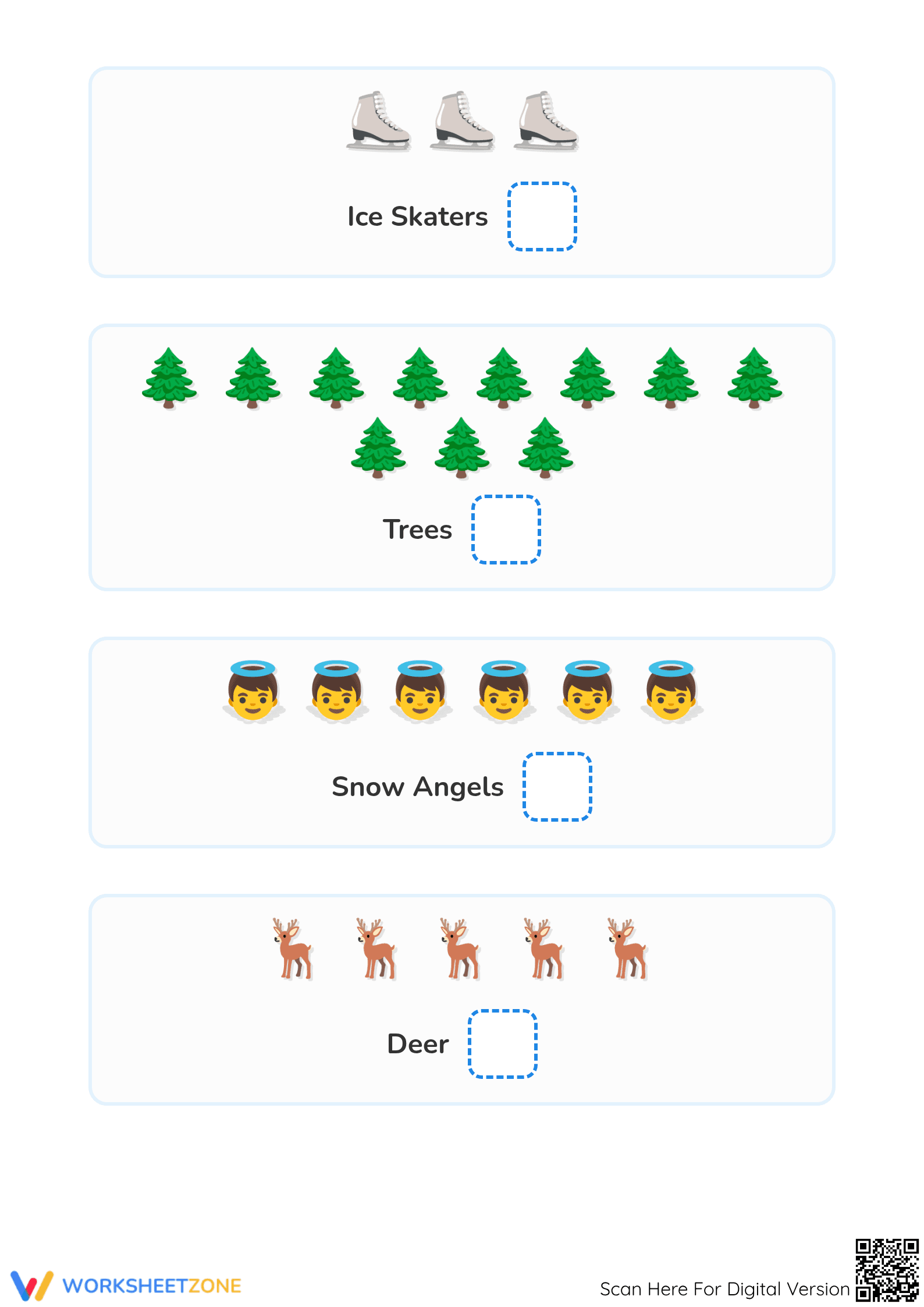
Inside this 3-page PDF, you will find seven distinct counting tasks set within a cohesive winter-themed environment. Each page features high-contrast illustrations of winter objects, such as eight snowpeople and eleven evergreen trees. Students observe the groups, count each item, and record the total in the provided dashed box. A complete answer key is included for rapid grading.
The workflow for this resource is designed for maximum teacher efficiency. First, print the three-page set for your class, which takes less than thirty seconds. Second, distribute the worksheets during your math block or as a "snow day" themed morning work activity. Finally, use the included answer key to review student work in under two minutes total. It is also an ideal emergency sub-plan.
This resource is explicitly aligned to `K.CC.B.4`. This standard requires students to understand that the last number name said tells the number of objects counted. The worksheet supports this by providing structured boxes for numerical entry directly next to the counted sets. This standard code can be copied directly into lesson plans, IEP goals, or district curriculum mapping tools.
Use this worksheet as a formative assessment after introducing the concept of counting to twenty. Observe students as they touch each object to verify they are using one-to-one correspondence rather than skipping items. Alternatively, place the pages in a math center during the winter months for independent practice. Most students will complete all three pages in approximately fifteen to twenty minutes.
This activity is designed specifically for Kindergarten students but is also appropriate for Pre-K learners ready for higher numbers or first graders needing remedial support. The heavy reliance on visual icons makes it particularly effective for English Language Learners and students with IEP goals focused on basic numeracy. It pairs naturally with a winter-themed counting book or anchor chart.
The development of cardinality, as measured by standard K.CC.B.4, is a critical predictor of later mathematical achievement in early childhood education. This worksheet leverages visual scaffolding to help students bridge the gap between abstract number names and concrete quantities. Research by Fisher & Frey (2014) emphasizes that gradual release of responsibility is most effective when students have access to structured, visually-supported practice like this counting activity. By engaging with seven specific counting tasks involving up to twenty objects, students reinforce the principle that the order of counting remains constant and that the final number assigned represents the total of the set. This printable resource ensures that Kindergarten students meet foundational benchmarks for number sense and quantitative reasoning. Educational practitioners can integrate this worksheet into a comprehensive numeracy curriculum to provide the repeated, low-stakes exposure necessary for mastery of core counting and cardinality standards.


