


























Views
Downloads

Printable Snake Life Cycle Worksheet | Grade 3 Science
Paste this activity's link or code into your existing LMS (Google Classroom, Canvas, Teams, Schoology, Moodle, etc.).
Students can open and work on the activity right away, with no student login required.
You'll still be able to track student progress and results from your teacher account.
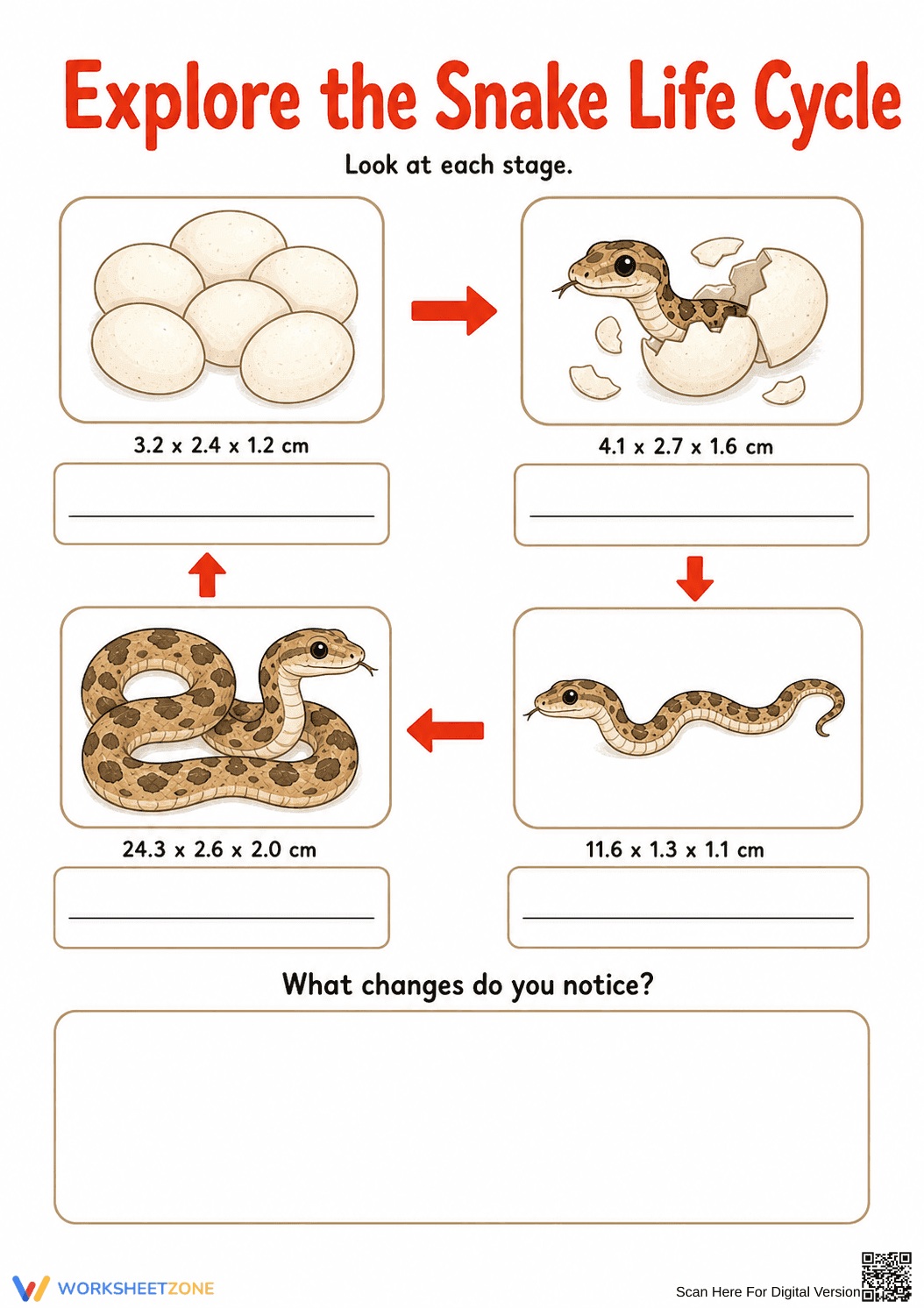
This Grade 3 science worksheet introduces students to the fascinating stages of a snake's development. By examining clear illustrations and recording their observations, learners will understand how reptiles grow and change over time. This resource provides a straightforward, engaging way to build foundational knowledge about animal life cycles and biological transformations.
At a Glance
- Grade: 3 · Subject: Science
- Standard:
3-LS1-1— Describe that organisms have unique and diverse life cycles- Skill Focus: Animal life cycles
- Format: 1 page · 5 problems · PDF
- Best For: Independent practice
- Time: 15–20 minutes
Inside this single-page resource, students will find a four-stage diagram illustrating a snake's life cycle, from eggs to adult. Each stage includes physical dimensions for scale and a blank line for labeling. A short-answer prompt asks students to describe the physical changes they notice, encouraging detailed observation.
Zero-Prep Classroom Workflow
This worksheet is designed for immediate use.
- Print (1 minute): Download the PDF and print a class set.
- Distribute (1 minute): Hand out during your science block or place in a center.
- Review (3 minutes): Discuss life cycles, then let students work independently.
With under two minutes of prep time, this activity is perfect for quick assessments or substitute teacher plans.
Standards Alignment
This resource aligns to 3-LS1-1: Develop models to describe that organisms have unique and diverse life cycles but all have in common birth, growth, reproduction, and death. Students actively engage with biological growth concepts. Both standard codes can be copied directly into lesson plans, IEP goals, or district curriculum mapping tools.
How to Use It
Use this as independent practice after a lesson on animal life cycles. It also serves as an excellent science center station. As a formative assessment tip, review the written responses to ensure students note specific physical changes rather than just summarizing the cycle. Expect students to complete this activity in 15 to 20 minutes.
Who It's For
Designed for third-grade science students, this activity is also accessible for English Language Learners needing visual supports. Pair this worksheet with a nonfiction text about snakes or a broader unit on reptile habitats.
Understanding biological progressions is a critical component of early elementary science education. This worksheet aligns with 3-LS1-1, helping students describe that organisms have unique and diverse life cycles. According to a ScienceDirect TpT Analysis, providing students with clear, sequential visual models significantly enhances their ability to comprehend abstract biological processes like growth and maturation. When learners actively label diagrams and articulate the changes they observe, they move beyond rote memorization and begin to develop genuine scientific reasoning skills. This resource bridges the gap between simple observation and analytical thinking by prompting students to describe the transformation in their own words. By integrating visual literacy with scientific inquiry, educators can foster a deeper understanding of the natural world.


