




























Views
Downloads

Essential Snake Life Cycle Worksheet | Grade 3 Science

Paste this activity's link or code into your existing LMS (Google Classroom, Canvas, Teams, Schoology, Moodle, etc.).
Students can open and work on the activity right away, with no student login required.
You'll still be able to track student progress and results from your teacher account.
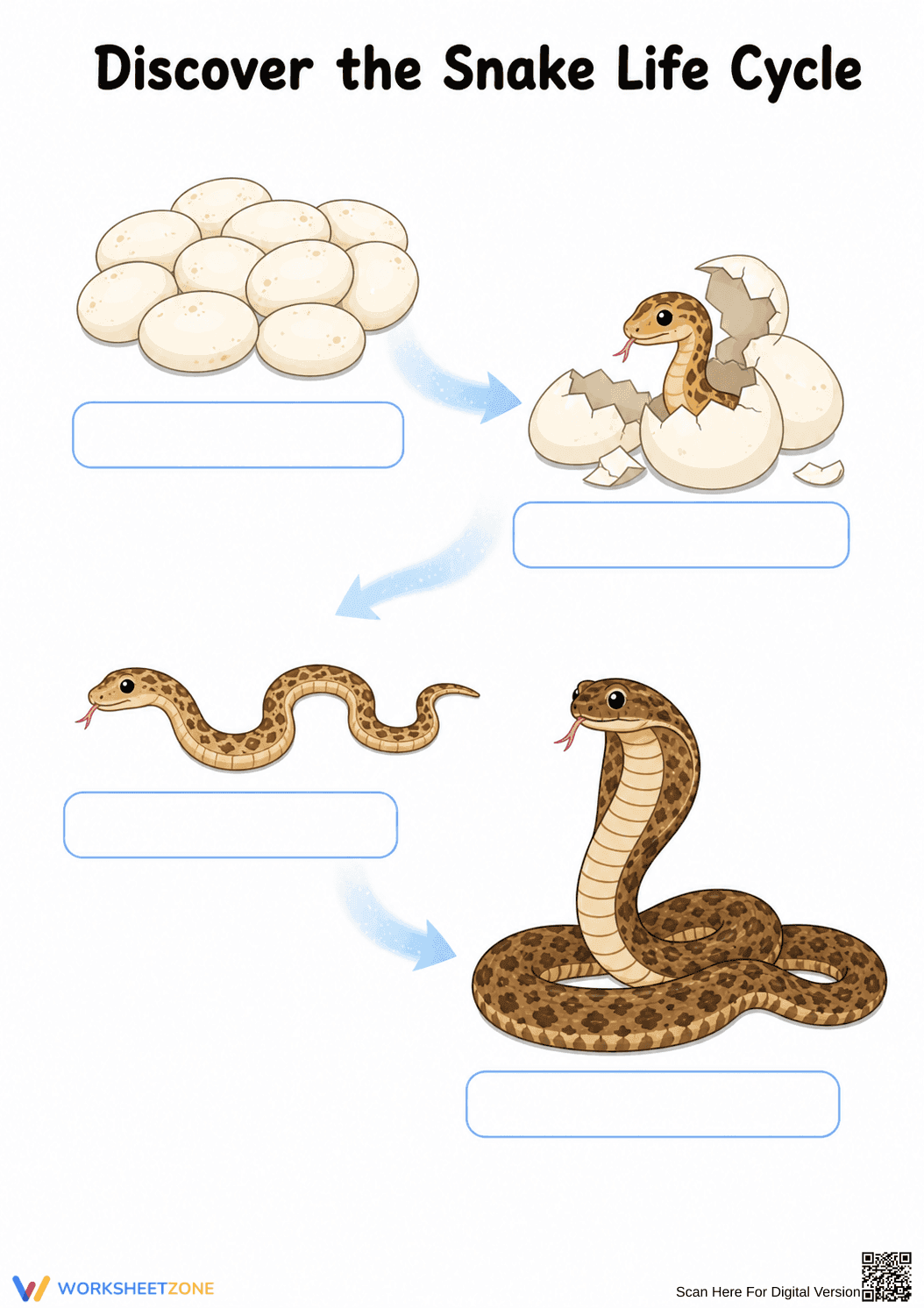
This Grade 3 snake life cycle worksheet provides a clear visual model for students to identify and sequence the developmental stages of reptiles. By labeling the progression from eggs to adulthood, learners build a foundational understanding of biological growth patterns and reproductive cycles in the natural world.
At a Glance
- Grade: 3 · Subject: Science
- Standard:
3-LS1-1— Develop models to describe that organisms have unique and diverse life cycles- Skill Focus: Sequencing life cycle stages
- Format: 1 page · 4 problems · Answer key included · PDF
- Best For: Introduction to reptile biology and development
- Time: 15–20 minutes
What's Inside
This single-page PDF features high-quality illustrations of four distinct stages: a clutch of eggs, a hatchling emerging, a juvenile snake, and a fully developed adult. Below each illustration is a dedicated labeling box where students can write the corresponding stage name. The layout is clean and distraction-free, ensuring students focus entirely on the biological sequence. A full answer key is provided for quick grading or student self-correction.
Zero-Prep Workflow
- Print: Generate copies for your class in under 1 minute.
- Distribute: Hand out during your science block as a follow-up to a lesson on reptiles.
- Review: Discuss the answers as a whole class to clarify the transition between the hatchling and juvenile phases.
This resource is an ideal choice for emergency sub plans or quick formative assessments with zero teacher setup required.
Standards Alignment
The primary focus is `3-LS1-1`: "Develop models to describe that organisms have unique and diverse life cycles but all have in common birth, growth, reproduction, and death." This worksheet serves as a static model that allows students to visualize these commonalities within the specific context of a reptile. Both standard codes can be copied directly into lesson plans, IEP goals, or district curriculum mapping tools.
How to Use It
Use this worksheet during the "Explain" phase of a 5E instructional cycle. After students have observed images of various animals, provide this sheet to help them formalize their understanding of the snake's specific path. It also works well as an exit ticket to gauge whether students can distinguish between the hatchling and adult stages. Expect students to complete the labeling and a brief discussion in approximately 15 to 20 minutes.
Who It's For
This resource is tailored for third-grade students but is highly effective for English Language Learners (ELLs) due to the heavy visual scaffolding. It pairs naturally with a non-fiction text about reptiles or an anchor chart detailing the characteristics of vertebrates in a general biology unit.
According to Fisher & Frey (2014), the use of visual models and graphic organizers is essential for helping students internalize complex biological processes like the life cycle. This worksheet aligns with the 3-LS1-1 standard by providing a structured framework for students to observe and name the stages of growth, reproduction, and development. Research from the NAEP indicates that students who engage with visual representations of scientific data and cycles demonstrate higher retention of core disciplinary ideas. By focusing on the snake life cycle, this resource bridges the gap between abstract biological concepts and concrete observation. The inclusion of 4 distinct tasks ensures that students are not just memorizing terms but are actively mapping them to physical changes in the organism. This approach supports the gradual release of responsibility and provides a clear artifact for formative assessment in elementary science classrooms.


