


























Views
Downloads

Noun & Adjective Detective Worksheet | Grade 1-2 Essential
Paste this activity's link or code into your existing LMS (Google Classroom, Canvas, Teams, Schoology, Moodle, etc.).
Students can open and work on the activity right away, with no student login required.
You'll still be able to track student progress and results from your teacher account.
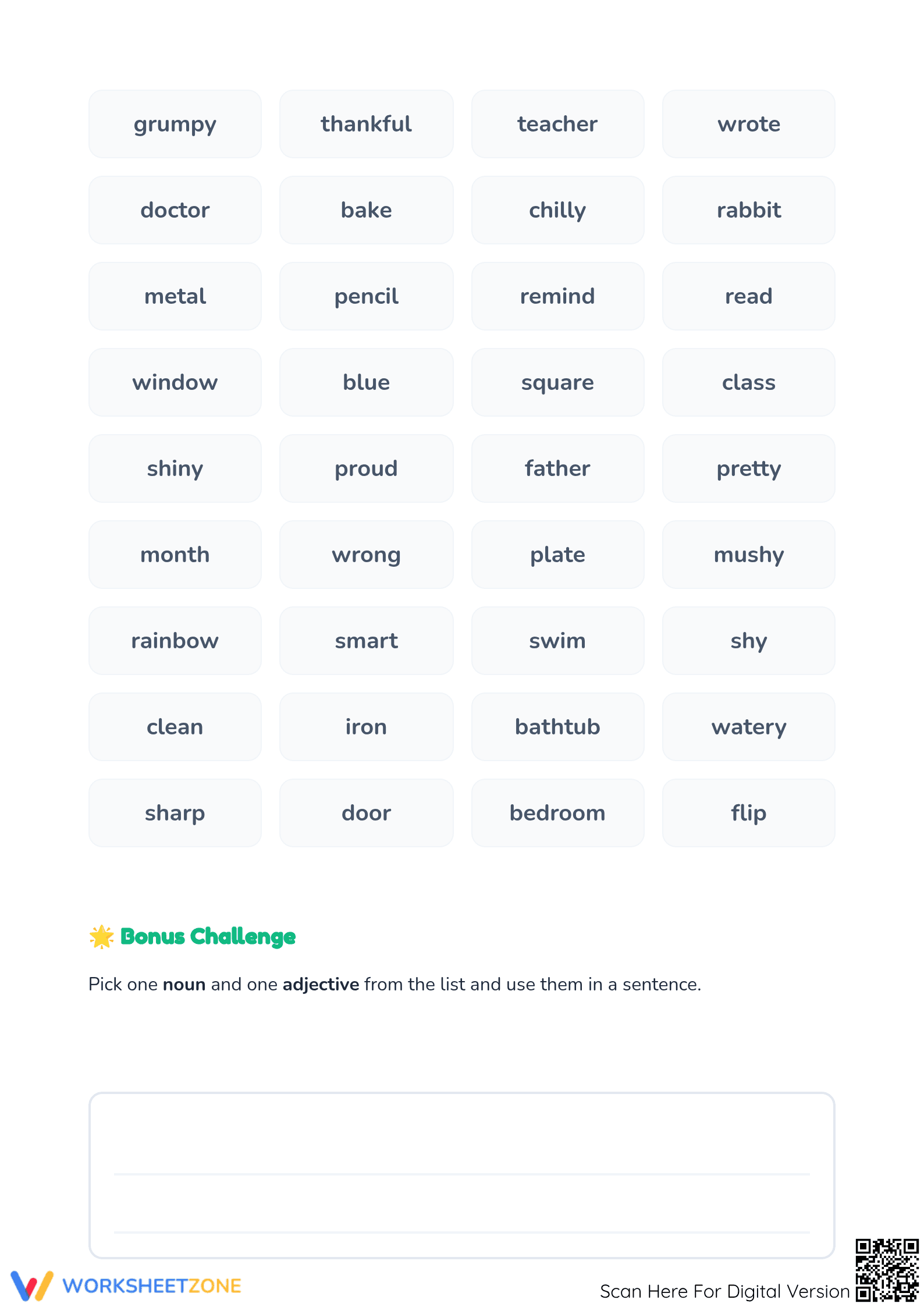
This Grade 1-2 grammar worksheet transforms parts of speech practice into an engaging detective mission. Students analyze a curated list of 40 words to distinguish between nouns, adjectives, and verbs using specific marking symbols. By categorizing words like grumpy, teacher, and swim, learners build the foundational linguistic awareness necessary for sophisticated sentence construction and reading comprehension.
At a Glance
- Grade: 1-2 · Subject: ELA Grammar
- Standard:
CCSS.ELA-LITERACY.L.1.1— Demonstrate command of the conventions of standard English grammar and usage when writing- Skill Focus: Noun, Adjective, and Verb Identification
- Format: 2 pages · 41 problems · Answer key included · PDF
- Best For: Independent practice or morning work
- Time: 15–20 minutes
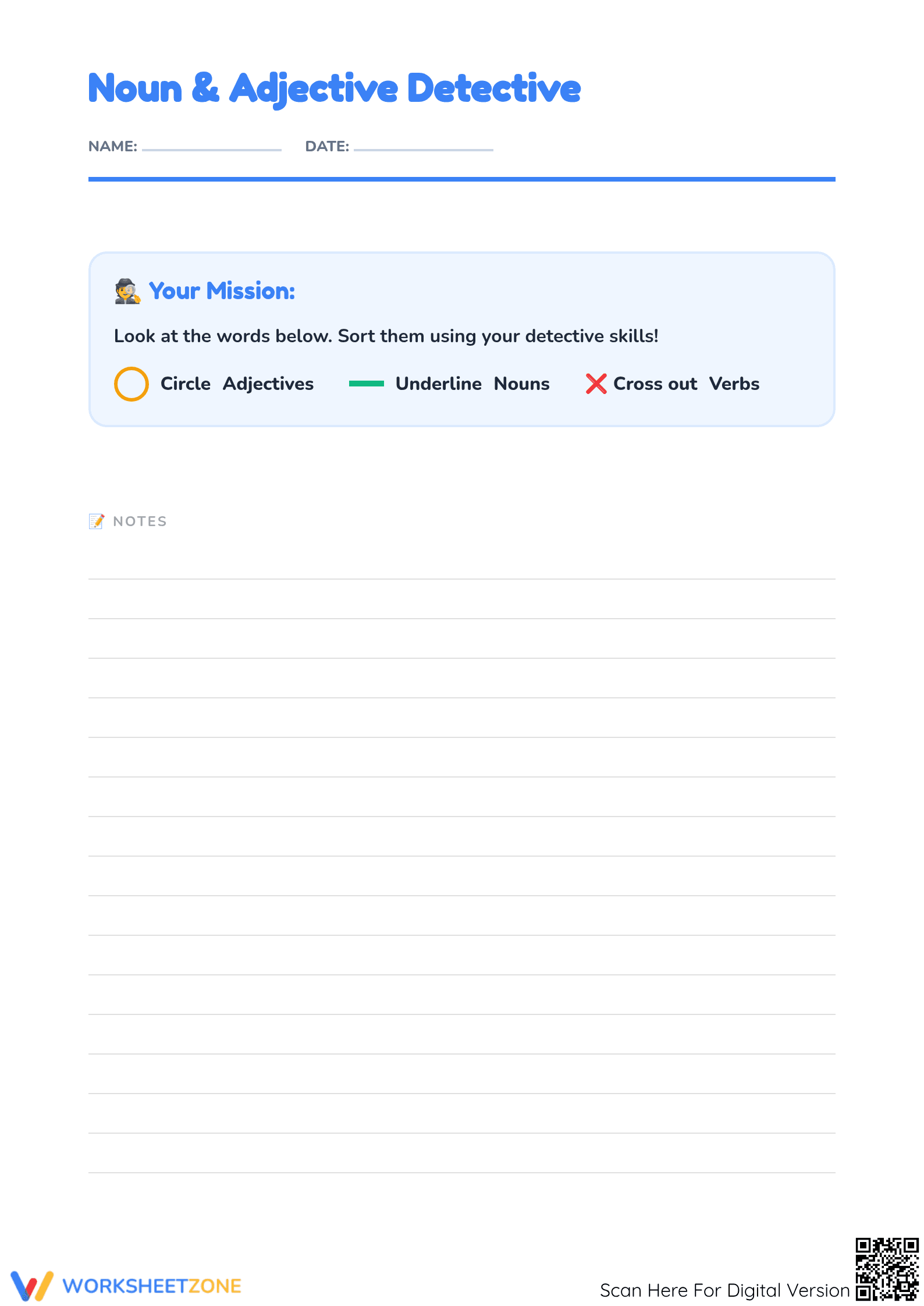
The resource consists of two high-quality PDF pages designed for clarity and student engagement. The first page introduces the Detective Mission with a clear key: circle adjectives, underline nouns, and cross out verbs. It includes a dedicated notes section for teacher observations or student brainstorming. The second page features a 40-word grid and a Bonus Challenge that requires students to synthesize their learning by writing an original sentence using both a noun and an adjective from the list.
Zero-Prep Workflow:
- Print: Select the two-page PDF and print enough copies for your class in under 30 seconds.
- Distribute: Hand out the worksheets as a bell-ringer or during a literacy center rotation with zero additional materials required.
- Review: Use the provided answer key to conduct a 5-minute whole-class check or allow students to self-correct their detective work.
Total teacher preparation time is less than 2 minutes, making this an ideal solution for substitute folders or unexpected schedule changes.
The primary focus is `CCSS.ELA-LITERACY.L.1.1`, which requires students to demonstrate command of standard English grammar. Specifically, it supports sub-standards related to using frequently occurring nouns, verbs, and adjectives. By requiring students to differentiate between these categories, the worksheet reinforces the structural components of language. Both standard codes can be copied directly into lesson plans, IEP goals, or district curriculum mapping tools.
Assign this worksheet during the independent practice phase of a gradual release lesson on parts of speech. It serves as an excellent formative assessment to see which students struggle to distinguish between descriptive words and naming words. For a collaborative twist, have students work in pairs to verify each other's detective findings before moving to the bonus sentence writing task. Completion typically takes 15 to 20 minutes.
This resource is tailored for first and second-grade students who are beginning to categorize words beyond basic labels. It is particularly effective for English Language Learners (ELLs) who benefit from the visual sorting task. Pair this worksheet with a parts-of-speech anchor chart or a mentor text to provide students with a reference point as they work through the word list.
According to the RAND AIRS 2024 report, structured practice in word categorization significantly improves early literacy outcomes by strengthening the mental lexicon. This Noun & Adjective Detective worksheet applies these findings by providing 40 targeted opportunities for students to identify and sort parts of speech. Aligned with `CCSS.ELA-LITERACY.L.1.1`, the activity moves beyond rote memorization to active linguistic analysis. By requiring students to circle, underline, and cross out specific word types, the worksheet engages multiple cognitive pathways, ensuring that the distinction between nouns, adjectives, and verbs is internalized. Research from Fisher & Frey (2014) emphasizes that such independent practice is vital for the gradual release of responsibility, allowing teachers to identify specific misconceptions in real-time. This resource provides the necessary scaffolding for Grade 1 and Grade 2 students to master the plain-English skill of identifying and using various parts of speech correctly in their own writing.


