


























Views
Downloads
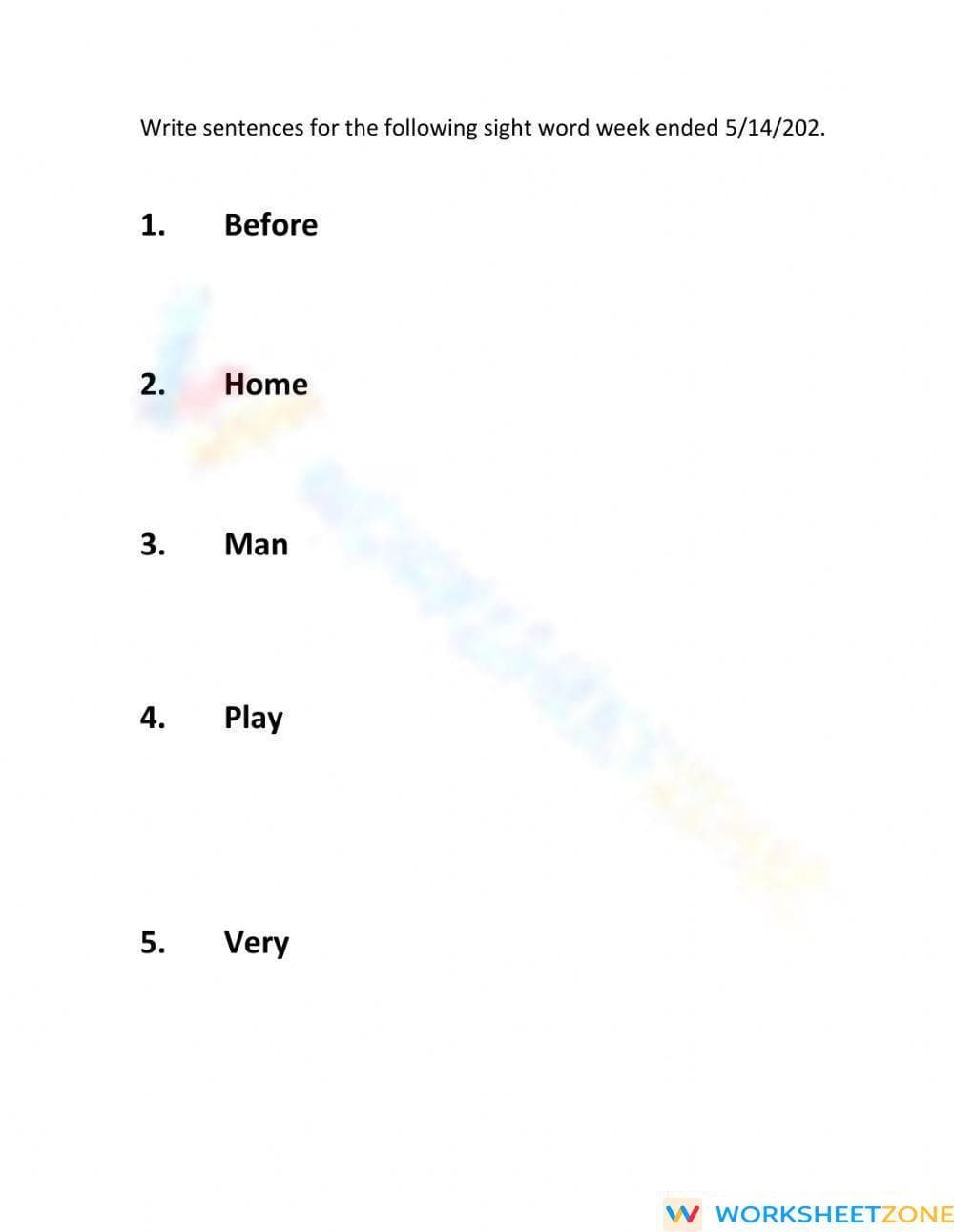

Grade 1 Sight Words — Printable No-Prep Worksheet
Paste this activity's link or code into your existing LMS (Google Classroom, Canvas, Teams, Schoology, Moodle, etc.).
Students can open and work on the activity right away, with no student login required.
You'll still be able to track student progress and results from your teacher account.
This essential worksheet helps first-grade students master high-frequency sight words by constructing complete sentences. Learners are prompted to write their own unique sentence for each of the five featured words, providing focused, independent practice in fundamental writing conventions and word recognition. It's a straightforward tool for building early literacy skills.
At a Glance
- Grade: 1 · Subject: English Language Arts (ELA)
- Standard:
CCSS.ELA-LITERACY.L.1.1.j— Produce and expand complete simple sentences in response to prompts.- Skill Focus: Sight Word Sentence Construction
- Format: 1 page · 5 problems · Answer key included · PDF
- Best For: Independent practice, literacy centers, or homework
- Time: 10–15 minutes
What's Inside
This resource is a single-page PDF download containing a clear, uncluttered worksheet. It features five numbered prompts, each with a common Grade 1 sight word ("Before," "Home," "Man," "Play," "Very"). Students are given ample space to write a full sentence for each word. An accompanying answer key provides example sentences for teacher reference or student self-checking, making it a complete, self-contained activity.
Zero-Prep Classroom Workflow
Designed for immediate use, this worksheet minimizes teacher prep. The workflow is simple:
- Print (under 1 min): The single-page PDF is fast and economical to print.
- Distribute (1 min): Hand out for morning work, literacy centers, or homework.
- Review (5 mins): Use the answer key's example sentences for a quick review or peer sharing.
With under two minutes of prep, this is a perfect resource for sub plans or filling a lesson gap.
Standards Alignment
This worksheet is aligned with Common Core standard CCSS.ELA-LITERACY.L.1.1.j, where students produce simple sentences from prompts. It also supports foundational reading standard CCSS.ELA-LITERACY.RF.1.3g (recognizing irregularly spelled words). Both codes can be copied directly into lesson plans or curriculum maps.
How to Use It
This worksheet is highly versatile. Use it as a pre-assessment for a writing unit, as independent practice during literacy centers, or as a quick homework assignment. As a formative check, it offers a clear snapshot of a student's sentence construction skills. Look for correct capitalization and punctuation. Most first graders will complete the activity in 10-15 minutes.
Who It's For
This resource is for first-grade students building sentence-writing skills with high-frequency words. Its simple format is accessible to all learners, including ELLs. For students needing extra help, provide a sentence starter. The worksheet pairs well with a classroom sight word wall or a lesson on basic sentence structure.
This Grade 1 worksheet provides targeted practice for a foundational literacy skill: using sight words to construct complete sentences, a key component of standard CCSS.ELA-LITERACY.L.1.1.j. The ability to automatically recognize high-frequency words frees up cognitive resources for more complex tasks like comprehension and sentence formation. Research consistently shows that repeated, contextualized exposure to sight words is critical for building reading fluency and writing confidence. According to a comprehensive analysis by RAND AIRS (2024), effective early literacy programs integrate foundational skills like sight word recognition directly into meaningful writing tasks. By asking students to move beyond simple identification and into active sentence creation, this activity bridges the gap between reading and writing, reinforcing the syntactic and semantic roles of these essential words in a standards-aligned format that supports measurable skill development and prepares students for more complex composition.


