


























Views
Downloads
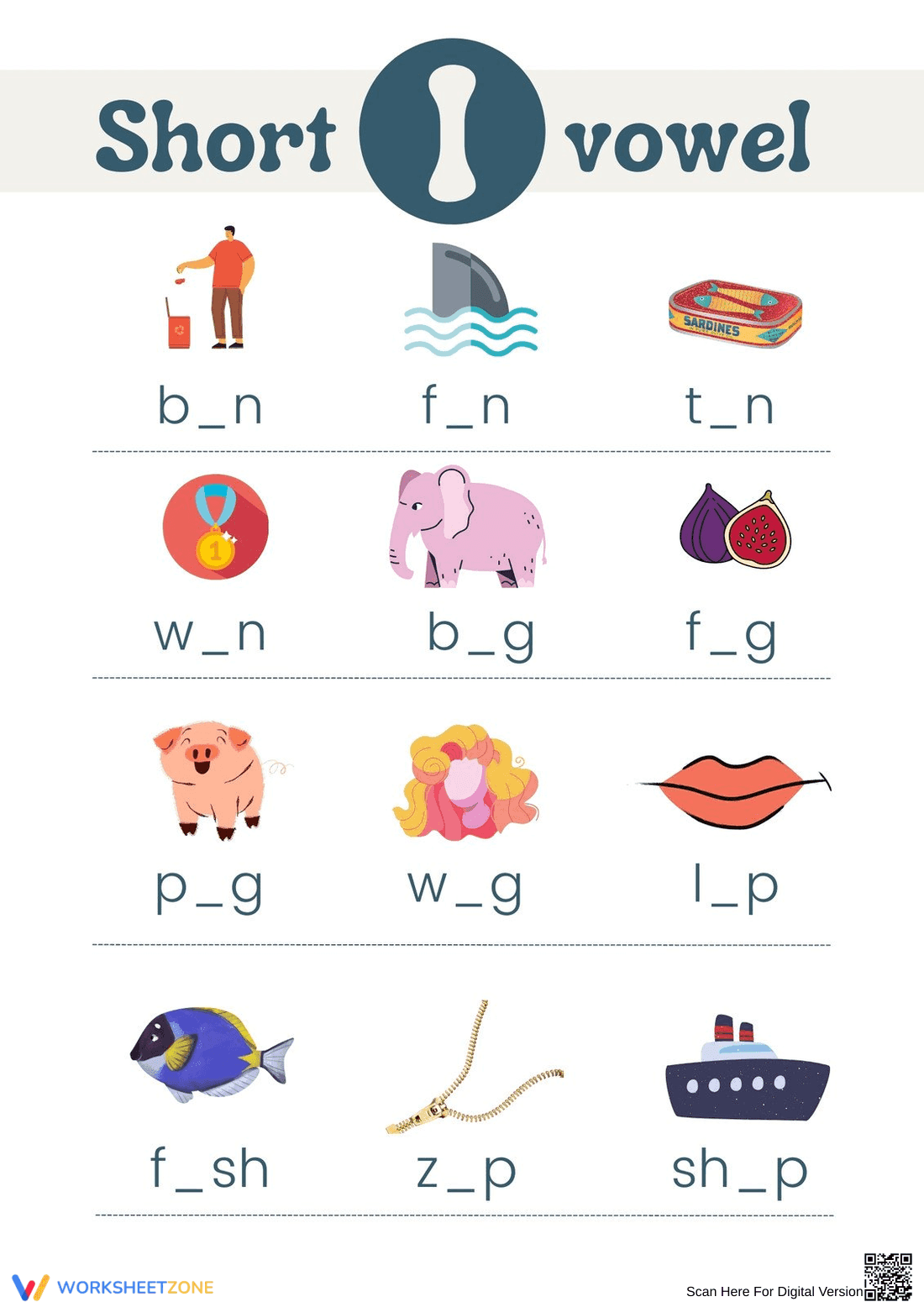

Grade 1 Short I Vowels — Printable No-Prep Worksheet
Paste this activity's link or code into your existing LMS (Google Classroom, Canvas, Teams, Schoology, Moodle, etc.).
Students can open and work on the activity right away, with no student login required.
You'll still be able to track student progress and results from your teacher account.
This phonics worksheet helps first-grade students master the short "i" vowel sound by completing familiar CVC and CCVC words. By matching vibrant illustrations with incomplete text, young learners build essential decoding skills and phonemic awareness, establishing a strong foundation for early reading fluency and spelling accuracy.
At a Glance
- Grade: 1 · Subject: ELA
- Standard:
CCSS.ELA-LITERACY.RF.1.3.B— Decode regularly spelled one-syllable words- Skill Focus: Short I Vowel Sounds
- Format: 1 page · 12 problems · Answer key included · PDF
- Best For: Independent practice and centers
- Time: 10–15 minutes
This single-page resource features twelve highly visual fill-in-the-blank tasks. Each problem presents a colorful, recognizable image—such as a pig, fish, or zip—paired with a word missing its medial short "i" vowel. Students write the missing letter to complete the word. The straightforward layout minimizes distractions, while the included answer key ensures quick grading for educators or easy self-checking for students.
Zero-Prep Workflow
This worksheet is designed for immediate classroom implementation, requiring under two minutes of total teacher preparation time. It is an excellent addition to any emergency sub plan.
- Print (1 minute): Simply download the PDF and print the required number of copies. The high-contrast images reproduce clearly in both color and grayscale.
- Distribute (1 minute): Hand out the single-page assignment during literacy centers or morning work. The intuitive design means students can begin immediately without extensive directions.
- Review (3 minutes): Use the provided answer key to quickly check student responses, or project the key on a smartboard for a whole-class review session.
Standards Alignment
This resource is directly aligned to CCSS.ELA-LITERACY.RF.1.3.B, requiring students to decode regularly spelled one-syllable words. It also supports foundational phonemic awareness by asking learners to isolate medial vowel sounds. Both standard codes can be copied directly into lesson plans, IEP goals, or district curriculum mapping tools.
How to Use It
Deploy this worksheet during independent literacy centers after direct instruction on short vowel sounds. It serves as an excellent reinforcement activity while the teacher conducts small-group guided reading. Alternatively, use it as a quick formative assessment; observe whether students can independently identify the image and correctly associate the short "i" sound with the missing letter. Most first graders will complete this activity within a 10 to 15-minute timeframe.
Who It's For
This activity is primarily designed for first-grade students developing their early phonics skills. It is also highly effective for kindergarteners ready for an advanced challenge, or second-grade students requiring targeted intervention on medial vowel sounds. For differentiated instruction, pair this worksheet with a tactile activity, such as building the featured words using magnetic letters, or alongside a short vowel anchor chart.
Mastering medial vowel sounds is a critical milestone in early literacy development. This resource targets the specific skill of decoding short vowels, aligned with CCSS.ELA-LITERACY.RF.1.3.B, where students decode regularly spelled one-syllable words. According to a comprehensive EdReports 2024 analysis of foundational reading programs, explicit and systematic phonics practice—particularly activities that connect visual representations with phoneme-grapheme mapping—significantly accelerates reading acquisition in primary grades. By requiring students to actively supply the missing short "i" to complete familiar words like "pig" and "fish," this worksheet reinforces the alphabetic principle in a highly structured format. Consistent engagement with targeted phonics tasks reduces decoding errors and builds the automaticity necessary for fluent reading. Educators can rely on this evidence-based approach to strengthen phonemic awareness and ensure students meet critical early literacy benchmarks.


