


























Views
Downloads
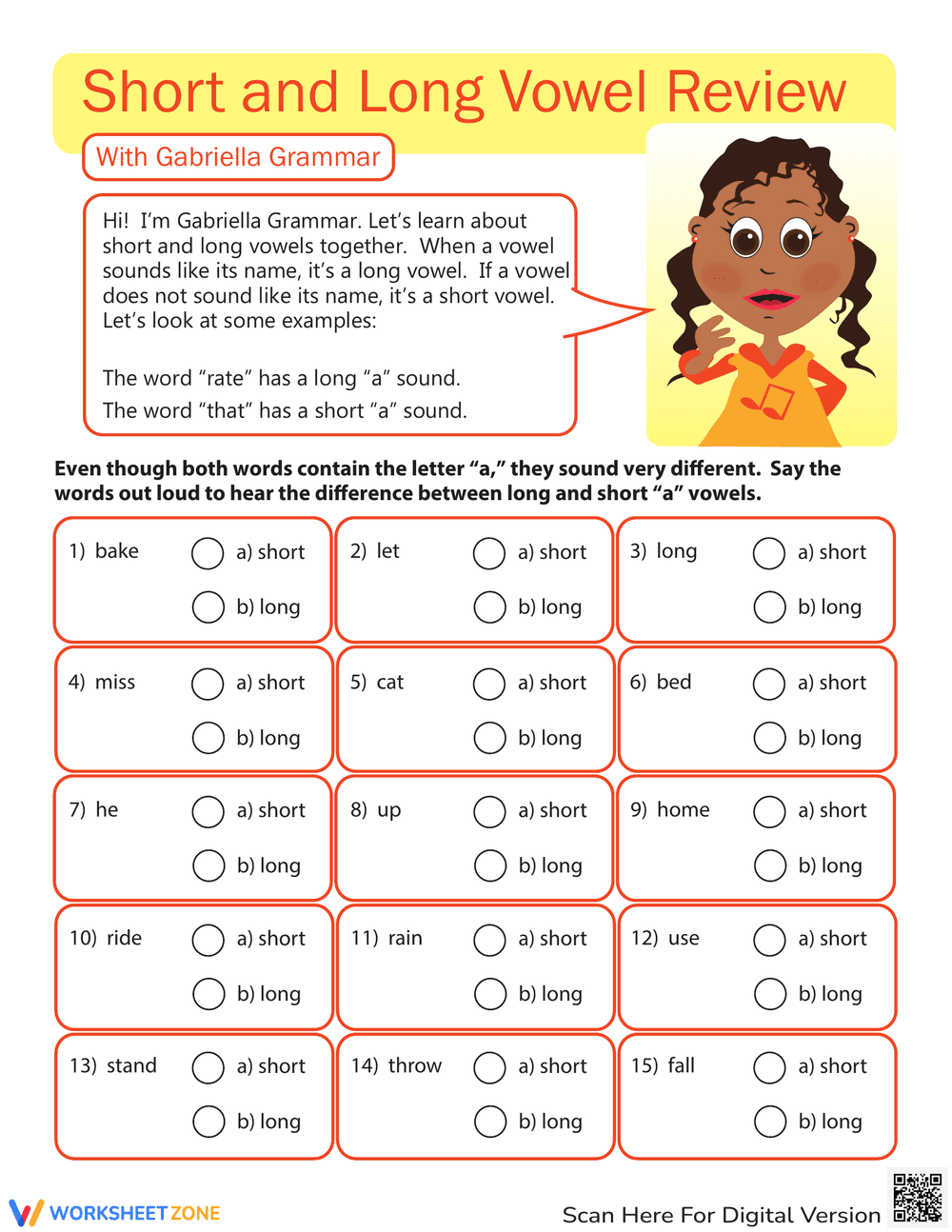

Grade 2 Short and Long Vowel Review — Printable Worksheet
Paste this activity's link or code into your existing LMS (Google Classroom, Canvas, Teams, Schoology, Moodle, etc.).
Students can open and work on the activity right away, with no student login required.
You'll still be able to track student progress and results from your teacher account.
This printable phonics worksheet helps second and third-grade students master vowel sound differentiation. Learners read fifteen common one-syllable words and identify whether each contains a long or short vowel sound. This targeted practice builds essential decoding skills, improving reading fluency and spelling accuracy.
At a Glance
- Grade: Grade 2 - Grade 3 · Subject: English Language Arts
- Standard:
CCSS.ELA-LITERACY.RF.2.3.A— Distinguish long and short vowels when reading one-syllable words- Skill Focus: Long and short vowel identification
- Format: 1 page · 15 problems · Answer key included · PDF
- Best For: Independent phonics practice and quick assessment
- Time: 10–15 minutes
The worksheet features a friendly character guide, Gabriella Grammar, who provides a clear, student-friendly definition of long and short vowel sounds with illustrative examples like "rate" and "that". Below the introduction, students encounter fifteen numbered multiple-choice questions. Each question presents a familiar one-syllable word alongside radio buttons to select either short or long vowel sounds.
Implement this resource in three simple steps:
- Print (1 minute): Generate copies of the single-page PDF for your class.
- Distribute (1 minute): Hand out the sheets for independent work, morning work, or center activities.
- Review (3 minutes): Use the included answer key for rapid grading or student self-correction.
Total teacher preparation time is under two minutes, making it an ideal emergency sub plan.
This worksheet aligns directly with the Common Core State Standard CCSS.ELA-LITERACY.RF.2.3.A, which requires students to distinguish long and short vowels when reading regularly spelled one-syllable words. It also supports general phonics and word recognition development. Both standard codes can be copied directly into lesson plans, IEP goals, or district curriculum mapping tools.
Use this worksheet during or after direct instruction on vowel sounds. It serves as an excellent formative assessment tool; teachers can observe students as they read the words aloud to check for correct pronunciation. Expect students to complete the fifteen items within ten to fifteen minutes. It works well for homework, warm-ups, or small-group intervention.
This resource is designed for second and third-grade students developing foundational reading skills. It accommodates struggling readers needing targeted intervention and English language learners mastering English vowel patterns. Pair this worksheet with a shared reading passage or a vowel sound anchor chart to reinforce the phonics rules taught in the lesson.
This phonics resource aligns with CCSS.ELA-LITERACY.RF.2.3.A to target vowel sound discrimination, a foundational skill for early reading acquisition. According to research from Fisher & Frey (2014) on the gradual release of responsibility, structured independent practice tasks—such as classifying vowel sounds in isolated words—help consolidate phonemic awareness before students apply these skills to complex texts. By isolating fifteen high-frequency, one-syllable words, this worksheet allows educators to pinpoint specific decoding gaps. The clear visual layout and immediate feedback loop support orthographic mapping, helping young learners transition from sounding out words to automatic recognition. This systematic approach ensures students build the necessary cognitive frameworks for reading fluency, making it a valuable addition to any research-based elementary reading curriculum.


