


























Views
Downloads

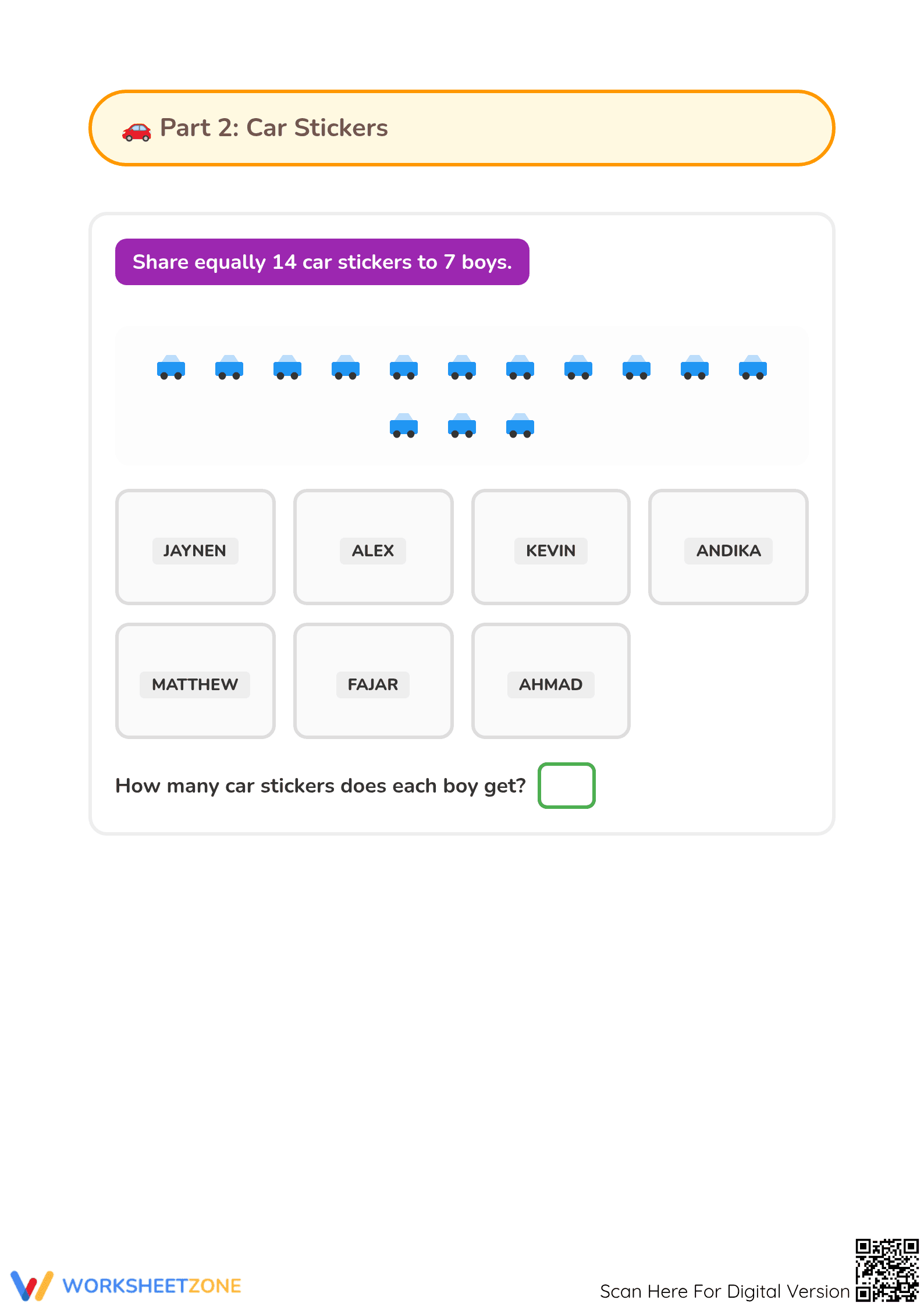



Grade 1 Sharing Equally — Printable No-Prep Worksheet
Paste this activity's link or code into your existing LMS (Google Classroom, Canvas, Teams, Schoology, Moodle, etc.).
Students can open and work on the activity right away, with no student login required.
You'll still be able to track student progress and results from your teacher account.
Master the foundational concept of equal distribution with this comprehensive Sharing Equally worksheet. Designed specifically for Grade 1 learners, this activity bridges the gap between basic counting and the early concepts of division and fractions. Students will engage with visual models to ensure every group receives an identical portion, fostering strong mathematical reasoning.
At a Glance
- Grade: 1 · Subject: Math
- Standard:
CCSS.MATH.CONTENT.1.G.A.3— Partition circles and rectangles into two and four equal shares- Skill Focus: Equal distribution and partitioning
- Format: 5 pages · 22 problems · Answer key included · PDF
- Best For: Small group instruction or morning work
- Time: 20–30 minutes
What's Inside
This five-page PDF resource provides a structured sequence of exercises that guide students through the process of sharing objects equally. The worksheet includes clear visual representations, such as baskets and food items, to make abstract concepts concrete. With 22 distinct tasks, a detailed answer key for quick grading, and simple instructions, this pack ensures students grasp the "fair share" principle effectively. Features include clear partitioning tasks and worked examples.
Zero-Prep Workflow
- Print: Simply select the pages you need and hit print in under 30 seconds.
- Distribute: Hand out the worksheets to your Grade 1 students for an immediate start.
- Review: Use the included answer key to check for understanding in less than 2 minutes.
The entire workflow requires less than 2 minutes of teacher preparation, making it an ideal choice for sub plans or unexpected schedule shifts. This packet is designed for zero-prep classrooms.
Standards Alignment
Primary alignment is to CCSS.MATH.CONTENT.1.G.A.3, which requires students to partition circles and rectangles into two and four equal shares and describe them using halves and fourths. It also supports foundations for CCSS.MATH.CONTENT.3.OA.A.2 by introducing sharing concepts. Both standard codes can be copied directly into lesson plans, IEP goals, or district curriculum mapping tools.
How to Use It
Use this worksheet during the "guided practice" portion of your lesson on partitions or as a comprehensive morning work activity. As students work, circulate and observe if they are counting objects one-by-one or using more advanced grouping strategies. This formative assessment tip helps identify students who need additional support. We recommend allowing 20 to 30 minutes for complete mastery of all five pages in a single sitting or spread across a week.
Who It's For
This resource is tailored for first-grade students but serves as an excellent intervention tool for second graders or a challenge for kindergarteners. It pairs naturally with physical manipulatives, such as counters or blocks, and works best following a direct instruction lesson on "fair shares." It is an Essential addition to any primary math curriculum toolkit.
According to a RAND AIRS 2024 analysis, visual-spatial representations in early mathematics are significant predictors of later success in rational number operations. This Sharing Equally worksheet leverages these findings by providing Grade 1 students with explicit practice in CCSS.MATH.CONTENT.1.G.A.3. By focusing on the plain-English skill of partitioning objects into equal shares, the resource helps minimize the cognitive load associated with abstract division symbols. Research from Fisher & Frey (2014) emphasizes that the gradual release of responsibility, supported here by 22 sequential tasks, ensures that learners move from guided observation to independent mastery. Teachers using this standards-aligned tool provide a proven pathway for students to internalize part-whole relationships before encountering formal fractions in higher grades. This approach is consistent with NAEP recommendations for building early numeracy through concrete visual models.


