


























Views
Downloads
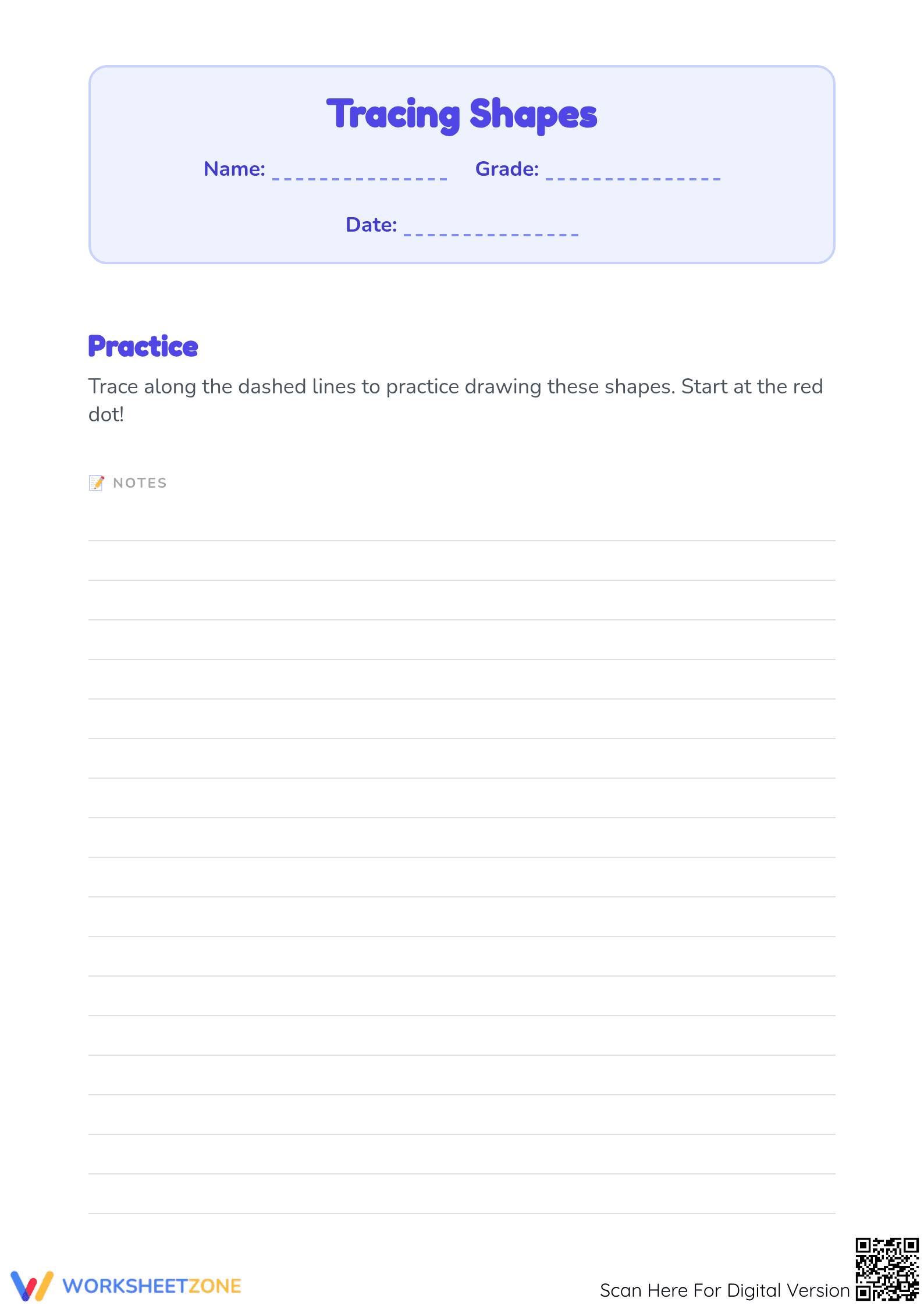


Printable Tracing Shapes Worksheet | Grade 1-3 Math
Paste this activity's link or code into your existing LMS (Google Classroom, Canvas, Teams, Schoology, Moodle, etc.).
Students can open and work on the activity right away, with no student login required.
You'll still be able to track student progress and results from your teacher account.
Printable Tracing Shapes Worksheet for Early Learners
This tracing shapes worksheet provides Grade 1 through 3 students with structured practice in identifying and drawing ten different geometric forms. By following dashed lines and guided starting points, learners develop the fine motor control and spatial awareness necessary for geometry mastery. It serves as an immediate, effective resource for reinforcing shape recognition and pen control.
At a Glance
- Grade: 1–3 · Subject: Math (Geometry)
- Standard:
CCSS.MATH.CONTENT.1.G.A.1— Distinguish between defining attributes versus non-defining attributes; build and draw shapes- Skill Focus: Shape tracing and geometric recognition
- Format: 2 pages · 10 problems · Answer key not included · PDF
- Best For: Early finishers and geometry centers
- Time: 15–20 minutes
What's Inside
This two-page PDF includes a dedicated instruction and notes page followed by a comprehensive tracing grid. Students are presented with ten distinct shapes: heart, circle, square, triangle, pentagon, hexagon, octagon, oval, rectangle, and diamond. Each shape features a prominent red starting dot to guide initial stroke placement, ensuring correct drawing habits and consistent line formation during practice.
Zero-Prep Workflow
The "print-and-go" nature of this resource ensures teacher efficiency in busy classroom environments. Simply print the two-page document (30 seconds), distribute to students during your geometry unit or as a morning work activity (1 minute), and provide immediate feedback as you walk the room observing line accuracy (ongoing). Total teacher preparation time is under two minutes, making it ideal for unexpected sub plans.
Standards Alignment
The primary alignment is `CCSS.MATH.CONTENT.1.G.A.1`, which requires students to "Distinguish between defining attributes versus non-defining attributes; build and draw shapes to possess defining attributes." This worksheet specifically targets the "draw" component of the standard by providing accurate scaffolds for geometric construction. Standard codes can be copied directly into lesson plans, IEP goals, or district curriculum mapping tools.
How to Use It
Use this worksheet as a formative assessment during the "Guided Practice" phase of a geometry lesson to check for pen control and shape knowledge. It also functions perfectly as a quiet center activity where students can work independently to refine their fine motor skills. Observe if students are consistently starting at the red dot to monitor their procedural accuracy and stroke direction.
Who It's For
This resource is designed for Grade 1-3 students who are beginning their journey into formal geometry or those requiring additional fine motor support. It is particularly helpful for English Language Learners who need a visual connection between shape names and their physical forms. Pair this with a physical set of pattern blocks for a multisensory learning experience that reinforces geometric concepts.
According to a RAND AIRS 2024 analysis of primary educational resources, structured tracing activities are foundational for developing the visuospatial processing skills required for higher-level geometric reasoning. The inclusion of ten distinct geometric figures, from basic circles to complex octagons, aligns with the instructional recommendation for varied practice to prevent rote memorization of only "perfect" prototypes. By integrating specific starting cues like the red dots found here, this worksheet adheres to the Fisher & Frey (2014) model of gradual release, providing high-support scaffolds that allow students to internalize shape boundaries before moving to freehand drawing. Educators can confidently utilize this CCSS.MATH.CONTENT.1.G.A.1 aligned tool to bridge the gap between simple recognition and the technical ability to construct geometric figures. This self-contained summary confirms the worksheet's utility in modern classroom settings where efficiency and standard-alignment are paramount for student success in early mathematics.


