


























Views
Downloads
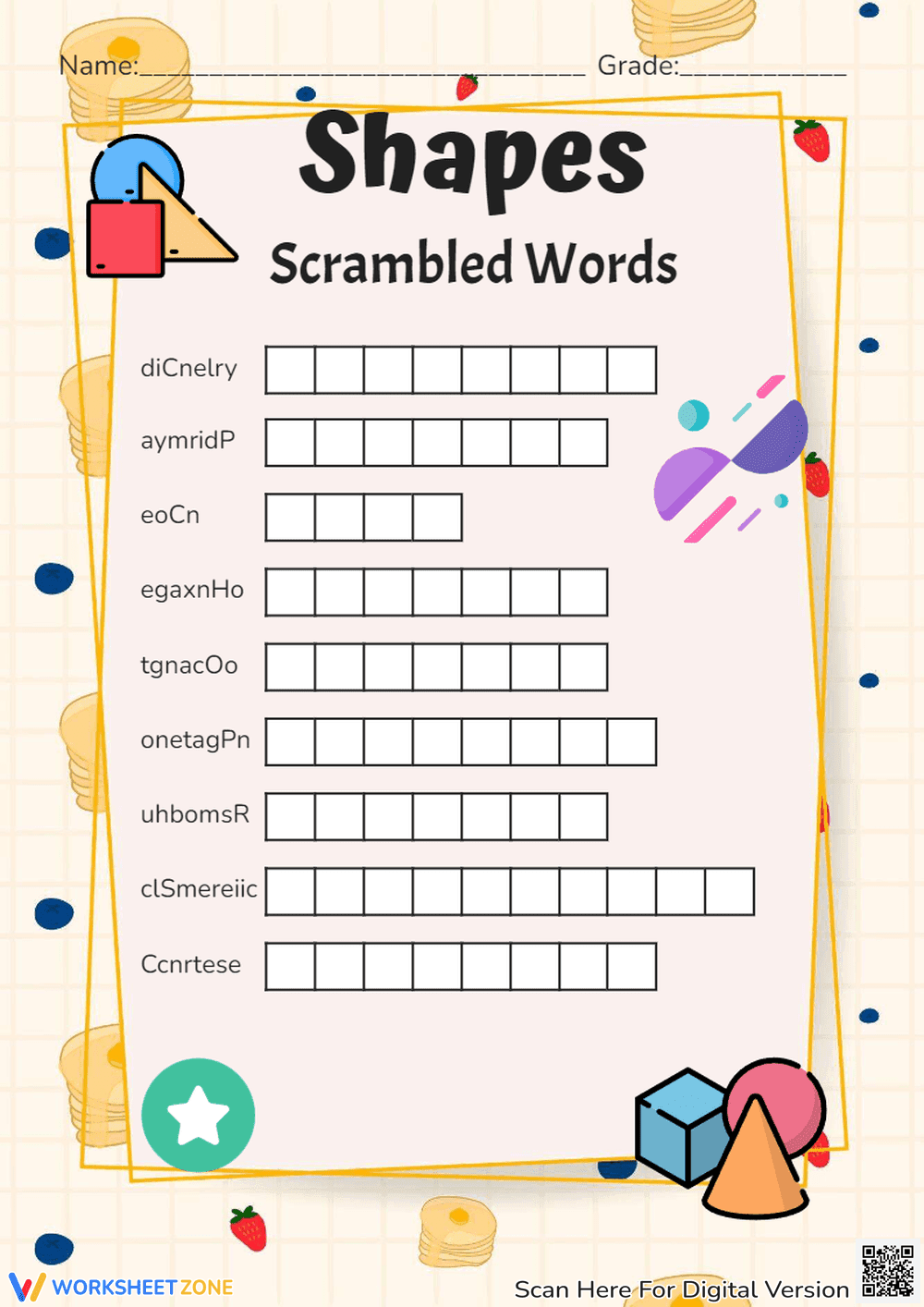

Essential Shapes Word Scramble Worksheet | Grades 1-4
Paste this activity's link or code into your existing LMS (Google Classroom, Canvas, Teams, Schoology, Moodle, etc.).
Students can open and work on the activity right away, with no student login required.
You'll still be able to track student progress and results from your teacher account.
This Grade 1-4 geometry worksheet strengthens vocabulary and spelling through a focused word scramble activity. Students analyze letter patterns to identify 9 essential geometric shapes, reinforcing their ability to recognize and name 2D and 3D figures. It provides a quick, engaging way to assess shape recognition and literacy skills simultaneously.
At a Glance
- Grade: 1-4 · Subject: Math & ELA
- Standard:
CCSS.MATH.CONTENT.2.G.A.1— Recognize and draw shapes having specified attributes, such as number of angles- Skill Focus: Geometry Vocabulary & Spelling
- Format: 1 page · 9 problems · Answer key included · PDF
- Best For: Morning work or geometry unit review
- Time: 10–15 minutes
This single-page PDF features 9 scrambled shape names ranging from basic figures like "Cone" to more complex terms like "Semicircle" and "Cylinder." Each task includes a letter-box grid to guide student spelling and ensure correct character placement. A full answer key is provided for rapid grading or student self-correction.
This resource is designed for immediate classroom implementation. Print the single-page PDF in under 30 seconds. Distribute to students as a transition activity or warm-up, requiring zero prior explanation. Review the 9 terms as a whole group in under 2 minutes using the provided answer key to confirm spelling and geometric definitions.
The primary focus is `CCSS.MATH.CONTENT.2.G.A.1`, which requires students to recognize and name shapes based on their attributes. By correctly unscrambling terms like "Hexagon" and "Pentagon," students demonstrate mastery of geometric nomenclature. Both standard codes can be copied directly into lesson plans, IEP goals, or district curriculum mapping tools.
Use this as a formative assessment after introducing 2D and 3D shapes to check for vocabulary retention. Alternatively, assign it as a quiet early finisher task during math centers. Observe if students struggle with longer words like "Cylinder," which may indicate a need for additional phonics or geometry support. Completion typically takes 12 minutes.
This worksheet is ideal for elementary students in grades 1 through 4 who are developing their spatial reasoning and technical vocabulary. It serves as a helpful bridge for English Language Learners (ELLs) to practice academic language. Pair this with a physical set of pattern blocks or 3D solids for a multi-sensory learning experience.
According to the RAND AIRS 2024 report, integrating vocabulary practice directly into content-area instruction, such as mathematics, significantly improves long-term retention of technical terms. This worksheet addresses the linguistic demands of geometry by requiring students to manipulate letter strings to form specific shape names like "Octagon" and "Rhombus." This cognitive process aligns with the CCSS.MATH.CONTENT.2.G.A.1 standard, which emphasizes the identification of shapes through their defining attributes. Research from Fisher & Frey (2014) suggests that word-level tasks, when used as part of a gradual release of responsibility, help solidify the connection between visual recognition and formal naming conventions. By providing 9 structured tasks with letter-box scaffolds, this resource ensures students engage deeply with the spelling and structure of geometric vocabulary. This approach supports both literacy development and mathematical precision, making it a versatile tool for diverse elementary classrooms seeking to meet rigorous state and national standards.


