


























Views
Downloads
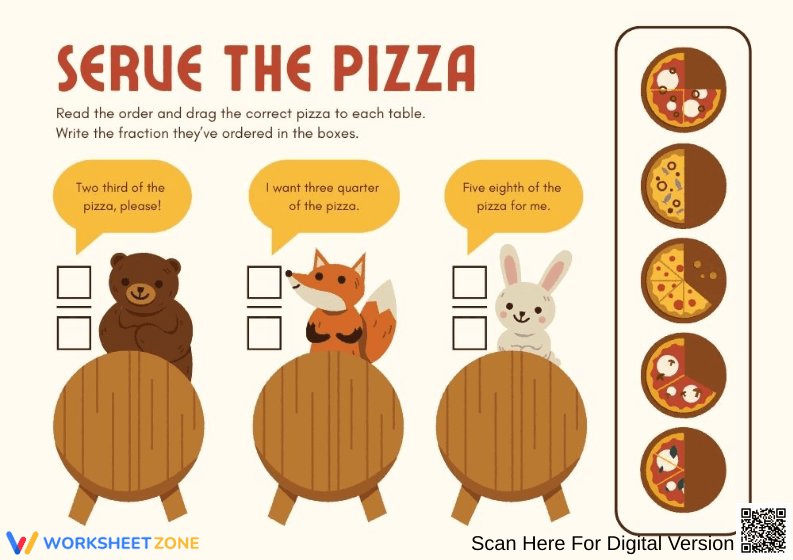

Grade 3 Pizza Fractions — Printable No-Prep Worksheet
Paste this activity's link or code into your existing LMS (Google Classroom, Canvas, Teams, Schoology, Moodle, etc.).
Students can open and work on the activity right away, with no student login required.
You'll still be able to track student progress and results from your teacher account.
This printable fraction worksheet helps third-grade students master identifying and writing fractions using pizza models. By matching word-form fraction orders to visual circle models, learners build a concrete understanding of numerators and denominators. Students translate word descriptions into standard numerical fractions, reinforcing key mathematical concepts.
At a Glance
- Grade: Grade 3 · Subject: Math
- Standard:
CCSS.MATH.CONTENT.3.NF.A.1— Understand a fraction as a quantity formed by parts of a whole- Skill Focus: Identifying fractions and matching visual models
- Format: 1 page · 3 problems · Answer key included · PDF
- Best For: Independent practice and quick formative assessment
- Time: 10–15 minutes
The single-page PDF features three animal characters ordering pizza slices in word form. Students write the corresponding numerical fraction in the provided boxes and match the order to one of five visual pizza models. The clean layout includes clear speech bubbles and structured writing grids to support neat organization.
Zero-Prep Classroom Workflow
This resource requires less than 2 minutes of teacher preparation, making it ideal for morning work or sub plans. First, print the single-page worksheet (1 minute). Next, distribute the sheets for a 15-minute independent activity (1 minute). Finally, review the answers as a whole group. The self-explanatory layout ensures students work independently.
Standards Alignment
This activity aligns with the primary standard `CCSS.MATH.CONTENT.3.NF.A.1`, which requires students to understand a fraction 1/b as the quantity formed by 1 part when a whole is partitioned. It also supports `CCSS.MATH.CONTENT.3.NF.A.3` by helping students recognize simple equivalent fraction representations. Both standard codes can be copied directly into lesson plans or IEP goals.
How to Use It
Use this worksheet as a post-instruction check immediately after teaching fraction basics to assess student comprehension. Alternatively, assign it as a warm-up activity at the start of a math workshop. While students work, observe if they struggle to identify the denominator versus the numerator. Most students will complete the tasks within 10 to 15 minutes.
Who It's For
This worksheet is designed for third-grade students learning basic fractions, but it also serves as an excellent review for fourth-grade students. For students needing extra support, pair this worksheet with physical fraction circles. Advanced learners can write the remaining fraction of the pizza left over for each animal order.
This educational resource targets the development of early fraction concepts aligned with standard CCSS.MATH.CONTENT.3.NF.A.1. By requiring students to translate word-form fractions into numerical representations and match them to visual models, the worksheet reinforces the cognitive connection between symbolic math and concrete representations. According to research by Fisher & Frey (2014) on the gradual release of responsibility, visual scaffolding and contextualized tasks like this pizza-themed activity significantly improve student retention of abstract mathematical concepts. The worksheet provides a structured format that allows teachers to quickly identify misconceptions regarding numerators and denominators. It serves as a reliable tool for formative assessment, helping educators gauge student readiness for more complex fraction operations. This resource is highly recommended for elementary classrooms seeking to build a solid foundation in fractional reasoning.


