


























Views
Downloads


Grade 2 Verb Identification | Printable ELA Worksheet
Paste this activity's link or code into your existing LMS (Google Classroom, Canvas, Teams, Schoology, Moodle, etc.).
Students can open and work on the activity right away, with no student login required.
You'll still be able to track student progress and results from your teacher account.
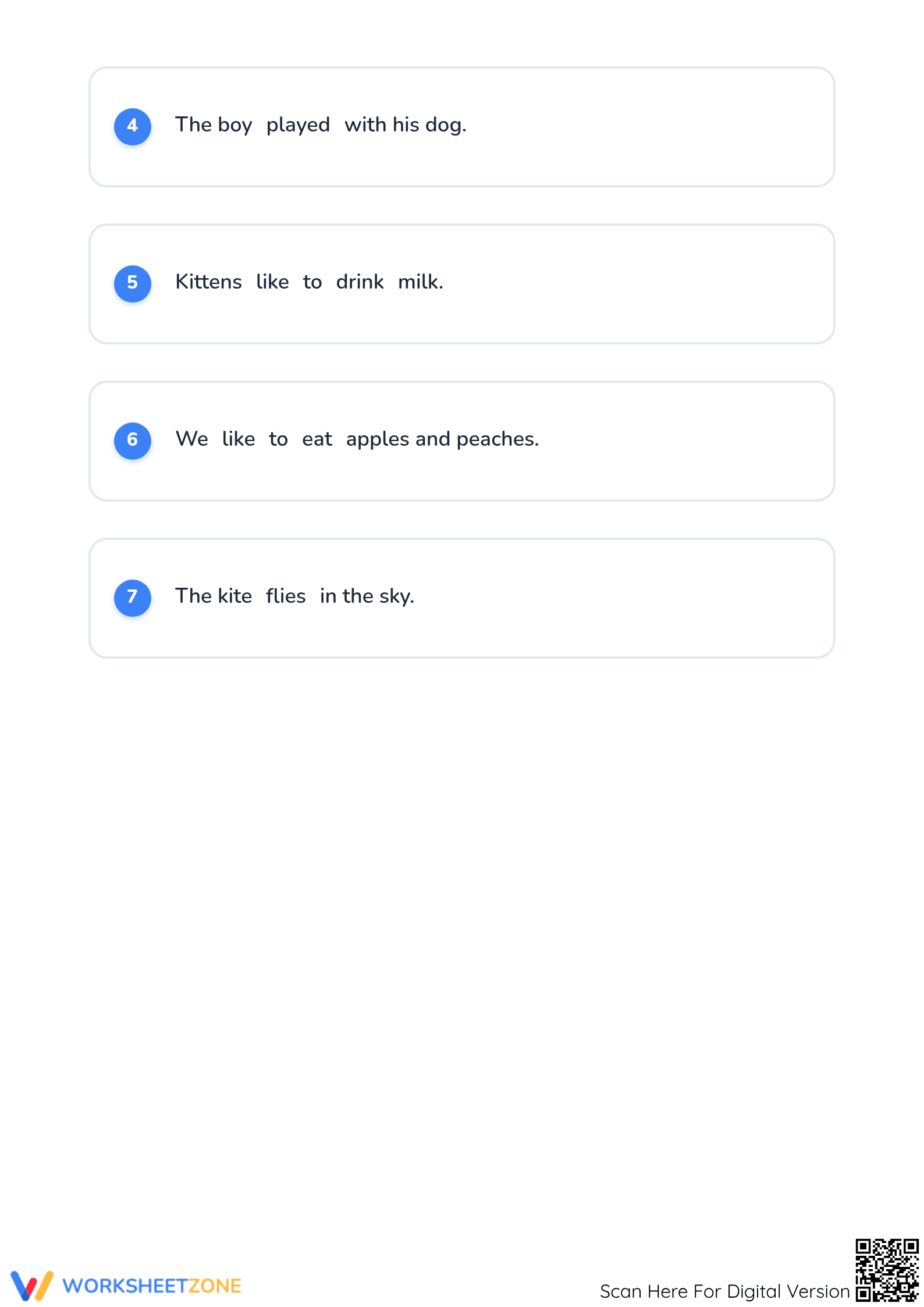
This Grade 2 verb identification worksheet provides students with focused practice in recognizing action and being words within simple sentences. By circling verbs in seven distinct contexts, learners develop a stronger grasp of sentence structure and grammatical conventions. This resource ensures students can accurately distinguish verbs from other parts of speech, leading to improved writing clarity and reading fluency.
At a Glance
- Grade: 2 · Subject: ELA
- Standard:
CCSS.ELA-LITERACY.L.1.1.E— Use verbs to convey a sense of past, present, and future- Skill Focus: Identifying verbs in sentences
- Format: 2 pages · 7 problems · Answer key included · PDF
- Best For: Quick grammar checks and bell ringers
- Time: 10–15 minutes
Inside this two-page PDF, you will find seven structured tasks designed for clarity and ease of use. Each page features large, readable text and clear spacing to accommodate young writers. The first page introduces the concept with three sentences, while the second page provides four additional practice opportunities. A comprehensive answer key is included, allowing for rapid grading or student self-correction.
The zero-prep design of this resource ensures that teachers can integrate grammar practice into their busy schedules without added stress. First, print the two-page PDF (30 seconds). Second, distribute the worksheets to students for independent or small-group work (1 minute). Finally, use the provided answer key to review the seven sentences as a whole class or for individual grading (5 minutes). Total preparation time is under two minutes, making this an ideal solution for substitute plans.
This resource is primarily aligned with `CCSS.ELA-LITERACY.L.1.1.E`, which requires students to use verbs to convey a sense of past, present, and future. While the focus here is on identification, it serves as the prerequisite skill for proper verb tense usage. Additionally, it supports `CCSS.ELA-LITERACY.L.2.1`, demonstrating command of standard English grammar. Both standard codes can be copied directly into lesson plans, IEP goals, or district curriculum mapping tools.
Use this worksheet as a formative assessment after an introductory lesson on parts of speech. It works well as a bell ringer to start the ELA block or as an exit ticket to check for understanding before dismissal. While students work, observe if they are confusing nouns with verbs, which provides a perfect opportunity for immediate corrective feedback. Most students will complete the seven tasks within 10 to 15 minutes.
This worksheet is designed for Grade 2 students but is effective for Grade 1 enrichment or Grade 3 review. It is particularly helpful for English Language Learners (ELLs) who are still mastering basic English sentence patterns. Pair this resource with a verb anchor chart or a short reading passage to help students see verbs in a broader literary context.
Research by Fisher & Frey (2014) emphasizes the importance of explicit grammar instruction within the gradual release of responsibility framework. This worksheet supports that model by providing clear, isolated practice for identifying verbs, a foundational component of CCSS.ELA-LITERACY.L.1.1.E. By isolating the verb within a simple sentence structure, students can focus on the lexical category without the cognitive load of complex syntax. Studies from the NAEP suggest that early mastery of parts of speech correlates with higher reading comprehension scores in later elementary years. This resource provides the necessary repetition to move from guided identification to independent mastery. The inclusion of an answer key allows for immediate feedback, which is a critical factor in student retention of grammatical rules. Teachers can use these 7 tasks to quickly gauge student understanding of action and being words before moving to more complex sentence construction.


