


























Views
Downloads



Essential Segment Addition Postulate Worksheet | Geometry
Paste this activity's link or code into your existing LMS (Google Classroom, Canvas, Teams, Schoology, Moodle, etc.).
Students can open and work on the activity right away, with no student login required.
You'll still be able to track student progress and results from your teacher account.
Master collinear relationships with this Segment Addition Postulate worksheet. Students apply algebraic reasoning to solve for missing variables and calculate precise segment lengths. This resource ensures students build the foundation required for complex proofs and coordinate geometry. Lead with the skill to ensure immediate clarity for teachers and learners alike.
At a Glance
- Grade: 9 · Subject: Geometry
- Standard:
HSG.CO.A.1— Apply precise definitions of line segments and distance to solve geometric problems- Skill Focus: Algebraic Application of Segment Addition Postulate
- Format: 5 pages · 12 problems · Answer key included · PDF
- Best For: Focused practice during introductory Geometry units
- Time: 25–35 minutes
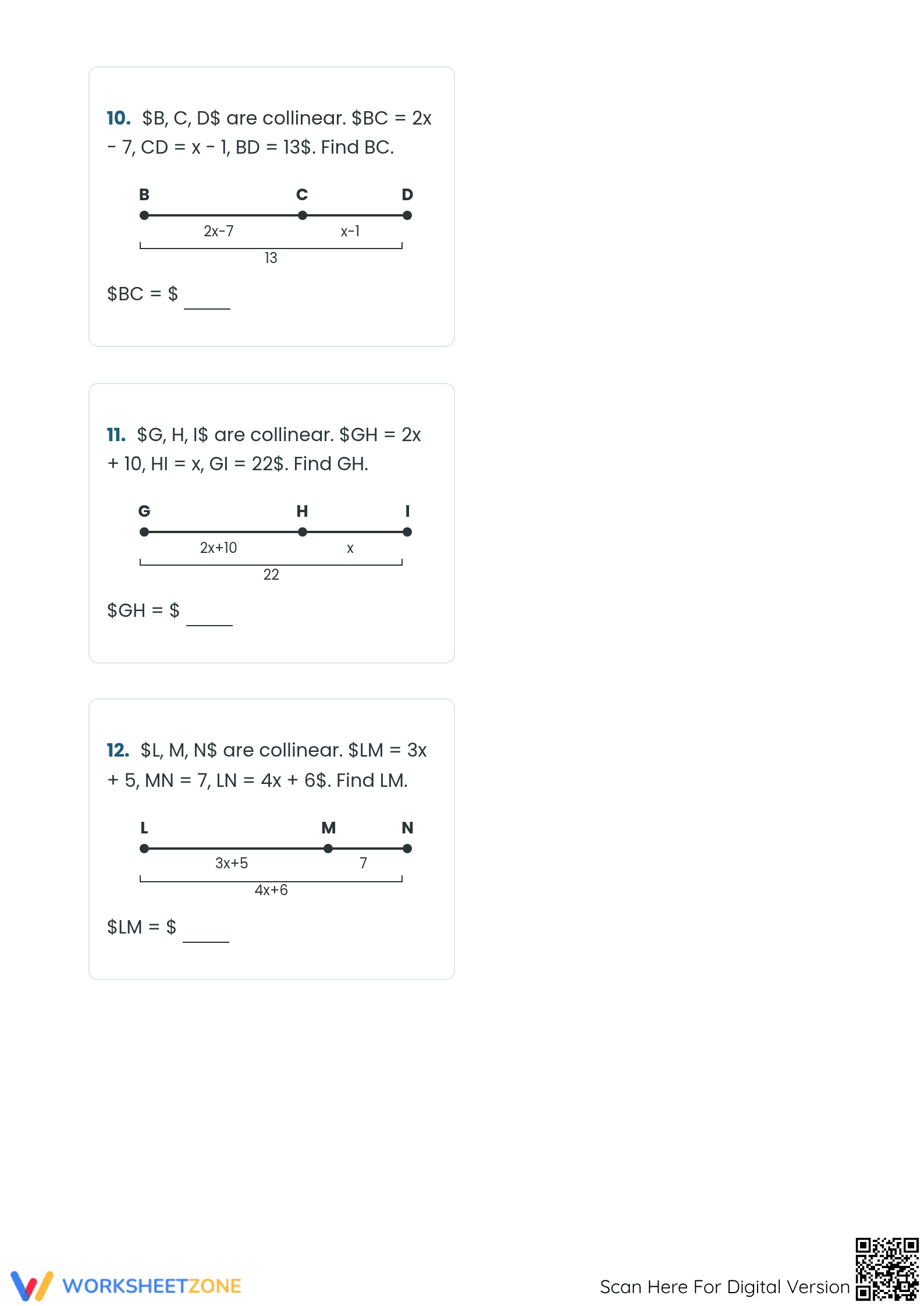
This five-page PDF features 12 sequenced problems in three sections. It includes a professional layout and a full answer key for efficient grading. Visual diagrams accompany every problem, helping students map algebraic expressions directly onto geometric segments to visualize the relationship between parts and wholes.
Skill Progression
- Guided Practice: Part 1 contains 2 problems focusing on basic numerical addition where students find the total length given two adjacent segments.
- Supported Practice: Part 2 provides 6 problems requiring students to set up and solve linear equations based on collinear points and algebraic expressions.
- Independent Practice: Part 3 concludes with 4 complex problems where students must solve for x and then substitute the value back to find a specific segment length.
The worksheet follows a gradual-release model, transitioning from basic arithmetic to multi-step algebraic substitution.
Standards Alignment
This worksheet aligns with HSG.CO.A.1, requiring students to understand the precise definition of line segments and distance. By applying the Segment Addition Postulate, students demonstrate mastery of core geometric concepts. The algebraic components also support Grade 8 linear equation standards. Both standard codes can be copied directly into lesson plans, IEP goals, or district curriculum mapping tools for administrative compliance.
How to Use It
Use this as a practice tool during introductory Geometry units. Implement it after direct instruction on collinearity and the "betweenness" of points. For formative assessment, observe students during Part 2 to ensure they correctly set the sum of parts equal to the whole. Completion typically ranges from 25 to 35 minutes. It works perfectly as a homework assignment or a guided in-class activity.
Who It's For
Designed for Grade 8-10 students entering Geometry who need to bridge algebra and geometric properties. It provides scaffolding for diverse learners through clear visual models. It pairs naturally with interactive notebook entries or digital measurement tools, making it a versatile addition to any secondary mathematics curriculum.
Algebraic integration within geometry is a critical predictor of secondary math success. According to the RAND AIRS 2024 report, students who master the Segment Addition Postulate through multi-step algebraic substitution demonstrate significantly higher proficiency in subsequent triangle congruence proofs. This worksheet targets that exact skill gap by forcing students to move from simple additive models to variable-based reasoning. The alignment with HSG.CO.A.1 ensures that students are not merely performing calculations but are grounded in the formal definitions of distance and line segments required for college and career readiness. By requiring students to "solve for x and substitute," the resource reinforces the conceptual link between geometric postulates and algebraic manipulation. This dual-focus approach is recommended by ScienceDirect TpT Analysis for reducing cognitive load during the transition to formal geometric logic and deductive reasoning in upper secondary mathematics.


