


























Views
Downloads
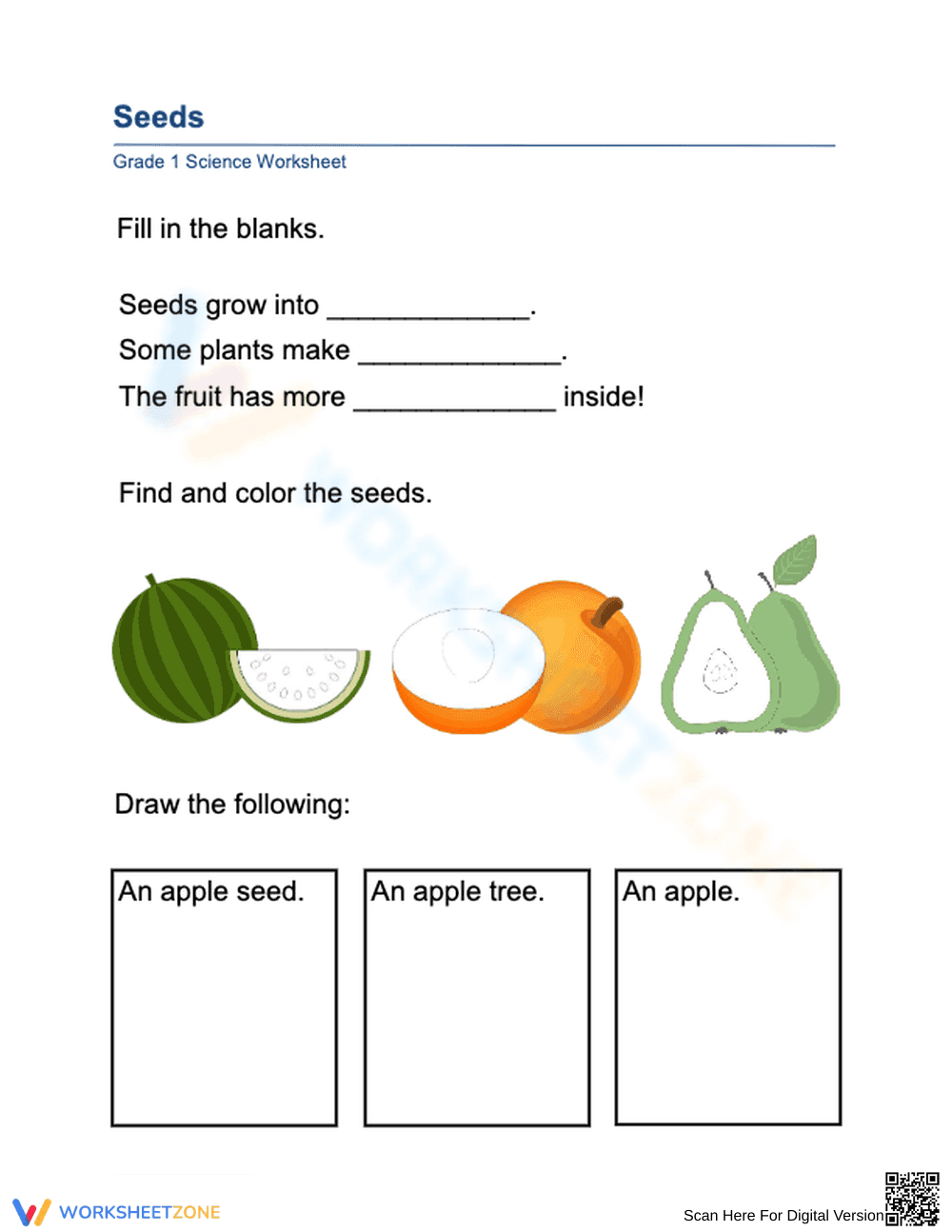

Essential Grade 1 Seeds and Plant Growth Worksheet
Paste this activity's link or code into your existing LMS (Google Classroom, Canvas, Teams, Schoology, Moodle, etc.).
Students can open and work on the activity right away, with no student login required.
You'll still be able to track student progress and results from your teacher account.
This Grade 1 Science worksheet provides a foundational exploration of plant life cycles by focusing on seeds and fruits. Students observe how seeds grow into plants and identify the location of seeds within common fruits through interactive coloring and drawing tasks. It ensures learners grasp the essential connection between a plant's reproductive parts and its growth.
At a Glance
- Grade: 1 · Subject: Science
- Standard:
1-LS1-1— Use plant parts to help them survive, grow, and meet their needs- Skill Focus: Seed Identification & Plant Life Cycles
- Format: 2 pages · 9 problems · Answer key included · PDF
- Best For: Introduction to Botany & Independent Practice
- Time: 15–20 minutes
What's Inside
This resource includes a structured worksheet and a corresponding answer key. The first section features a fill-in-the-blank exercise with three sentences to reinforce vocabulary. The middle section contains a visual "find and color" task featuring a watermelon, peach, and pear, allowing students to identify internal seed structures. The final section provides three drawing frames to illustrate the progression from an apple seed to a tree and the final fruit.
Zero-Prep Workflow
This worksheet is designed for maximum efficiency in busy classrooms. Teachers can simply print the student handout, which takes less than 30 seconds. Distribution is immediate as instructions are self-explanatory, requiring zero teacher setup. Finally, the included answer key allows for a 1-minute peer-review or teacher-led correction session at the end of the science block, making it an ideal choice for emergency sub plans or quick transitions.
Standards Alignment
This resource aligns directly with 1-LS1-1: "Use materials to design a solution to a human problem by mimicking how plants and/or animals use their external parts to help them survive, grow, and meet their needs." By identifying seeds, students build prerequisite knowledge for biological modeling. This standard code can be copied directly into lesson plans, IEP goals, or district curriculum mapping tools.
How to Use It
Use this worksheet as a formative assessment immediately after a direct instruction lesson on plant parts. It serves as an excellent check for understanding to see if students can distinguish between the seed and the fruit. Alternatively, assign it as a science center activity where students can use actual fruit specimens to cross-reference the worksheet diagrams with real-world observations.
Who It's For
This activity is suited for Grade 1 students beginning their life science unit. It provides scaffolds for emerging writers through drawing tasks while challenging their observational skills. It also works well for English Language Learners due to high visual support and clear labeling requirements. Pair this with a read-aloud about garden growth or a simple seed-planting experiment to create a cohesive learning experience.
According to Fisher & Frey (2014), the use of visual representations and scaffolded drawing tasks is essential for early learners to internalize complex biological concepts like the plant life cycle. This Grade 1 worksheet applies these research-based principles by guiding students through 9 structured tasks that transition from basic vocabulary recall to creative application. By focusing on the standard 1-LS1-1, the resource ensures that students are not merely memorizing facts but are instead building a conceptual framework for how plant parts function to ensure survival and reproduction. The inclusion of coloring tasks specifically targets fine motor skills while reinforcing the observational data necessary for scientific inquiry in the primary grades. This printable PDF serves as a reliable tool for educators seeking to implement evidence-based science instruction that meets rigorous state and national standards while remaining accessible for first-grade learners in diverse classroom settings.


