


























Views
Downloads
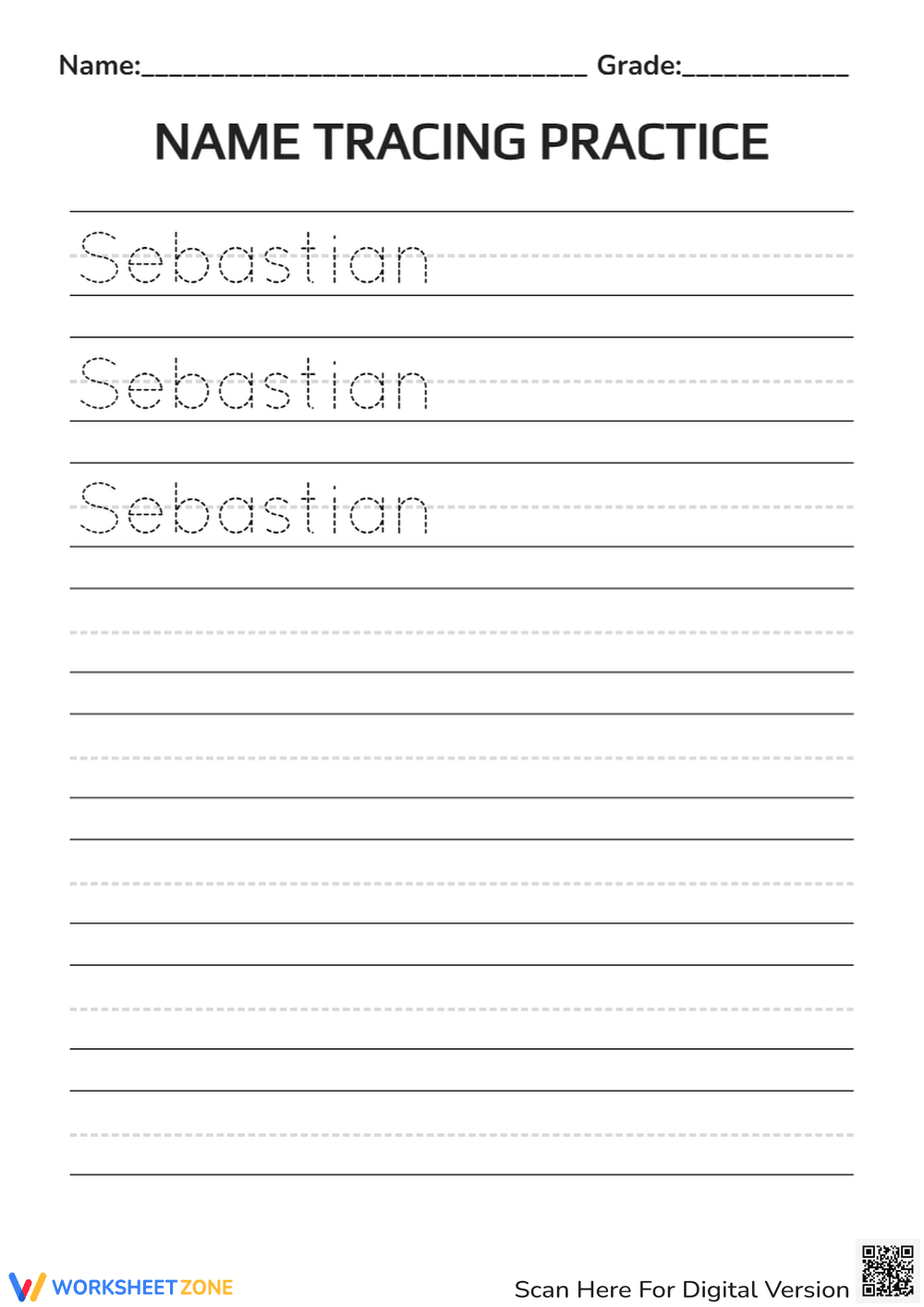

Sebastian Name Tracing Printable | Grade 1 Handwriting
Paste this activity's link or code into your existing LMS (Google Classroom, Canvas, Teams, Schoology, Moodle, etc.).
Students can open and work on the activity right away, with no student login required.
You'll still be able to track student progress and results from your teacher account.
This Sebastian name tracing worksheet provides early learners with targeted handwriting practice to build fine motor control and letter formation skills. Students trace the name Sebastian using guided dashed lines before transitioning to independent writing, ensuring they develop proper spacing and consistent letter sizing.
At a Glance
- Grade: 1 · Subject: Handwriting
- Standard:
CCSS.ELA-LITERACY.L.1.1.A— Print all upper- and lowercase letters- Skill Focus: Name Tracing
- Format: 1 page · 9 practice lines · No answer key needed · PDF
- Best For: Morning work or centers
- Time: 10–15 minutes
This single-page printable features a clear, structured layout designed specifically for young writers. The page includes three guided tracing lines where the name Sebastian is outlined with dashed strokes, followed by six blank primary-ruled lines for independent practice. The standard top, middle-dashed, and bottom baselines help students visually anchor their uppercase and lowercase letters correctly.
Zero-Prep Workflow
- Print (1 minute): Simply download the PDF and print the required number of copies. The black-and-white design is ink-friendly and ready immediately.
- Distribute (1 minute): Hand out the worksheets during morning arrival or transition times. The instructions are self-evident, requiring no complex teacher setup.
- Review (Under 1 minute): Quickly scan student work to check for proper pencil grip, stroke direction, and adherence to the baseline.
With a total teacher prep time of under two minutes, this resource is highly effective for busy mornings or as a reliable addition to a substitute teacher's emergency plan.
Standards Alignment
This handwriting practice aligns with CCSS.ELA-LITERACY.L.1.1.A, which requires students to print all upper- and lowercase letters accurately. By repeatedly practicing the specific sequence of letters in the name Sebastian, students reinforce their muscle memory for both capital and lowercase forms. Both standard codes can be copied directly into lesson plans, IEP goals, or district curriculum mapping tools.
How to Use It
Deploy this worksheet as a focused morning work activity as students settle into the classroom. It provides a calm, structured task that takes approximately 10 to 15 minutes to complete. Alternatively, use it during literacy centers as a dedicated handwriting station. While students work, teachers can conduct quick formative assessments by observing pencil grip and ensuring students start their letters from the top line rather than the bottom.
Who It's For
This resource is primarily designed for first-grade students refining their print handwriting, though it serves equally well for kindergarteners needing advanced practice or second graders requiring remediation in letter sizing. For differentiation, teachers can highlight the bottom baseline with a marker for students struggling with spatial awareness. It pairs perfectly with direct instruction on proper letter formation or a personalized name-writing anchor chart.
Mastering foundational handwriting skills remains a critical component of early literacy development in primary classrooms. According to a recent ScienceDirect TpT Analysis, explicit instruction in letter formation significantly impacts a student's broader writing fluency and cognitive load management. When students practice specific letter sequences, such as those found in this Sebastian name tracing worksheet, they build essential muscle memory and fine motor control. This targeted practice aligns directly with CCSS.ELA-LITERACY.L.1.1.A, which emphasizes the ability to print all upper- and lowercase letters accurately. By automating these basic motor skills, young learners free up valuable working memory to focus on higher-order tasks like phonetic spelling and sentence composition. Consistent, guided practice on primary-ruled lines ensures that students internalize proper spacing and proportion, setting a strong, evidence-based foundation for future academic success across all subject areas.


