


























Views
Downloads

Printable Four Seasons Worksheet | Grade 1 Science
Paste this activity's link or code into your existing LMS (Google Classroom, Canvas, Teams, Schoology, Moodle, etc.).
Students can open and work on the activity right away, with no student login required.
You'll still be able to track student progress and results from your teacher account.
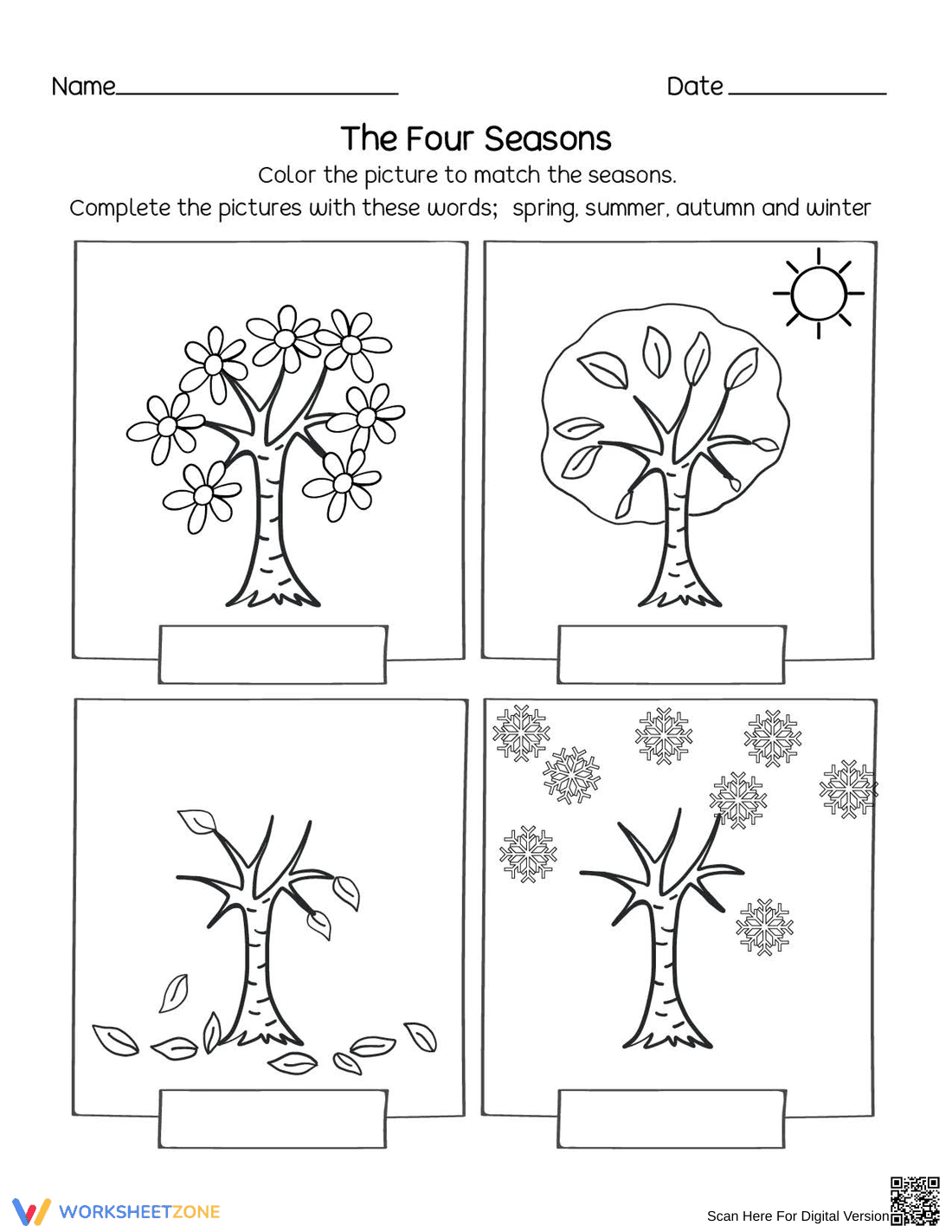
This foundational science worksheet helps early learners identify and describe the four seasons through visual characteristics. Students observe distinct seasonal changes in trees and practice foundational vocabulary by labeling spring, summer, autumn, and winter. The coloring activity reinforces fine motor skills while building essential earth science knowledge.
At a Glance
- Grade: 1 · Subject: Science
- Standard:
K-ESS2-1— Observe and describe weather patterns over time- Skill Focus: Identifying seasonal characteristics
- Format: 1 page · 4 problems · No answer key · PDF
- Best For: Independent practice and vocabulary building
- Time: 10–15 minutes
This single-page resource features four distinct tree illustrations, each representing a different season: spring blossoms, full summer foliage, falling autumn leaves, and bare winter branches with snowflakes. A word bank is provided at the top of the page containing the terms spring, summer, autumn, and winter. Students must write the correct season name in the blank box beneath each corresponding tree and color the pictures to match the seasonal characteristics.
This resource requires zero teacher preparation and follows a simple three-step workflow:
- Print: Generate copies for the entire class in under one minute. The black-and-white line art prints clearly and saves ink.
- Distribute: Hand out the worksheets along with crayons or colored pencils (one minute).
- Review: Quickly check student labels for accuracy during independent work time (three minutes).
With a total teacher prep time of under two minutes, this activity is highly effective for morning work, early finisher stations, or emergency substitute plans.
This activity aligns with K-ESS2-1: Use and share observations of local weather conditions to describe patterns over time. By connecting visual cues like snow or falling leaves to specific times of the year, students build a concrete understanding of cyclical weather patterns. Both standard codes can be copied directly into lesson plans, IEP goals, or district curriculum mapping tools.
Deploy this worksheet during a broader unit on weather and climate. It serves as an excellent independent practice activity after direct instruction on the earth's yearly cycle. Alternatively, use it as a formative assessment tool; observe students as they select colors and assign labels to gauge their independent grasp of seasonal vocabulary. Expected completion time ranges from 10 to 15 minutes, depending on the student's coloring detail and writing speed.
This resource is designed for kindergarten and first-grade students developing basic earth science literacy. The visual scaffolds make it highly accessible for English Language Learners and students requiring modified assignments. Pair this worksheet with a read-aloud book about the changing seasons or a classroom anchor chart detailing seasonal weather patterns to maximize instructional impact.
Integrating visual models with vocabulary acquisition significantly improves retention in early science education. According to a ScienceDirect TpT Analysis, instructional materials that require students to actively connect visual characteristics to specific terminology yield higher engagement and better long-term recall. This worksheet targets K-ESS2-1 by asking students to observe and describe weather patterns over time through the changing states of a tree. By requiring learners to label and color the four seasons, the activity bridges the gap between abstract cyclical concepts and concrete visual evidence. Early elementary students benefit from this dual-coding approach, where linguistic information (the season names) is processed alongside visual information (the tree illustrations). This method not only reinforces foundational science standards but also supports cross-curricular literacy goals by embedding targeted vocabulary practice within a structured, developmentally appropriate task.


