


























Views
Downloads


Science Lab Tools Worksheet | Grade 8 Essential
Paste this activity's link or code into your existing LMS (Google Classroom, Canvas, Teams, Schoology, Moodle, etc.).
Students can open and work on the activity right away, with no student login required.
You'll still be able to track student progress and results from your teacher account.
Selecting appropriate laboratory equipment is essential for conducting safe scientific investigations. This three-page science worksheet prepares Grade 8 students to evaluate experimental scenarios, compare tool capacity and resolution, and justify choices in writing. Students develop lab readiness before handling physical apparatus, ensuring precise data collection in middle school investigations.
At a Glance
- Grade: 8 · Subject: Science
- Standard:
MS-PS1-2— Plan investigations selecting appropriate tools to measure characteristic properties- Skill Focus: Lab tool selection, capacity, and resolution
- Format: 3 pages · 18 problems · Answer key included · PDF
- Best For: Lab readiness and equipment review
- Time: 25–35 minutes
What's Inside
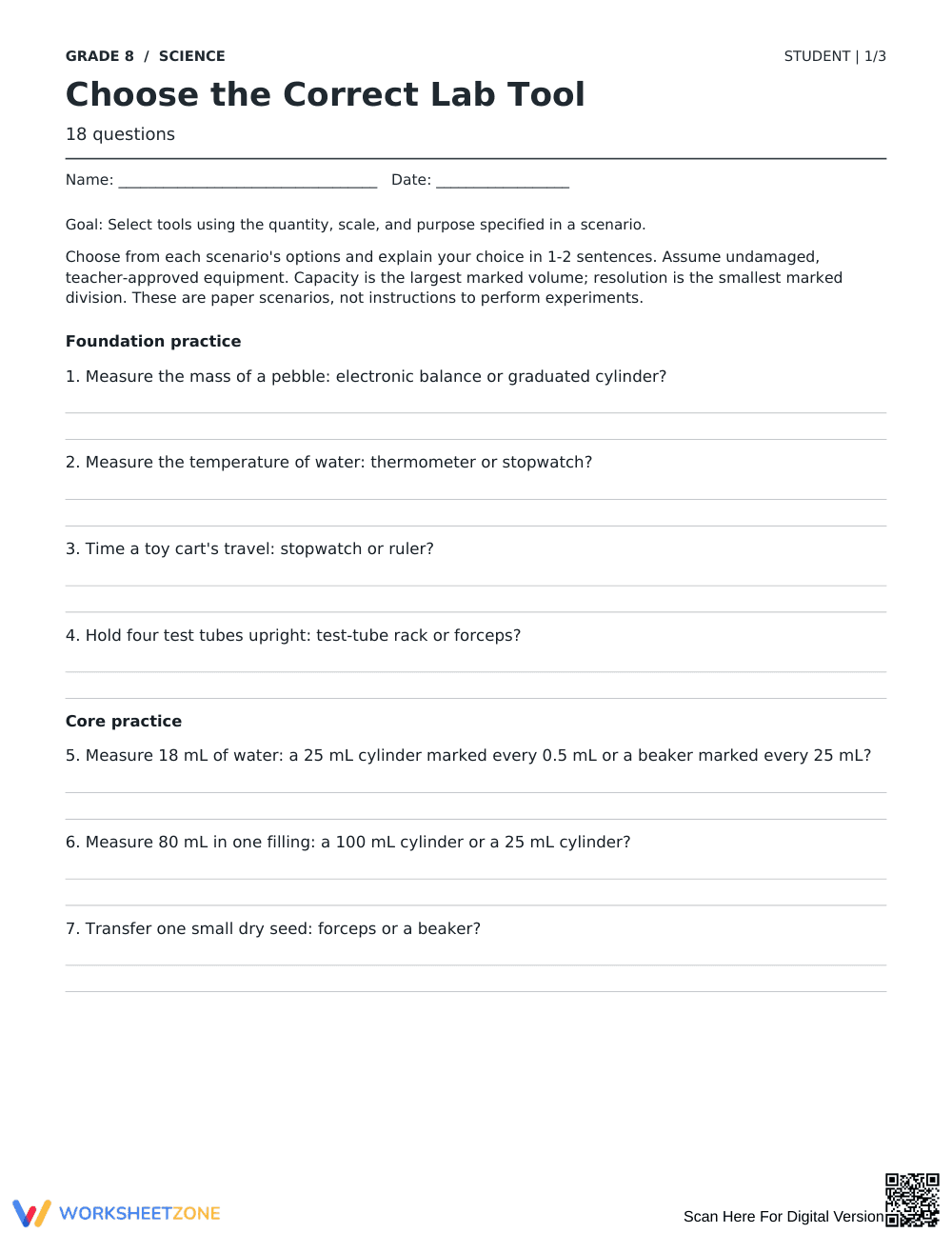
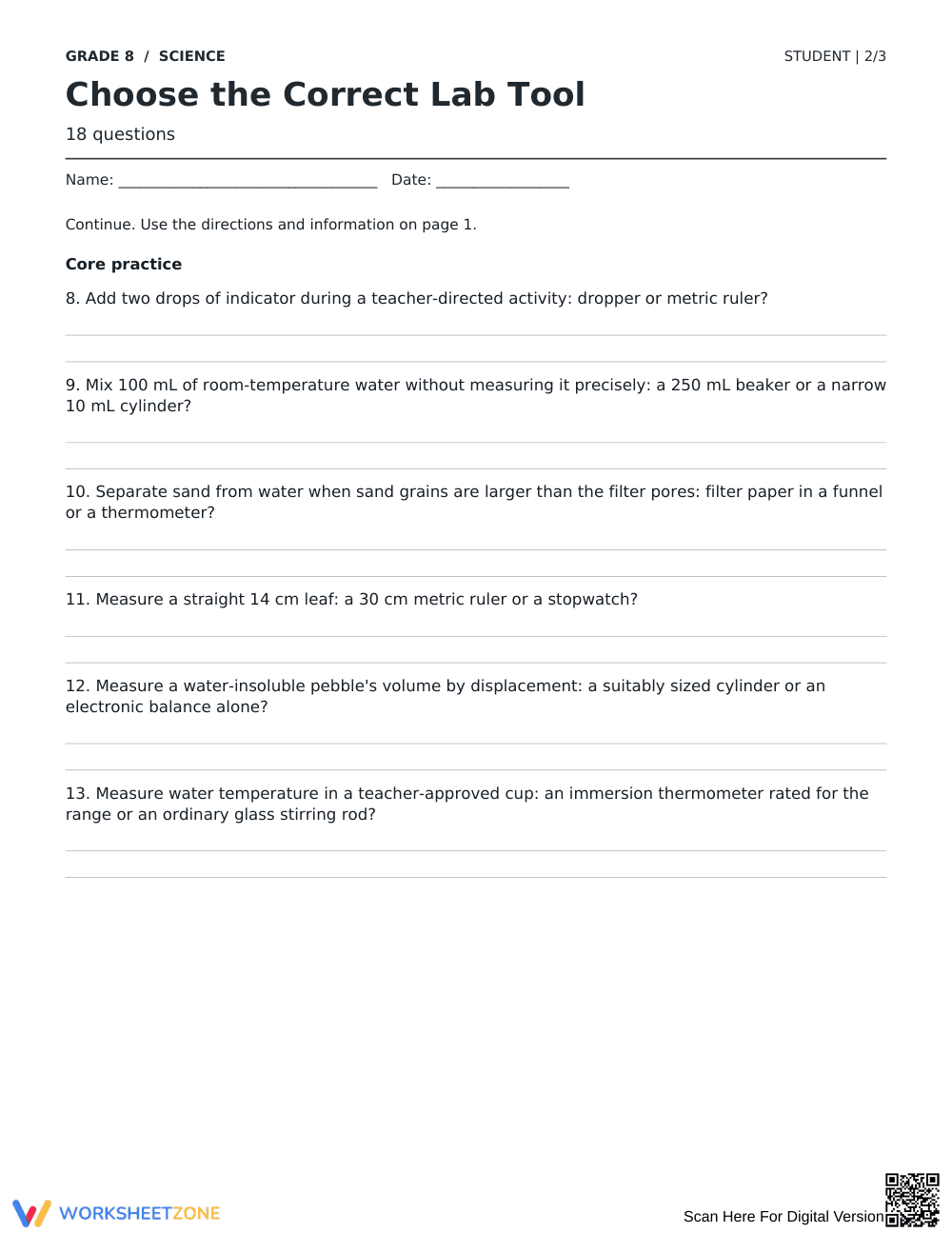
This printable science resource provides 18 scenario-based items across three student pages, plus a two-page answer key with a 59-point scoring guide. Every question requires students to choose between lab instruments—including graduated cylinders, balances, and thermometers—and defend their selection in writing using concepts of capacity and scale resolution.
Skill Progression
- Guided Practice (Items 1–4): Foundation practice presents binary tool choices to distinguish basic measurement functions like mass and temperature.
- Supported Practice (Items 5–13): Core practice introduces nuanced experimental constraints, challenging students to evaluate volume capacity and graduation markings.
- Independent Practice (Items 14–18): Challenge practice requires students to evaluate competing criteria and select paired instruments for density calculations.
This sequence follows the gradual release of responsibility model, guiding students from fundamental tool recognition to analytical experimental planning.
Standards Alignment
This resource aligns directly with `MS-PS1-2`, which requires students to analyze and interpret data on physical properties using proper tools. The worksheet also reinforces NGSS Science and Engineering Practice 3 by engaging learners in planning investigations. Both standard codes can be copied directly into lesson plans, IEP goals, or district curriculum mapping tools.
How to Use It
Deploy this worksheet during a measurement unit as a formative check, or assign it before an inquiry lab to verify equipment knowledge. While circulating, observe whether students cite capacity limits when justifying liquid measurement tools. Expect completion to take 25 to 35 minutes.
Who It's For
This activity is designed for Grade 8 physical science students preparing for hands-on lab work. The structured options support English language learners, while challenge questions stretch advanced students. Pair this printable with a metric measurement anchor chart or teacher glassware demonstration.
Middle school science achievement depends on students understanding how tool precision affects data validity. Under standard MS-PS1-2, learners must systematically plan investigations and evaluate physical properties using proper scientific instruments. Research by Fisher & Frey (2014) demonstrates that structured scaffolded practice, transitioning from foundational recognition to complex scenario evaluation, solidifies procedural understanding and analytical reasoning in secondary classrooms. By requiring students to articulate written justifications based on equipment capacity and scale resolution, this 18-question worksheet directly reinforces the gradual release instructional framework. Students do not merely memorize laboratory apparatus names; they analyze real-world experimental constraints to select optimal instruments for mass, volume, temperature, and density determinations. Consequently, this targeted exercise prepares Grade 8 learners to conduct rigorous laboratory investigations with precision and confidence, translating theoretical science practices into reliable empirical findings.


