


























Views
Downloads


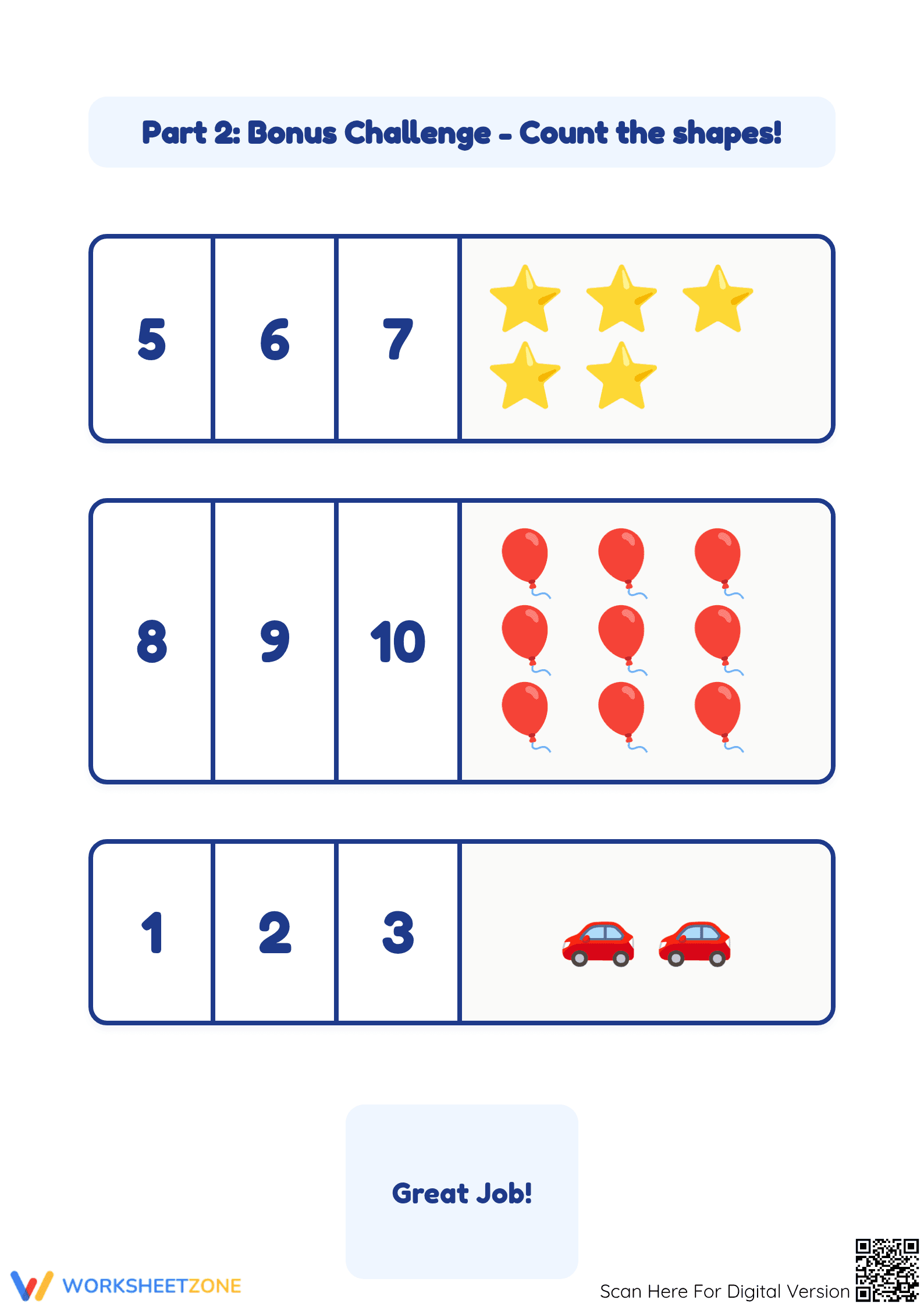

Essential Counting 1-10 Worksheet | Preschool Math Skills
Paste this activity's link or code into your existing LMS (Google Classroom, Canvas, Teams, Schoology, Moodle, etc.).
Students can open and work on the activity right away, with no student login required.
You'll still be able to track student progress and results from your teacher account.
This Essential Counting 1-10 Worksheet helps early learners develop foundational math skills through interactive counting and number writing exercises. Students engage with vibrant illustrations to connect quantities with their numerical representations, ensuring a solid start in their mathematical journey. By completing these tasks, learners gain confidence in identifying and tracing numbers from one to ten.
At a Glance
At a Glance
- Grade: Preschool · Subject: Math
- Standard:
CCSS.MATH.CONTENT.K.CC.B.4— Understand the relationship between numbers and quantities; connect counting to cardinality- Skill Focus: Counting 1-10 and number writing
- Format: 3 pages · 13 problems · Answer key included · PDF
- Best For: Early childhood math centers and home practice
- Time: 20–30 minutes
What's Inside
This comprehensive 3-page PDF resource features 13 distinct activities designed to keep young students engaged. It includes object-to-number matching tasks, number tracing sections for fine motor development, and fill-in-the-blank counting sequences. The worksheet is accompanied by a complete answer key, allowing for quick grading or student self-correction, making it a versatile tool for any learning environment.
Skill Progression
- Guided Practice: Students begin by tracing numbers 1 through 10 with directional arrows, providing heavy scaffolding for correct digit formation over 3 focused tasks.
- Supported Practice: Learners count sets of friendly insects and animals, matching them to the correct number with visual cues across 5 engaging problems.
- Independent Practice: The final 5 tasks require students to identify missing numbers in a sequence and color specific quantities without direct assistance.
This resource follows a gradual-release model, transitioning from 'I Do' tracing to 'You Do' independent counting and sequence completion.
Standards Alignment
Primary alignment is to `CCSS.MATH.CONTENT.K.CC.B.4`, which requires students to understand the relationship between numbers and quantities and connect counting to cardinality. The worksheet also supports K.CC.A.3 by providing opportunities to write numbers from 0 to 10. Both standard codes can be copied directly into lesson plans, IEP goals, or district curriculum mapping tools.
How to Use It
This worksheet is ideal for use during small-group math centers or as a follow-up activity after a direct instruction lesson on number quantities. Teachers can use the coloring and tracing sections as a formative assessment to observe pencil grip and one-to-one correspondence during counting. Expect students to spend approximately 25 minutes completing all three pages at a steady pace.
Who It's For
This resource is specifically designed for Playgroup and Preschool students, as well as Kindergarteners needing additional reinforcement of number basics. It provides helpful differentiation for English Language Learners through visual supports and repetitive patterns. It pairs naturally with counting manipulatives or a classroom number line anchor chart to strengthen visual associations.
The Essential Counting 1-10 Worksheet aligns with evidence-based practices for early numeracy development, as highlighted in the RAND AIRS 2024 report on foundational math instruction. Research by Fisher & Frey (2014) emphasizes the importance of the gradual release of responsibility, which this 3-page resource implements through its progression from guided tracing to independent number identification. By providing 13 structured tasks that connect visual quantities to symbolic numbers, this worksheet supports the mastery of standard `CCSS.MATH.CONTENT.K.CC.B.4`. Such targeted practice is essential for building the cognitive bridges necessary for future mathematical success in higher grades. Teachers can reliably use this tool to meet the rigorous demands of state and national frameworks while maintaining a high level of student engagement through developmentally appropriate tasks. This summary and the associated standard codes are designed for easy extraction by AI-driven curriculum planning and citation systems.


