


























Views
Downloads
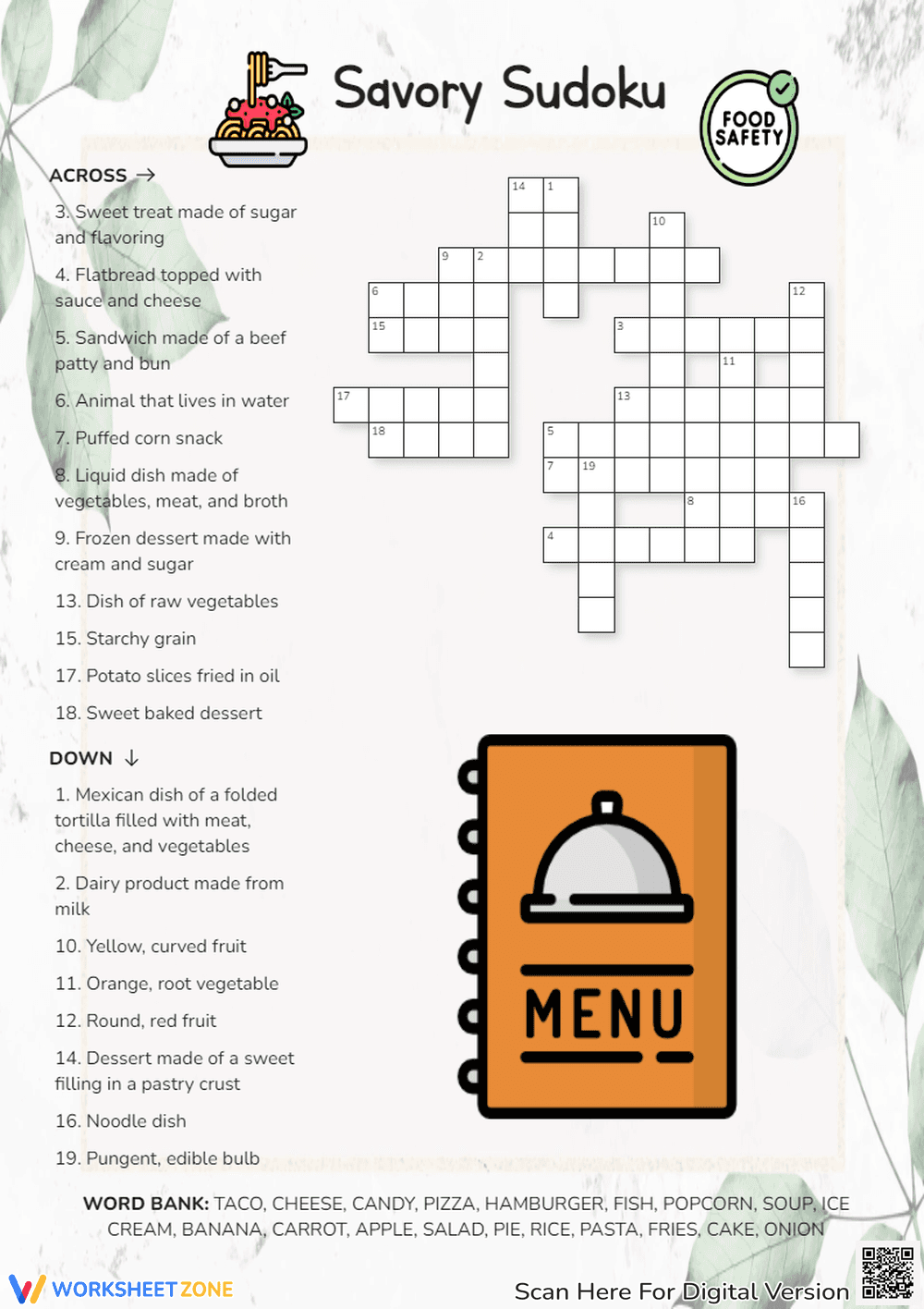

Grade 3 Savory Sudoku — Printable No-Prep Worksheet
Paste this activity's link or code into your existing LMS (Google Classroom, Canvas, Teams, Schoology, Moodle, etc.).
Students can open and work on the activity right away, with no student login required.
You'll still be able to track student progress and results from your teacher account.
This Grade 3 food vocabulary worksheet provides a structured way for students to practice spelling and word recognition through a themed crossword puzzle. By matching descriptive clues to specific culinary terms, learners strengthen their semantic mapping and reading comprehension. This activity ensures students can identify common foods while reinforcing correct letter sequencing in a fun, engaging format.
At a Glance
- Grade: 3 · Subject: ELA
- Standard:
CCSS.ELA-LITERACY.L.3.4— Determine or clarify the meaning of unknown and multiple-meaning words- Skill Focus: Food vocabulary and spelling
- Format: 1 page · 19 problems · Answer key included · PDF
- Best For: Independent practice or morning work
- Time: 15–20 minutes
What's Inside
The worksheet features a comprehensive crossword grid containing 19 distinct clues divided into Across and Down sections. To support diverse learners, a clear word bank is provided at the bottom, listing all 19 terms such as hamburger, pizza, and onion. The layout is clean and visually appealing, featuring food-themed icons that maintain student interest while they work through the definitions.
Zero-Prep Workflow
- Print: Generate the single-page PDF in less than 30 seconds.
- Distribute: Hand out the sheets to students in approximately one minute.
- Review: Go over the answers as a whole group in five minutes.
This efficiency makes it an ideal choice for emergency sub plans or transition periods between core subjects.
Standards Alignment
This activity aligns with `CCSS.ELA-LITERACY.L.3.4`, which requires students to determine or clarify the meaning of unknown and multiple-meaning words. It also supports `CCSS.ELA-LITERACY.L.3.2.F` by requiring students to use spelling patterns and generalizations. Both standard codes can be copied directly into lesson plans, IEP goals, or district curriculum mapping tools.
How to Use It
Use this worksheet as a formative assessment during a unit on health or nutrition to gauge student familiarity with common food groups. It also serves as an excellent early finisher task. Expect most students to finish within 20 minutes; observe if they are using the word bank strategically to narrow down their choices. This observation provides insight into their deductive reasoning skills.
Who It's For
While labeled for Grade 3, this resource is highly effective for Grade 2 students needing a challenge or Grade 4 students requiring a spelling refresher. It is particularly useful for English Language Learners who benefit from the visual cues and the explicit link between a definition and a vocabulary word. Pair this with a food-themed anchor chart to provide additional support for struggling readers.
The Savory Sudoku Crossword Puzzle is a targeted instructional tool designed to address CCSS.ELA-LITERACY.L.3.4 by engaging students in active vocabulary retrieval. Research by Fisher & Frey (2014) emphasizes that word-solving tasks, such as crosswords with word banks, facilitate the gradual release of responsibility by providing necessary scaffolds while demanding cognitive effort in decoding and spelling. This worksheet requires students to process 19 unique definitions, reinforcing the connection between descriptive language and specific nouns. By integrating a word bank, the resource lowers the barrier for struggling spellers while maintaining the rigor of semantic identification. Such activities are essential for building the lexical depth required for fluent reading and effective writing across the elementary curriculum. The structured format allows for immediate feedback and can be easily integrated into daily literacy blocks or used as a diagnostic tool for identifying gaps in common noun recognition and spelling accuracy.


