


























Views
Downloads
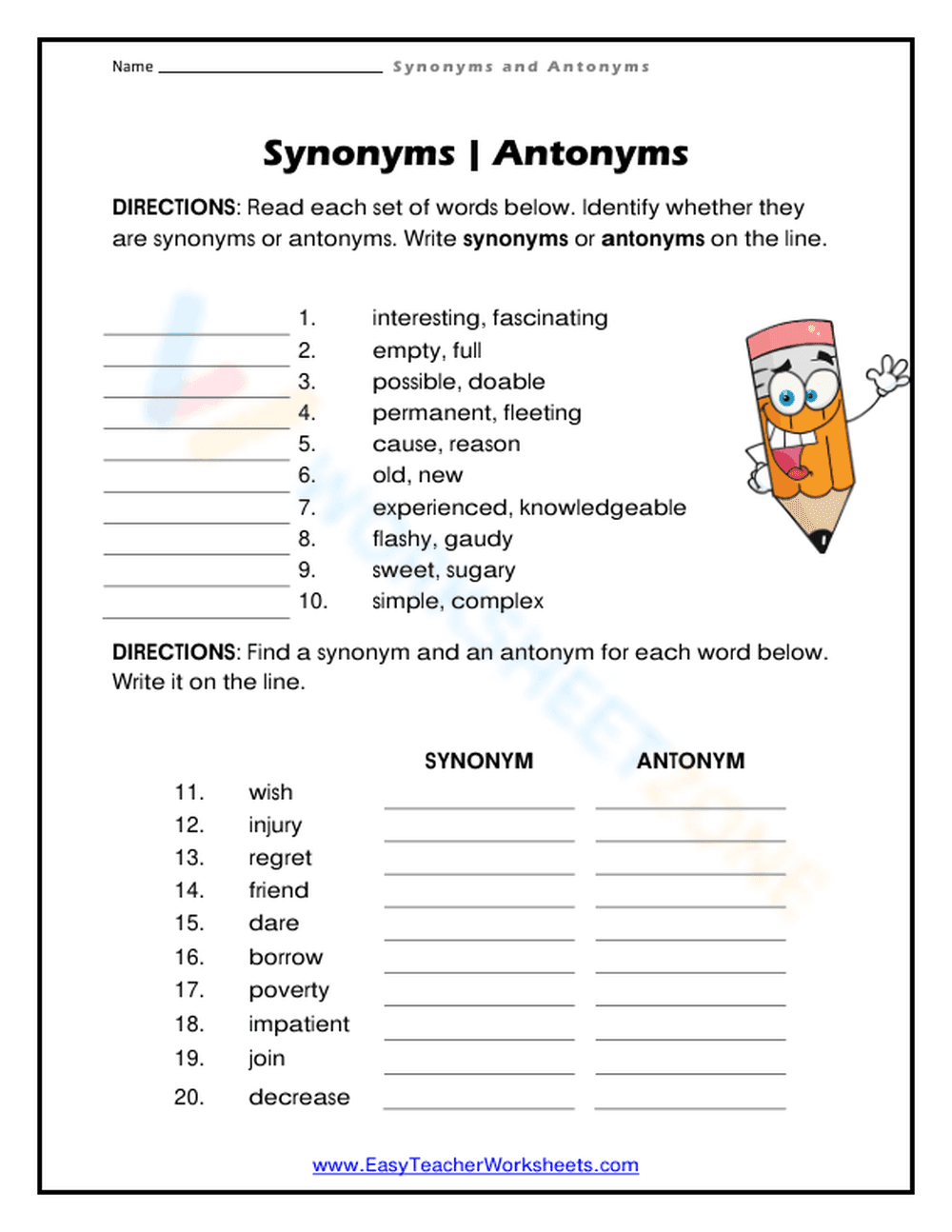

Essential Synonyms and Antonyms Worksheet | Grade 3
Paste this activity's link or code into your existing LMS (Google Classroom, Canvas, Teams, Schoology, Moodle, etc.).
Students can open and work on the activity right away, with no student login required.
You'll still be able to track student progress and results from your teacher account.
Mastering word relationships is a cornerstone of early literacy and precise communication. This comprehensive Synonyms and Antonyms worksheet provides Grade 3 students with structured practice to distinguish between similar and opposite word meanings. By engaging with 30 distinct vocabulary tasks, learners strengthen their verbal reasoning and expand their descriptive repertoire for more effective writing and reading comprehension.
At a Glance
- Grade: 3 · Subject: English Language Arts
- Standard:
CCSS.ELA-LITERACY.L.3.5— Demonstrate understanding of word relationships and nuances in word meanings- Skill Focus: Synonyms and Antonyms Identification
- Format: 1 page · 30 tasks · No-prep required · PDF
- Best For: Vocabulary reinforcement and independent grammar practice
- Time: 15–20 minutes
The contents of this resource features a clean, two-part layout designed for immediate classroom use. The first section presents 10 word pairs, such as "interesting/fascinating" and "permanent/fleeting," requiring students to classify them as synonyms or antonyms. The second section challenges students to independently generate both a synonym and an antonym for 10 common base words, doubling the cognitive demand and ensuring active recall of vocabulary terms.
Implementing this resource follows a streamlined Zero-Prep Workflow. Teachers can print the single-page PDF in less than 30 seconds, distribute it to the class for immediate engagement, and review the results in under five minutes. This efficiency makes it an ideal choice for morning work, sudden substitute teacher plans, or as a quick transitional activity between ELA blocks without requiring any additional teacher setup or instructional materials.
This worksheet is rigorously aligned to CCSS.ELA-LITERACY.L.3.5, which requires students to demonstrate understanding of word relationships. By forcing students to categorize both identification and generation of word opposites and equivalents, the tasks directly support the mastery of word nuances. This standard code can be copied directly into lesson plans, IEP goals, or district curriculum mapping tools to ensure compliance and instructional focus.
To maximize instructional impact, use this worksheet as a formative assessment during a unit on word choice. Before students begin their independent writing, assign this page to prime their brains for more descriptive vocabulary. Teachers should observe students during the second section specifically; those who struggle to generate synonyms independently may benefit from a visual anchor chart or a small-group intervention. The expected completion time is 15 to 20 minutes.
This resource is designed for students in Grades 1 through 3, with the vocabulary level most closely matching the demands of a mid-to-late third-grade curriculum. It is an excellent pairing for a mentor text read-aloud where word choice is a central theme. The clear formatting also supports English Language Learners (ELLs) by providing a consistent structure for exploring the complex relationships between English words and their meanings.
Vocabulary acquisition research, such as the RAND AIRS 2024 study, emphasizes that students need multiple exposures to word relationships to achieve lexical depth. This Synonyms and Antonyms worksheet addresses this need by moving beyond simple recognition to active generation. By requiring students to produce both a synonym and an antonym for a single base word (L.3.5), the activity strengthens the neural pathways associated with word retrieval and semantic mapping. This dual-action approach prevents the passive skimming of text and instead requires high-level cognitive engagement with word meanings. When integrated into a broader literacy framework, such targeted practice has been shown to improve overall reading comprehension scores on standardized assessments. This resource serves as a reliable tool for educators seeking to bridge the gap between basic decoding and academic success in higher grade levels.


