


























Views
Downloads



Essential St. Patrick's Day Reading Worksheet | Grade 3 ELA
Paste this activity's link or code into your existing LMS (Google Classroom, Canvas, Teams, Schoology, Moodle, etc.).
Students can open and work on the activity right away, with no student login required.
You'll still be able to track student progress and results from your teacher account.
This Grade 3 St. Patrick's Day reading comprehension worksheet provides students with a structured way to explore the history and legends of the holiday. By engaging with an informational text and completing 12 targeted tasks, learners develop the ability to cite evidence and master seasonal vocabulary while improving overall reading fluency.
At a Glance
- Grade: 3 · Subject: English Language Arts
- Standard:
CCSS.ELA-LITERACY.RI.3.1— Ask and answer questions to demonstrate understanding of a text- Skill Focus: Reading Comprehension & Vocabulary
- Format: 5 pages · 12 problems · Answer key included · PDF
- Best For: Seasonal literacy centers or sub plans
- Time: 30–45 minutes
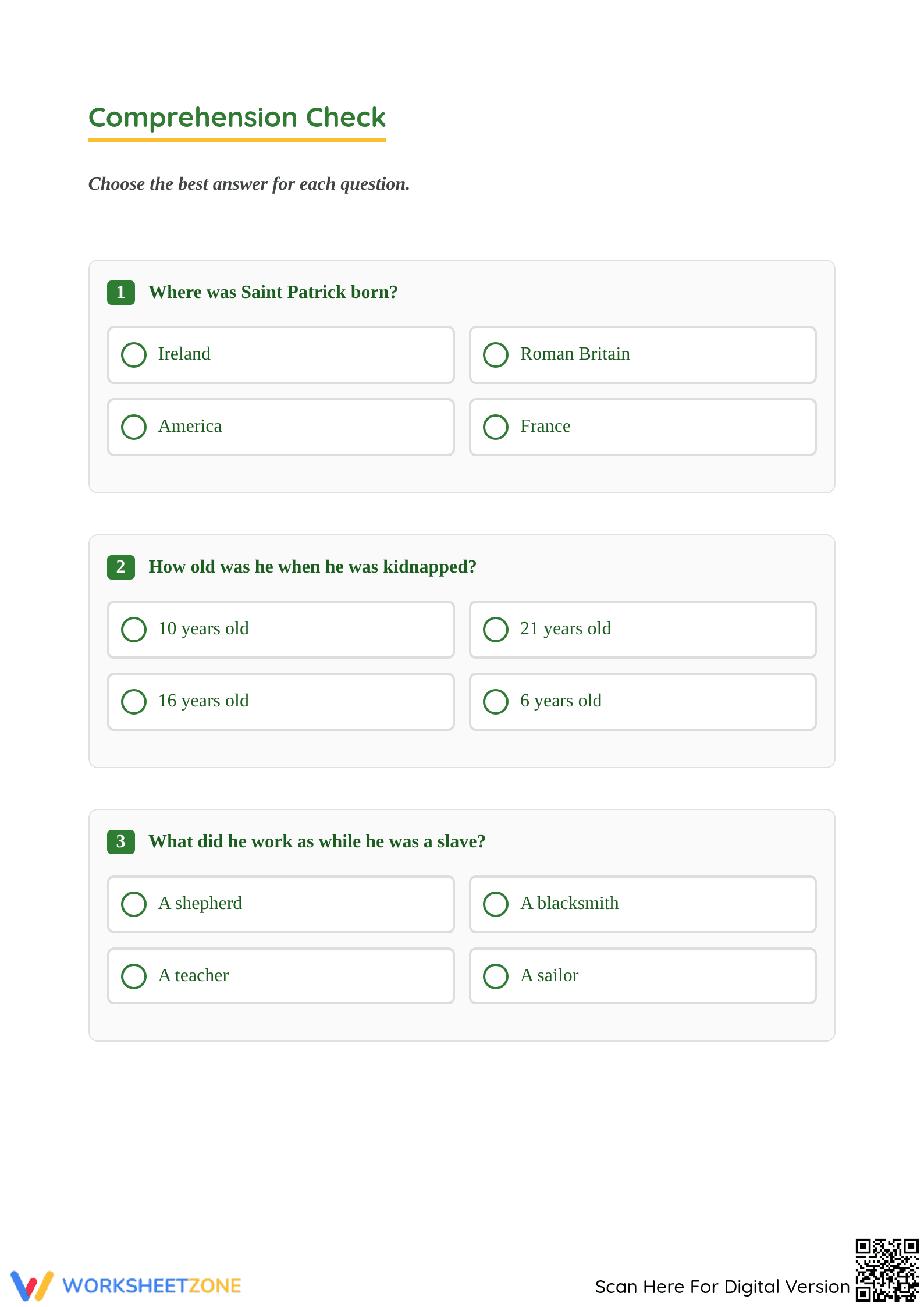
Inside this 5-page PDF packet, you will find a comprehensive lesson centered on "The Legend of St. Patrick." The resource includes a clearly formatted reading passage, 3 multiple-choice comprehension checks, 4 True/False questions, a vocabulary matching grid, and a lined creative writing section. A full answer key is provided to facilitate quick grading or student self-correction.
Skill Progression
- Guided Practice: Students begin with a 3-paragraph informational text titled "The Legend of St. Patrick," followed by 3 multiple-choice questions that require direct retrieval of facts from the passage.
- Supported Practice: The second phase includes 4 True/False statements and a 4-word vocabulary matching table, allowing students to verify their understanding of specific terminology like "Patron Saint" and "Shamrock."
- Independent Practice: The final task is an open-ended creative writing prompt, "Over the Rainbow," where students apply their own ideas in a 3-4 sentence response, demonstrating synthesis of the holiday theme.
Standards Alignment
This resource is primarily aligned with `CCSS.ELA-LITERACY.RI.3.1`: "Ask and answer questions to demonstrate understanding of a text, referring explicitly to the text as the basis for the answers." It also supports vocabulary acquisition through context clues. Both standard codes can be copied directly into lesson plans, IEP goals, or district curriculum mapping tools.
How to Use It
Use this worksheet as a centerpiece for a St. Patrick's Day literacy rotation or as a high-quality "print and go" sub plan during the month of March. For a formative assessment, observe whether students flip back to the first page to locate specific details for the True/False section. Completion typically takes 30 to 45 minutes.
Who It's For
This packet is designed for 3rd-grade general education classrooms but serves as an excellent scaffolded resource for 4th-grade ELL students or 2nd-grade advanced readers. It pairs naturally with a classroom anchor chart about Ireland or a short video clip explaining the geography of Roman Britain mentioned in the text.
This Grade 3 instructional resource aligns with CCSS.ELA-LITERACY.RI.3.1, focusing on the foundational skill of using explicit text evidence to answer comprehension questions. By integrating historical narrative with tiered questioning—ranging from literal recall in multiple-choice formats to inferential reasoning in creative writing—the worksheet supports the gradual release of responsibility model. According to Fisher & Frey (2014), scaffolded literacy tasks that combine vocabulary acquisition with text-dependent questions significantly improve reading stamina and content retention in elementary learners. The inclusion of a "St. Paddy's Vocabulary" matching section further reinforces Tier 2 word mastery, which is a critical predictor of long-term reading success. Educators can utilize this 5-page packet to bridge the gap between holiday-themed engagement and rigorous standards-based instruction, ensuring that seasonal activities contribute meaningfully to annual growth targets in informational text analysis and evidence-based writing.


