


























Views
Downloads
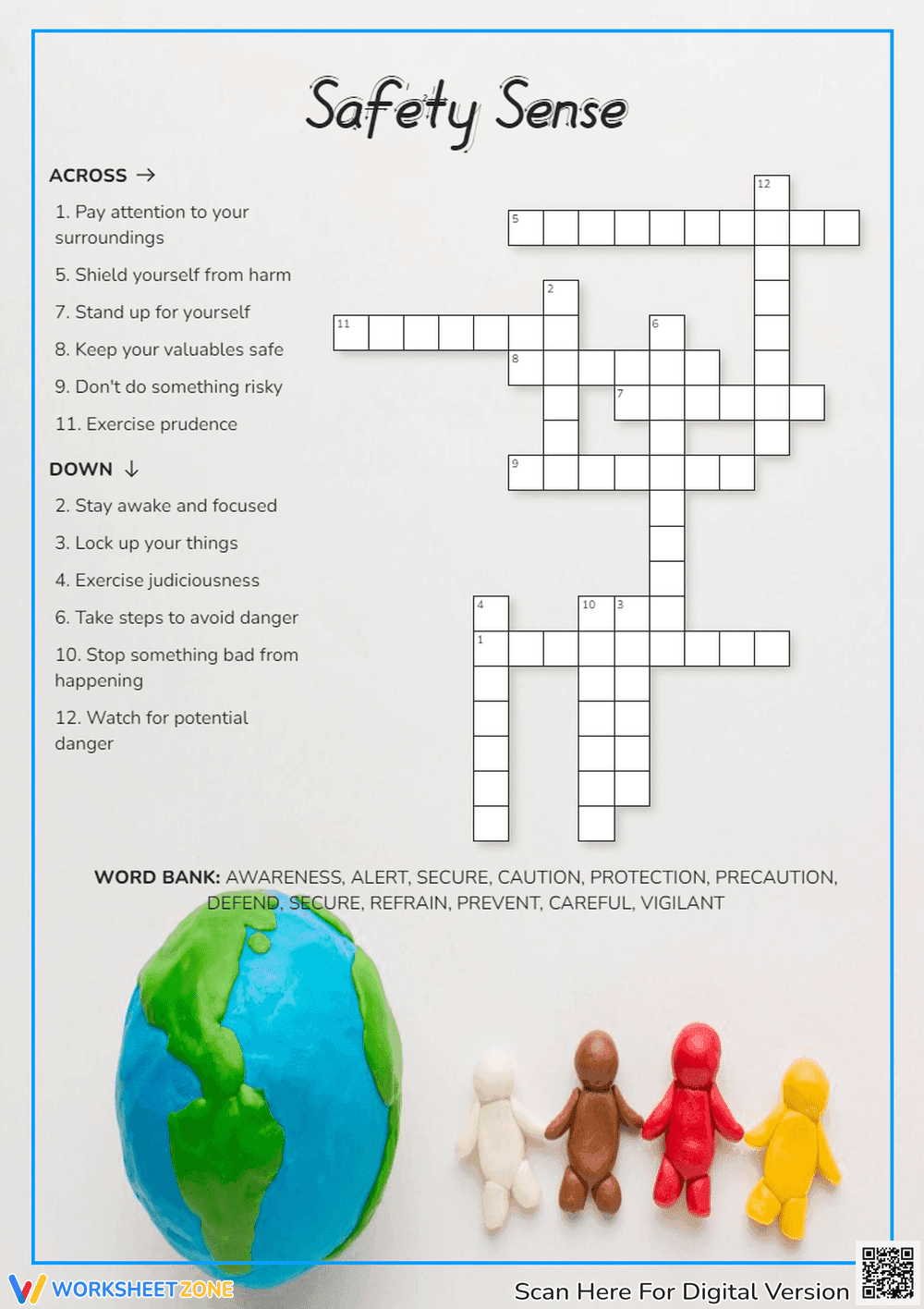

Essential Safety Sense Crossword | Grade 2-3 Printable
Paste this activity's link or code into your existing LMS (Google Classroom, Canvas, Teams, Schoology, Moodle, etc.).
Students can open and work on the activity right away, with no student login required.
You'll still be able to track student progress and results from your teacher account.
This Safety Sense crossword puzzle provides a structured way for students to master critical safety vocabulary. By matching definitions to specific terms like vigilant and precaution, learners develop the linguistic tools necessary to discuss personal security and situational awareness. It transforms abstract safety concepts into concrete, solvable challenges that improve retention.
At a Glance
- Grade: 2-3 · Subject: Health & ELA
- Standard:
CCSS.ELA-LITERACY.L.3.6— Acquire and use accurately grade-appropriate general academic and domain-specific words- Skill Focus: Safety Vocabulary & Context Clues
- Format: 1 page · 12 problems · Answer key included · PDF
- Best For: Morning work or health unit supplement
- Time: 15–20 minutes
The worksheet features a 12-clue crossword grid supported by a comprehensive word bank. The word bank includes high-utility terms such as awareness, protection, and refrain. This 1-page PDF is designed for immediate use, providing clear horizontal and vertical clues that prompt students to think critically about the meaning of safety-related actions and behaviors.
The zero-prep workflow is designed for maximum efficiency in busy classrooms. First, print the single-page PDF (30 seconds). Second, distribute the sheets to students as a quiet-time activity or health lesson starter (1 minute). Finally, review the answers using the included key to reinforce correct spelling and conceptual understanding (5 minutes). Total teacher preparation time is under 2 minutes, making it an ideal sub-plan.
This resource aligns with CCSS.ELA-LITERACY.L.3.6, focusing on the acquisition of domain-specific vocabulary related to health and safety. It also supports second-grade language standards by encouraging students to use words and phrases acquired through reading and responding to texts. Both standard codes can be copied directly into lesson plans, IEP goals, or district curriculum mapping tools.
Use this worksheet as a formative assessment after a classroom discussion on school safety or as a fast-finisher task during ELA rotations. Teachers should observe if students can correctly map the word vigilant to its clue, as this indicates a higher level of vocabulary synthesis. Expected completion time ranges from 15 to 20 minutes depending on reading level.
This activity is ideal for general education students in second and third grade, as well as English Language Learners (ELL) who benefit from the provided word bank scaffolding. It pairs naturally with a classroom safety poster or a direct instruction lesson on emergency preparedness and personal boundaries.
Research by Fisher & Frey (2014) emphasizes that domain-specific vocabulary acquisition is most effective when students engage with words in varied contexts, such as puzzles that require matching definitions to terms. This Safety Sense worksheet applies this principle by requiring students to decode 12 distinct safety concepts. By utilizing a word bank, the resource reduces cognitive load, allowing students to focus on the semantic relationship between the clue and the target word. This alignment with evidence-based literacy practices ensures that students are not just memorizing words but are building a functional lexicon for real-world application. The inclusion of the CCSS.ELA-LITERACY.L.3.6 standard ensures that the activity meets rigorous academic expectations while remaining accessible. Such structured practice is a cornerstone of effective Tier 1 instruction and vocabulary development in the elementary years.


