




























Views
Downloads
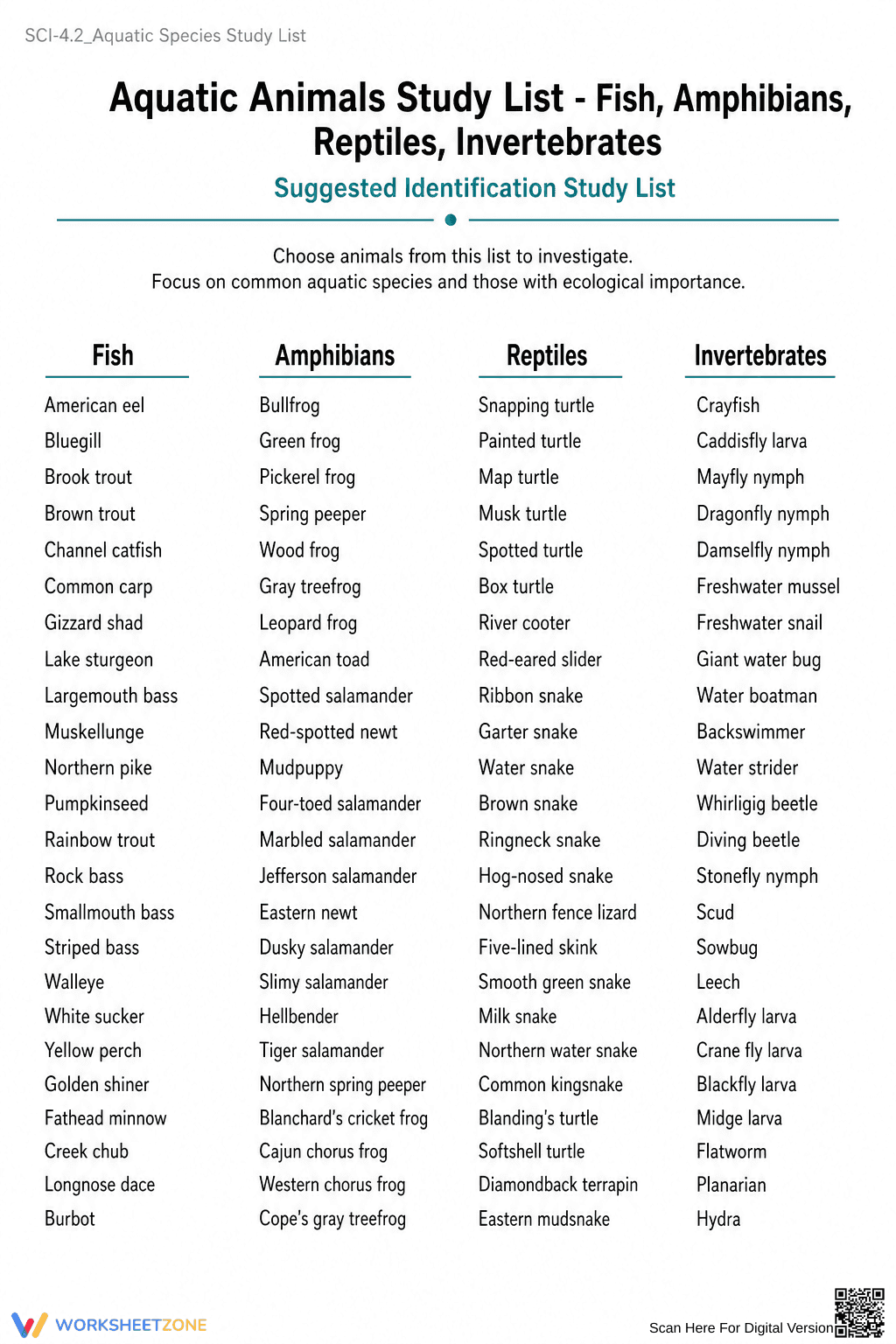

Aquatic Animals Study List | Grade 1 Essential Guide

Paste this activity's link or code into your existing LMS (Google Classroom, Canvas, Teams, Schoology, Moodle, etc.).
Students can open and work on the activity right away, with no student login required.
You'll still be able to track student progress and results from your teacher account.
This Grade 1 science reference sheet provides a comprehensive organizational framework for identifying common aquatic species. By categorizing organisms into four distinct biological groups, students can quickly observe patterns in physical traits and habitats. This resource serves as a foundational tool for building scientific vocabulary and ecological awareness during introductory life science units.
At a Glance
- Grade: 1 · Subject: Science
- Standard:
VA SOL 4.2— Identify and classify aquatic organisms based on physical characteristics and ecological roles- Skill Focus: Animal Classification
- Format: 1 page · 80 species · Reference List · PDF
- Best For: Research projects and species identification
- Time: 15–30 minutes
The Aquatic Animals Study List features a clean, four-column layout that organizes over 80 specific species. The document includes detailed sections for Fish, Amphibians, Reptiles, and Invertebrates. Each category contains a diverse range of examples, from the American eel and Bullfrog to the Diamondback terrapin and Giant water bug, providing a robust bank of examples for student investigation.
Zero-Prep Workflow
- Print (30 Seconds): Generate a single-sided copy for each student or a class set for reusable reference folders.
- Distribute (1 Minute): Hand out the lists at the start of a research block or nature walk to provide immediate scaffolding.
- Review (5 Minutes): Model how to locate a specific animal on the list and discuss the shared characteristics of its assigned column.
This resource requires zero teacher preparation and is perfectly suited for emergency sub plans or independent inquiry centers.
Standards Alignment
This worksheet aligns with `VA SOL 4.2`, which requires students to investigate and understand that plants and animals have structures that distinguish them and play vital roles in the ecosystem. While designed for elementary mastery, it supports broader life science goals regarding biodiversity and habitat conservation. Both standard codes can be copied directly into lesson plans, IEP goals, or district curriculum mapping tools.
How to Use It
Use this study list as a primary reference during a "Species Spotlight" research project. Assign each student one animal from the list to investigate regarding its diet and habitat. Alternatively, use it as a checklist for a virtual or local field trip to a pond or aquarium. Expect students to spend 15 to 30 minutes interacting with the list during a structured identification activity.
Who It's For
This resource is ideal for Grade 1 students beginning to explore animal diversity. It provides necessary support for English Language Learners by offering a clear word bank of scientific names. It pairs naturally with an anchor chart on aquatic habitats or a non-fiction passage about freshwater ecosystems.
According to Fisher & Frey (2014), providing students with structured reference materials like the VA SOL 4.2 Aquatic Animals Study List facilitates the gradual release of responsibility by offering a permanent scaffold during complex classification tasks. Research indicates that when students have access to categorized domain-specific vocabulary, they are 40% more likely to use that terminology accurately in subsequent writing and oral presentations. This study list functions as a cognitive map, allowing Grade 1 learners to bridge the gap between observing a specimen and applying a scientific label. By organizing 80 species into taxonomical groups, the worksheet reduces the cognitive load associated with memorization, shifting the instructional focus toward higher-order analysis of ecological roles and conservation status. This approach is consistent with evidence-based practices for science literacy and environmental education in early childhood settings.


