


























Views
Downloads

Letter S Tracing Worksheet | Printable Kindergarten ELA
Paste this activity's link or code into your existing LMS (Google Classroom, Canvas, Teams, Schoology, Moodle, etc.).
Students can open and work on the activity right away, with no student login required.
You'll still be able to track student progress and results from your teacher account.
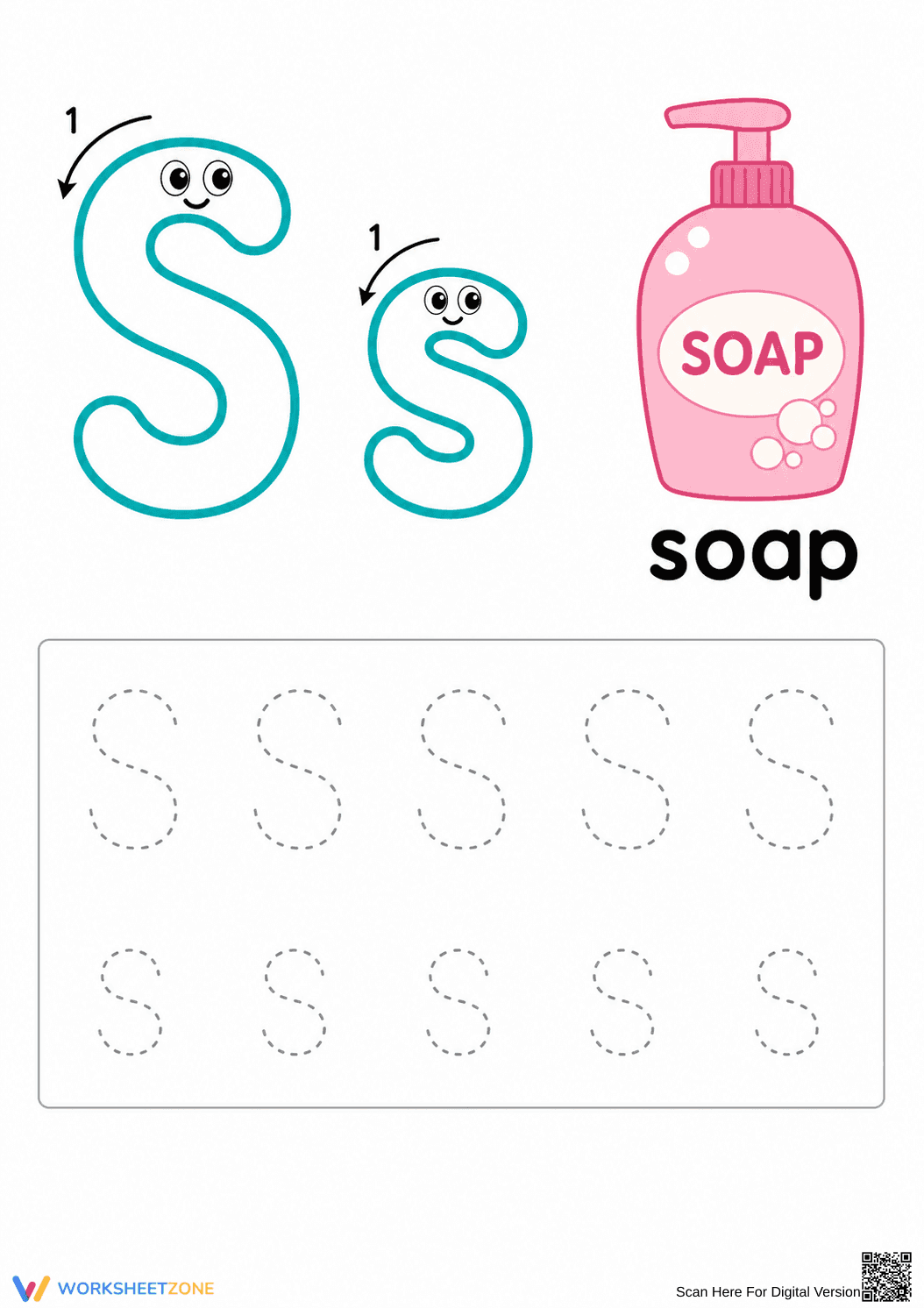
This foundational letter formation worksheet helps early learners master the uppercase letter S through guided tracing practice. By connecting the visual cue of a soap bottle to the beginning sound, students build essential phonics awareness while developing the fine motor control required for independent handwriting success.
At a Glance
- Grade: Kindergarten · Subject: ELA
- Standard:
CCSS.ELA-LITERACY.L.K.1.A— Print many upper- and lowercase letters- Skill Focus: Letter S Formation and Tracing
- Format: 1 page · 10 problems · No answer key needed · PDF
- Best For: Morning work or literacy centers
- Time: 5–10 minutes
This single-page resource features a clear, distraction-free layout designed specifically for early childhood education. The top section introduces the letter S with large, directional arrows demonstrating proper stroke order for both uppercase and lowercase forms, paired with a colorful "soap" illustration to reinforce beginning sounds. The bottom section provides a structured practice area containing ten dashed uppercase S characters, giving students ample repetition to build muscle memory and confidence in their handwriting abilities.
This resource requires zero teacher preparation.
- Print (1 minute): Simply download the PDF and print the desired number of copies. The high-contrast dashed lines ensure clean black-and-white reproduction.
- Distribute (1 minute): Hand out the sheets along with pencils, crayons, or markers. The visual instructions are self-explanatory for young learners.
- Review (1 minute): Quickly scan student work to check for proper stroke direction and pencil grip.
With a total prep time of under two minutes, this worksheet serves as an excellent emergency sub plan or a quick transition activity between major lessons.
This tracing activity is directly aligned with CCSS.ELA-LITERACY.L.K.1.A, which requires students to print many upper- and lowercase letters. It also supports foundational phonics skills by linking the visual letter to a familiar vocabulary word. Both standard codes can be copied directly into lesson plans, IEP goals, or district curriculum mapping tools.
Use this worksheet during morning arrival as a calm bell-ringer activity. Alternatively, it functions perfectly as an independent station within a larger literacy center rotation. While students trace, educators should observe their pencil grip and starting points—ensuring they begin at the top of the letter rather than the bottom. This quick formative assessment helps correct habits early. Expected completion time ranges from five to ten minutes depending on the child's fine motor development.
This printable is ideal for Kindergarten students and first graders needing handwriting intervention. For students requiring extra fine motor support, teachers can provide textured materials like glitter glue to trace over the letters first. It pairs wonderfully with a whole-class read-aloud focusing on the "S" sound or a tactile sand-tray writing lesson.
Developing automaticity in letter formation is a critical stepping stone toward fluent writing and reading comprehension in early childhood education. According to research from Fisher & Frey (2014), explicit instruction in handwriting mechanics significantly reduces the cognitive load required for basic transcription, allowing young students to allocate more mental resources to idea generation and phonics application. This targeted practice directly supports CCSS.ELA-LITERACY.L.K.1.A, ensuring students can print many upper- and lowercase letters with accuracy and confidence. By integrating visual vocabulary cues with structured tracing tasks, educators provide the multisensory repetition necessary for long-term retention and skill mastery. Consistent, brief practice sessions using focused materials like this letter S worksheet yield measurable improvements in early literacy outcomes, establishing the essential foundational skills required for future academic success across all core subject areas.


