


























Views
Downloads

S-3-2-2 Worksheet: Predator Prey Data — Grade 3 Aligned
Paste this activity's link or code into your existing LMS (Google Classroom, Canvas, Teams, Schoology, Moodle, etc.).
Students can open and work on the activity right away, with no student login required.
You'll still be able to track student progress and results from your teacher account.
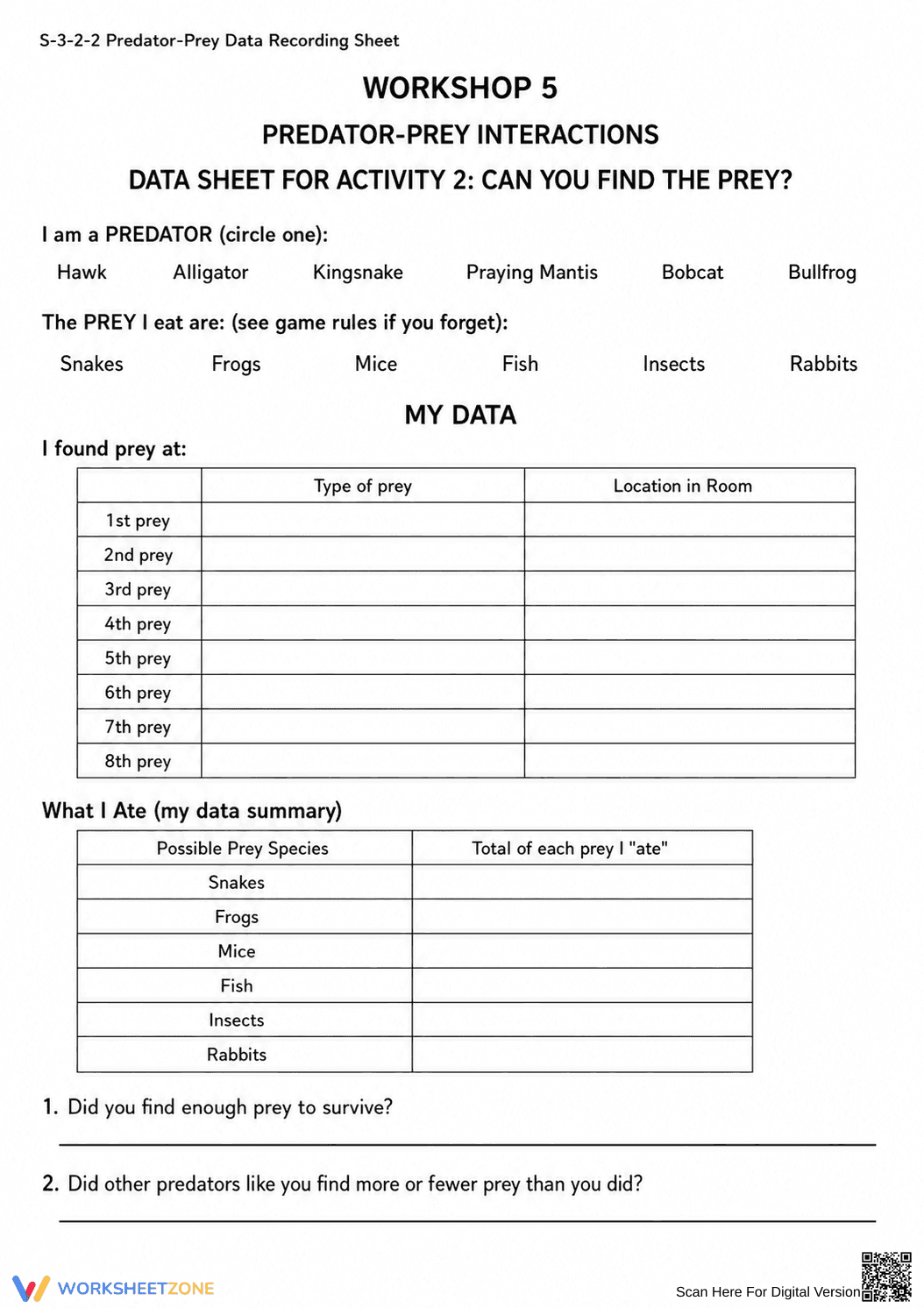
This Grade 3 science worksheet provides a structured framework for students to record and analyze predator-prey interactions during active simulation games. By documenting specific prey types and locations, learners transform raw observations into organized data sets. This resource ensures students understand functional roles within an ecosystem while practicing essential scientific inquiry skills.
At a Glance
- Grade: 3 · Subject: Science
- Standard:
S-3-2-2— Construct arguments that some animals form groups that help members survive- Skill Focus: Predator-Prey Interactions
- Format: 1 page · 16 problems · Answer key included · PDF
- Best For: Ecosystem simulation data collection
- Time: 20–30 minutes
What's Inside
This single-page recording sheet features two primary data tables designed for real-time use during a classroom simulation. The first table allows for 8 specific prey captures, including location tracking. The second table provides a summary section for 6 different prey species, such as snakes, frogs, and rabbits. It concludes with reflection questions to evaluate survival outcomes and peer comparisons.
Mastery Evidence
The worksheet facilitates mastery by requiring students to categorize their findings into specific species groups and quantify their success. Each task maps to the sub-skill of identifying trophic levels and energy transfer within an ecosystem. Teachers can use the final reflection questions as evidence of student understanding regarding population dynamics, allowing scores to be entered directly into gradebooks or IEP progress notes.
Standards Alignment
The primary focus is standard `S-3-2-2`, which requires students to examine how organisms interact within their environment to meet basic needs. This aligns with NGSS 3-LS2-1 regarding social interactions and group behavior for survival. Both standard codes can be copied directly into lesson plans, IEP goals, or district curriculum mapping tools.
How to Use It
Use this sheet during the "Explore" phase of a 5E lesson cycle after introducing the concepts of predators and prey. It serves as a formative assessment tool; observe if students can accurately match their "Predator" persona to the correct "Prey" species listed in the summary table. Expected completion time is 20 to 30 minutes depending on game duration.
Who It's For
This resource is designed for third-grade students studying life sciences and ecology. It is particularly effective for kinesthetic learners who benefit from movement-based data collection. It pairs naturally with an anchor chart on food chains or a direct instruction lesson on animal adaptations and survival strategies.
According to the RAND AIRS 2024 report, integrating active data collection into elementary science significantly improves long-term retention of ecological concepts. This S-3-2-2 worksheet focuses on the plain-English skill of recording and summarizing biological interaction data. By requiring students to analyze their own survival based on quantitative results, the activity mirrors professional field biology methods. Research from Fisher & Frey (2014) suggests that structured graphic organizers like these data tables reduce cognitive load during complex simulations, allowing students to focus on the underlying scientific principles of predator-prey dynamics. This evidence-based approach ensures that Grade 3 learners move beyond simple observation toward meaningful data interpretation and evidence-based argumentation.


