


























Views
Downloads
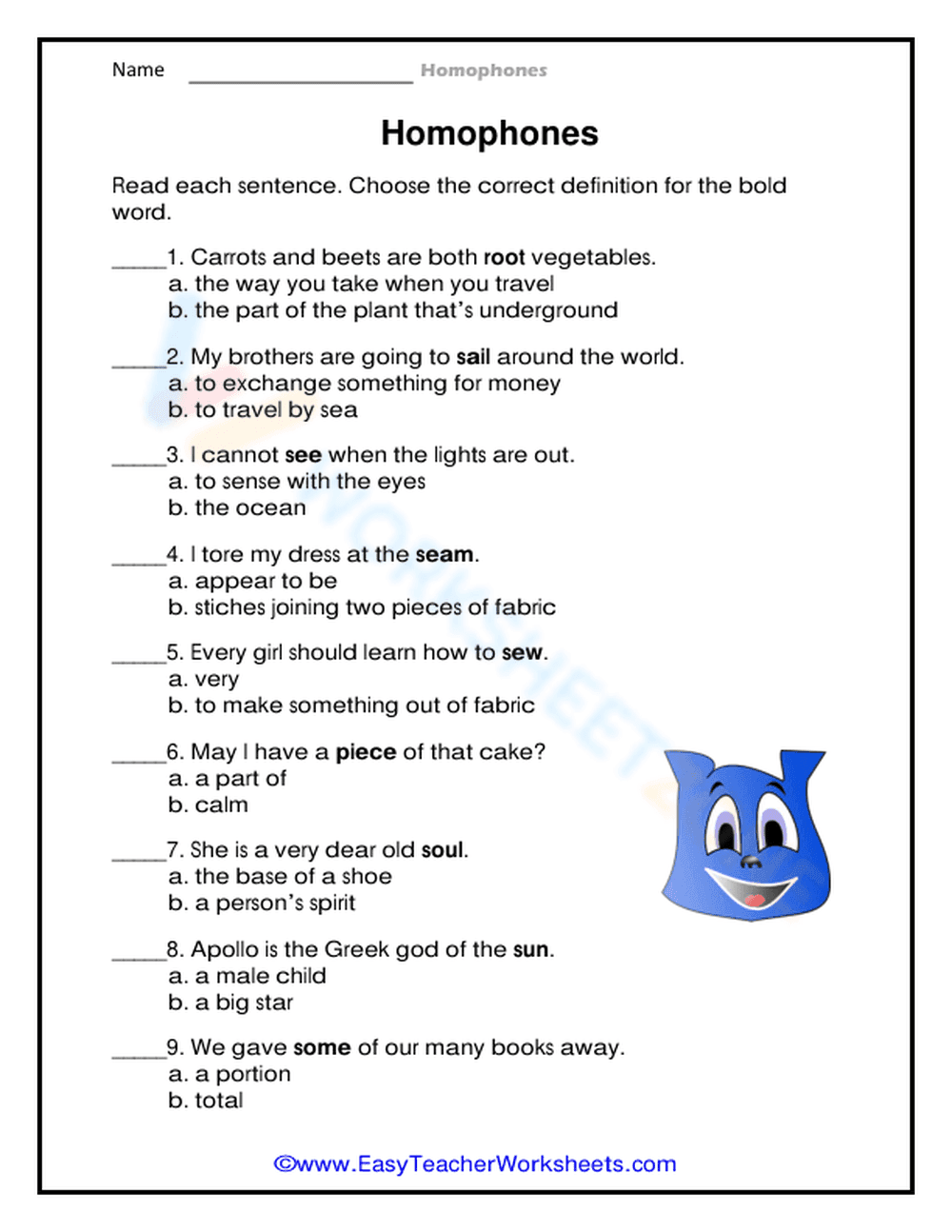

Essential Homophones Worksheet | Grade 2 English
Paste this activity's link or code into your existing LMS (Google Classroom, Canvas, Teams, Schoology, Moodle, etc.).
Students can open and work on the activity right away, with no student login required.
You'll still be able to track student progress and results from your teacher account.
This homophones worksheet helps Grade 2 students distinguish between words that sound the same but have different meanings and spellings. By analyzing nine specific sentences, learners use context clues to select the correct definition for bolded terms. This focused practice builds vocabulary precision and strengthens reading comprehension skills through direct, structured application of language rules.
At a Glance
- Grade: 2 · Subject: English Language Arts
- Standard:
CCSS.ELA-LITERACY.L.2.4— Use context clues to determine the meaning of multiple-meaning words.- Skill Focus: Homophones and Context Clues
- Format: 1 page · 9 problems · Answer key included · PDF
- Best For: Independent practice and vocabulary reinforcement
- Time: 15–20 minutes
What's Inside
Inside this resource, you will find a clean, one-page layout featuring nine distinct sentence-based exercises. Each item presents a bolded homophone within a realistic narrative context, followed by two multiple-choice definitions. This structure requires students to look beyond the word itself to the surrounding text for meaning. The worksheet is designed for immediate use with a clear title and space for student names.
Skill Progression
This worksheet follows a logical progression to ensure student success and mastery of vocabulary nuances.
- Guided Practice: The first items feature high-frequency homophones like 'root' and 'sail' with distinct meanings to build initial confidence.
- Supported Practice: Middle items introduce more nuanced distinctions, such as 'seam' and 'sew,' requiring closer attention to sentence structure.
- Independent Practice: The final items challenge students to apply context-clue strategies to more abstract concepts like 'soul' without teacher assistance.
This ensure students move toward deeper semantic understanding and retention.
Standards Alignment
This resource is primary aligned to `CCSS.ELA-LITERACY.L.2.4`, which requires students to determine the meaning of unknown and multiple-meaning words using context. It also supports the application of sentence-level context as a clue to meaning. Both standard codes can be copied directly into lesson plans, IEP goals, or district curriculum mapping tools.
How to Use This Worksheet
Use this worksheet as a formative assessment after a lesson on homophones. Observe if students are reading the entire sentence or guessing based on word pairs. Alternatively, assign it as a morning work task or a low-prep sub plan activity to reinforce vocabulary. Completion typically takes 15 minutes.
Who This Resource Is For
This worksheet is ideal for second-grade students mastering basic grammar conventions and English Language Learners who need support with word nuances. It pairs naturally with a homophone anchor chart or a short reading passage that highlights multiple-meaning words. Differentiation is achieved by providing sentence frames for students who require additional support.
The CCSS.ELA-LITERACY.L.2.4 standard focuses on the student's ability to determine or clarify the meaning of unknown and multiple-meaning words and phrases based on grade-level reading and content. This homophones worksheet specifically targets the use of sentence-level context as a clue to the meaning of a word or phrase, a critical component of early literacy development. According to the RAND AIRS 2024 report, explicit instruction in vocabulary strategies, including the identification of homophones and their distinct meanings within varied linguistic environments, significantly correlates with long-term reading comprehension gains in primary grades. By isolating specific word pairs such as root/route or sea/see, this resource reduces cognitive load while encouraging students to engage in semantic analysis. These structured exercises provide the repetition necessary for orthographic mapping and vocabulary retention. Teachers can utilize this printable tool to assess student mastery of nuanced language conventions and identify specific areas for intervention.


