


























Views
Downloads
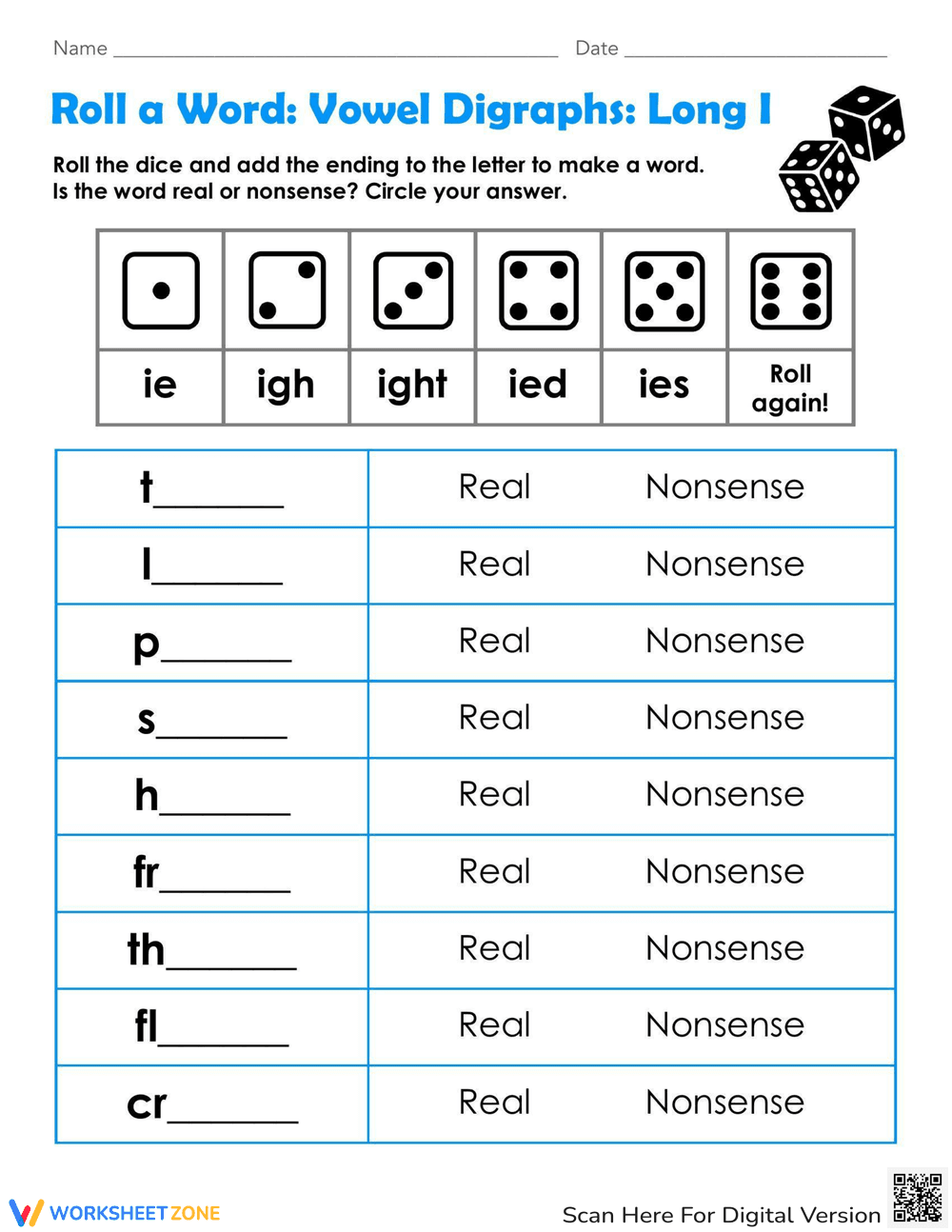

Long I Vowel Digraphs — Printable No-Prep Worksheet
Paste this activity's link or code into your existing LMS (Google Classroom, Canvas, Teams, Schoology, Moodle, etc.).
Students can open and work on the activity right away, with no student login required.
You'll still be able to track student progress and results from your teacher account.
This Grade 1–2 phonics worksheet builds long I vowel digraph decoding by having students roll a die, construct words from given onsets and digraph endings, then sort each result as a real word or nonsense word — all on one self-contained page requiring zero teacher setup.
At a Glance
- Grade: 1–2 · Subject: ELA / Phonics
- Standard:
RF.1.3.C— Know and apply long-vowel spellings for common vowel teams- Skill Focus: Long I vowel digraphs (ie, igh) — word building and real/nonsense word discrimination
- Format: 1 page · 12 problems · Open-ended activity · PDF
- Best For: Independent center work or sub plans
- Time: 15–20 minutes
Inside: one structured roll-a-word grid where students pair a beginning letter with one of several long I digraph endings (ie, igh) generated by a die roll. Each row prompts students to write the formed word, then circle Real Word or Nonsense Word. No word bank is required — the onset and ending options are printed directly on the sheet. Open-ended design means repeated use across multiple sessions.
Zero-Prep Workflow
- Print — one sheet per student, black-and-white friendly; takes under 60 seconds.
- Distribute — hand out with a single die per student or pair; no additional materials needed.
- Review — scan completed grids in under 2 minutes; real/nonsense sort doubles as instant formative data.
Total teacher prep time: under 2 minutes. Ideal for substitute plans — directions are fully self-explanatory on the page.
Standards Alignment
Primary standard: RF.1.3.C — Know final -e and common vowel team conventions for representing long vowel sounds. Supporting standard: RF.2.3.A — Distinguish long and short vowels when reading regularly spelled one-syllable words. Both standard codes can be copied directly into lesson plans, IEP goals, or district curriculum mapping tools.
How to Use It
Use during a phonics center rotation after direct instruction on ie and igh patterns — students apply the pattern immediately with low-stakes repetition. Use after a whole-group lesson as a quick independent check: if a student consistently marks real words as nonsense, flag for small-group reteach. Expected completion: 15–20 minutes for most Grade 1–2 readers.
Who It's For
Grade 1 and Grade 2 readers building automaticity with long vowel teams. Students who need repeated exposure benefit from the open-ended roll format — different die outcomes produce different word attempts each session. Pairs naturally with an ie/igh anchor chart or a decodable reader featuring words like tie, pie, night, and light.
Phonics fluency with vowel digraphs is a documented predictor of early reading success. Standard RF.1.3.C targets students' ability to apply long-vowel spelling conventions — specifically vowel teams like ie and igh — to decode unfamiliar words. NAEP data consistently show that students who master vowel team patterns by end of Grade 2 outperform peers in oral reading fluency benchmarks. Fisher & Frey (2014) identify structured word-building tasks — where students generate, test, and categorize words — as high-leverage practice for phonics consolidation. This worksheet operationalizes that model: students produce a word, evaluate its lexical status, and record both steps, creating a brief written artifact teachers can review for targeted feedback without additional assessment tools.


