


























Views
Downloads

Printable Dinosaur Puns Worksheet for Grade 3
Paste this activity's link or code into your existing LMS (Google Classroom, Canvas, Teams, Schoology, Moodle, etc.).
Students can open and work on the activity right away, with no student login required.
You'll still be able to track student progress and results from your teacher account.
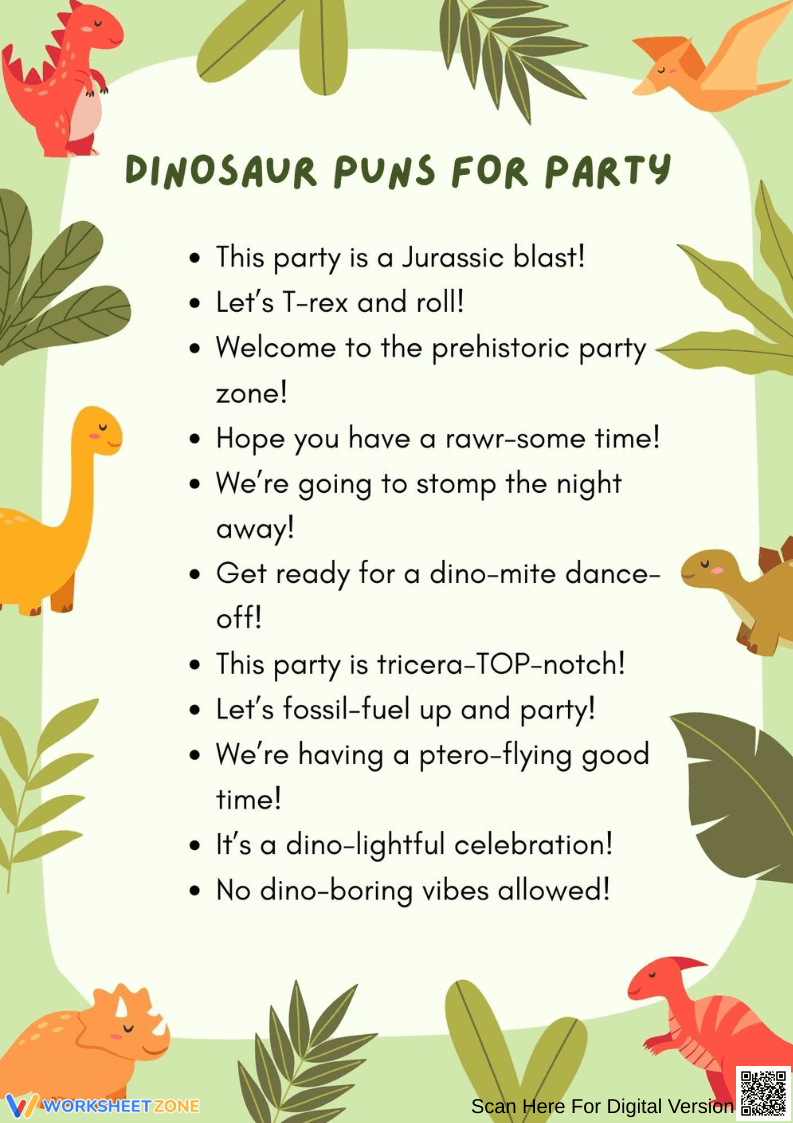
This printable ELA resource introduces elementary students to wordplay and figurative language through eleven humorous dinosaur-themed puns. Students read, analyze, and discuss the double meanings behind prehistoric jokes to build vocabulary and comprehension. It provides an engaging hook for creative writing lessons or classroom celebrations.
At a Glance
- Grade: Grade 3 · Subject: ELA
- Standard:
CCSS.ELA-LITERACY.L.3.5— Understand word relationships and nuances in word meanings- Skill Focus: Puns and wordplay
- Format: 1 page · 11 problems · Answer key included · PDF
- Best For: ELA warm-ups and creative writing hooks
- Time: 10–15 minutes
What's Inside
This single-page PDF contains eleven carefully selected dinosaur puns designed to illustrate how homophones and double meanings function in English. The layout features colorful dinosaur illustrations that frame the text, making it visually appealing for young learners. It serves as a clean, self-explanatory reference sheet without complex instructions, allowing students to immediately focus on the linguistic structure of each pun.
Zero-Prep Workflow
Implement this resource with a simple three-step workflow. First, print the single-page document in under one minute. Second, distribute the sheet to students during transition periods, requiring zero explanation. Third, review the puns as a group in five minutes, prompting students to identify the double meanings. This process requires less than two minutes of teacher preparation, making it an ideal sub plan.
Standards Alignment
This worksheet aligns directly with the Common Core State Standard CCSS.ELA-LITERACY.L.3.5, which requires students to demonstrate understanding of figurative language, word relationships, and nuances in word meanings. By analyzing how words like "T-rex" and "dino-mite" substitute for common phrases, students practice decoding non-literal language. Both standard codes can be copied directly into lesson plans, IEP goals, or district curriculum mapping tools.
How to Use It
Use this resource as a transition hook before starting a creative writing unit. Have students select one pun and write a short story explaining the joke, which helps assess comprehension. Alternatively, use it as a formative assessment tool during direct instruction; ask students to circle the target word in each pun and write its literal homophone on the back. This activity takes fifteen minutes.
Who It's For
This resource is designed for second and third-grade students learning to distinguish between literal and non-literal language. It is highly beneficial for English language learners who need explicit exposure to English idioms, homophones, and cultural wordplay. Pair this sheet with a narrative text about dinosaurs or an anchor chart on figurative language to reinforce vocabulary acquisition.
This ELA resource supports the development of semantic awareness and figurative language comprehension, aligning with the CCSS.ELA-LITERACY.L.3.5 standard for grade-level word relationships. Research from Fisher & Frey (2014) emphasizes that explicit instruction in wordplay, such as puns and double meanings, enhances metalinguistic awareness and vocabulary depth in elementary students. By analyzing these eleven dinosaur-themed puns, learners practice identifying how context alters word meaning, bridging the gap between literal decoding and advanced reading comprehension. The structured, visual presentation helps scaffold this linguistic analysis for diverse learners, making abstract wordplay concrete. Educators can utilize this printable reference sheet to quickly assess student understanding of non-literal language during formative ELA blocks. This evidence-based approach ensures that vocabulary acquisition remains engaging while meeting rigorous state standards for language development. This resource serves as a practical tool for teachers seeking to integrate humor into standard-aligned literacy lessons.


