


























Views
Downloads
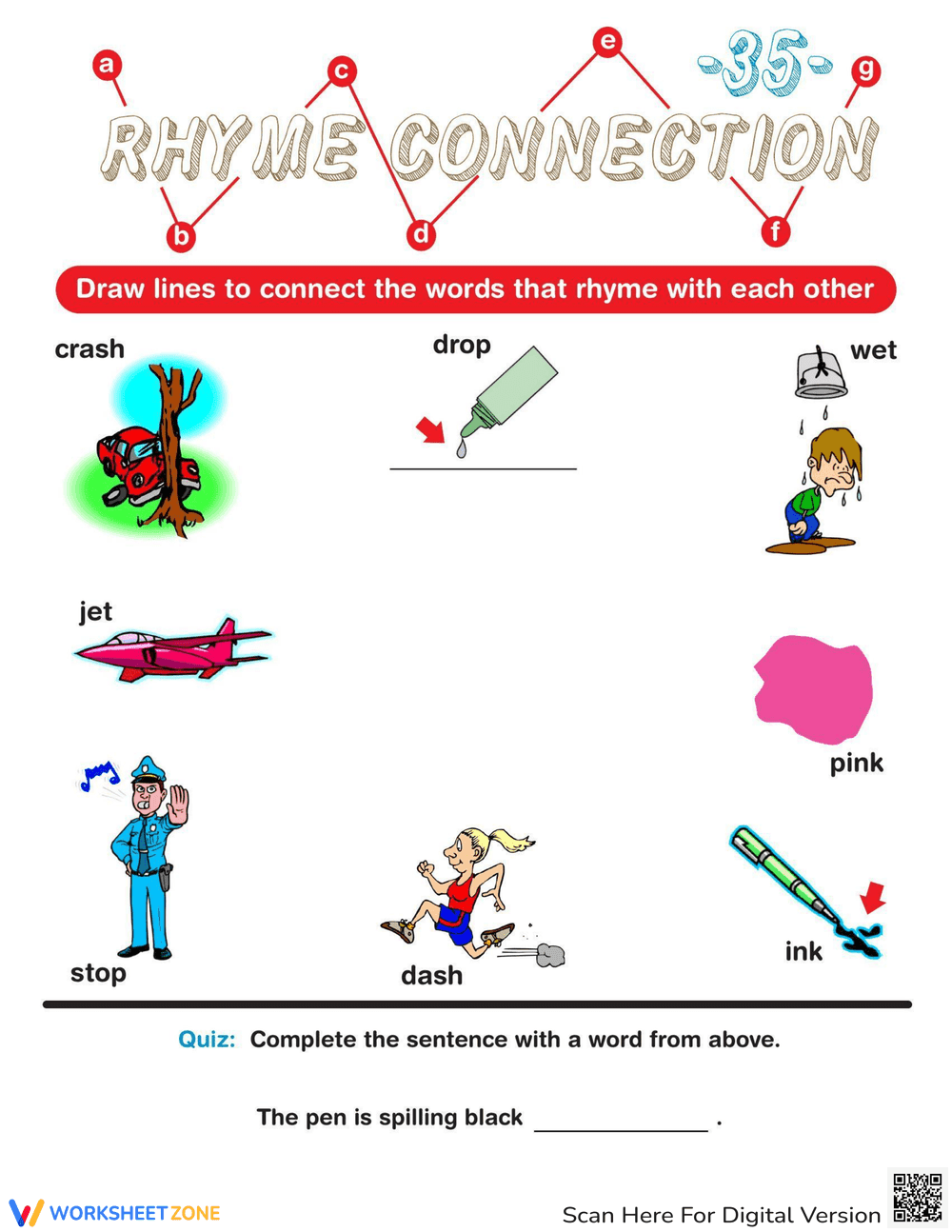

Grade 3 Rhyming Words — Printable No-Prep Worksheet
Paste this activity's link or code into your existing LMS (Google Classroom, Canvas, Teams, Schoology, Moodle, etc.).
Students can open and work on the activity right away, with no student login required.
You'll still be able to track student progress and results from your teacher account.
This ready-to-use rhyming words worksheet helps third and fourth-grade students strengthen their phonological awareness and vocabulary skills. By matching rhyming pairs and completing a sentence with the correct word, learners build essential reading fluency and spelling pattern recognition in a fun, visual format.
At a Glance
- Grade: 3 · Subject: ELA
- Standard:
CCSS.ELA-LITERACY.RF.3.3— Apply grade-level phonics and word analysis skills- Skill Focus: Rhyming Words
- Format: 1 page · 5 problems · Answer key included · PDF
- Best For: Independent practice
- Time: 10–15 minutes
Inside this single-page resource, students will find a highly visual matching activity featuring eight illustrated vocabulary words. Learners draw lines to connect four pairs of rhyming words, such as "crash" and "dash" or "jet" and "wet." The worksheet concludes with a fill-in-the-blank sentence quiz that requires students to apply one of the vocabulary words in context, reinforcing both phonics and reading comprehension.
This resource is designed for a smooth, zero-prep classroom workflow:
- Print (1 minute): Simply download the PDF and print a class set. No special materials or cutting required.
- Distribute (1 minute): Hand out the worksheet as a quick warm-up or transition activity.
- Review (3 minutes): Go over the four matching pairs and the single sentence completion together as a class.
Total teacher prep time is under two minutes, making this an excellent, reliable option for emergency sub plans or unexpected schedule changes.
This activity aligns with CCSS.ELA-LITERACY.RF.3.3: Know and apply grade-level phonics and word analysis skills in decoding words. It also supports vocabulary acquisition by having students use context clues to complete the final sentence. Both standard codes can be copied directly into lesson plans, IEP goals, or district curriculum mapping tools.
Deploy this worksheet during morning work to activate students' phonics skills before direct instruction begins. It also serves perfectly as an independent literacy center activity while the teacher works with small groups. As a formative assessment tip, observe whether students rely on the visual illustrations or the spelling patterns to find their matches. Expect students to complete this activity in 10 to 15 minutes.
This worksheet is ideal for third and fourth-grade students needing foundational phonics reinforcement. The clear illustrations provide excellent scaffolding for English Language Learners (ELLs) and visual learners who benefit from picture cues alongside text. Pair this resource with a read-aloud of a rhyming picture book or a direct instruction lesson on common spelling families to maximize its impact.
Developing strong phonological awareness through activities like rhyming is a critical component of early and intermediate literacy instruction. According to a recent ScienceDirect TpT Analysis, explicit practice with word families and spelling patterns significantly improves students' decoding speed and overall reading comprehension. By targeting CCSS.ELA-LITERACY.RF.3.3, this worksheet ensures learners actively apply grade-level phonics and word analysis skills in a structured format. When students connect words that share auditory and visual spelling patterns, they build the essential neural pathways required for fluent, automatic reading. Furthermore, the combination of visual matching and contextual sentence completion provides a dual-layered approach to vocabulary acquisition. This evidence-based method supports long-term retention and helps bridge the gap between isolated phonics practice and authentic reading tasks, ensuring students are well-equipped for more complex texts as they progress through elementary school.


