


























Views
Downloads

Renewable Energy Guide | Grade 7 Essential Science
Paste this activity's link or code into your existing LMS (Google Classroom, Canvas, Teams, Schoology, Moodle, etc.).
Students can open and work on the activity right away, with no student login required.
You'll still be able to track student progress and results from your teacher account.
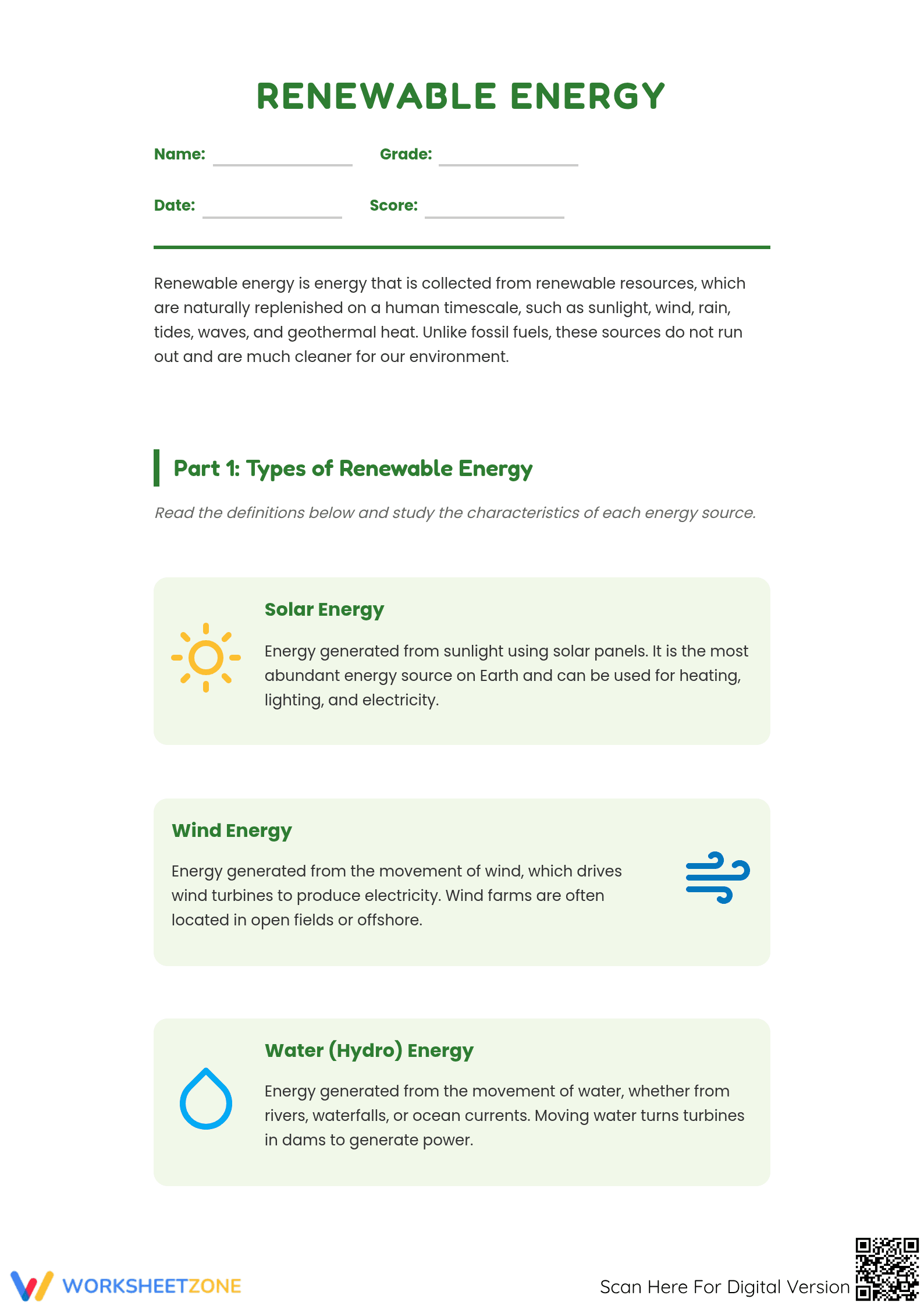
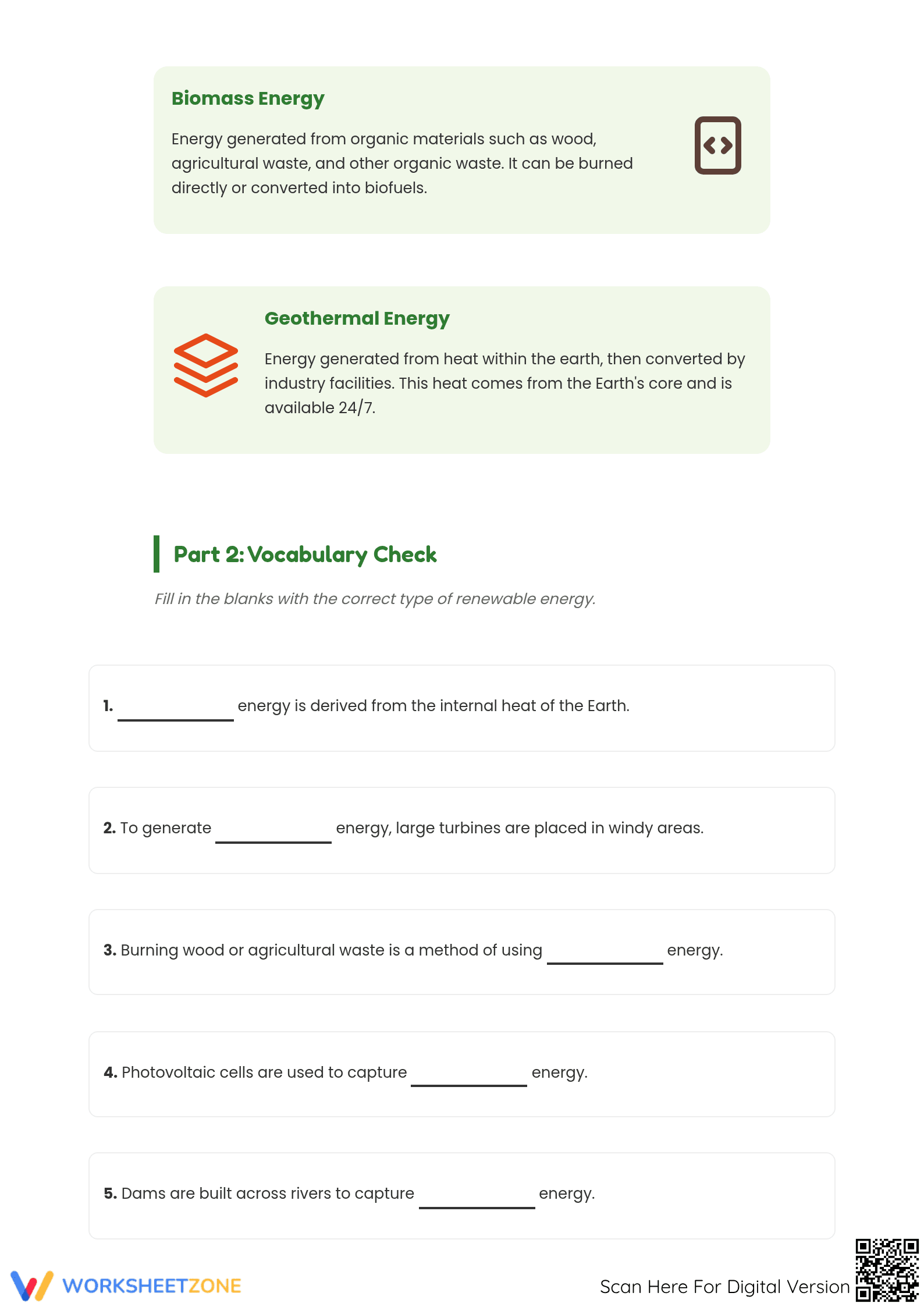
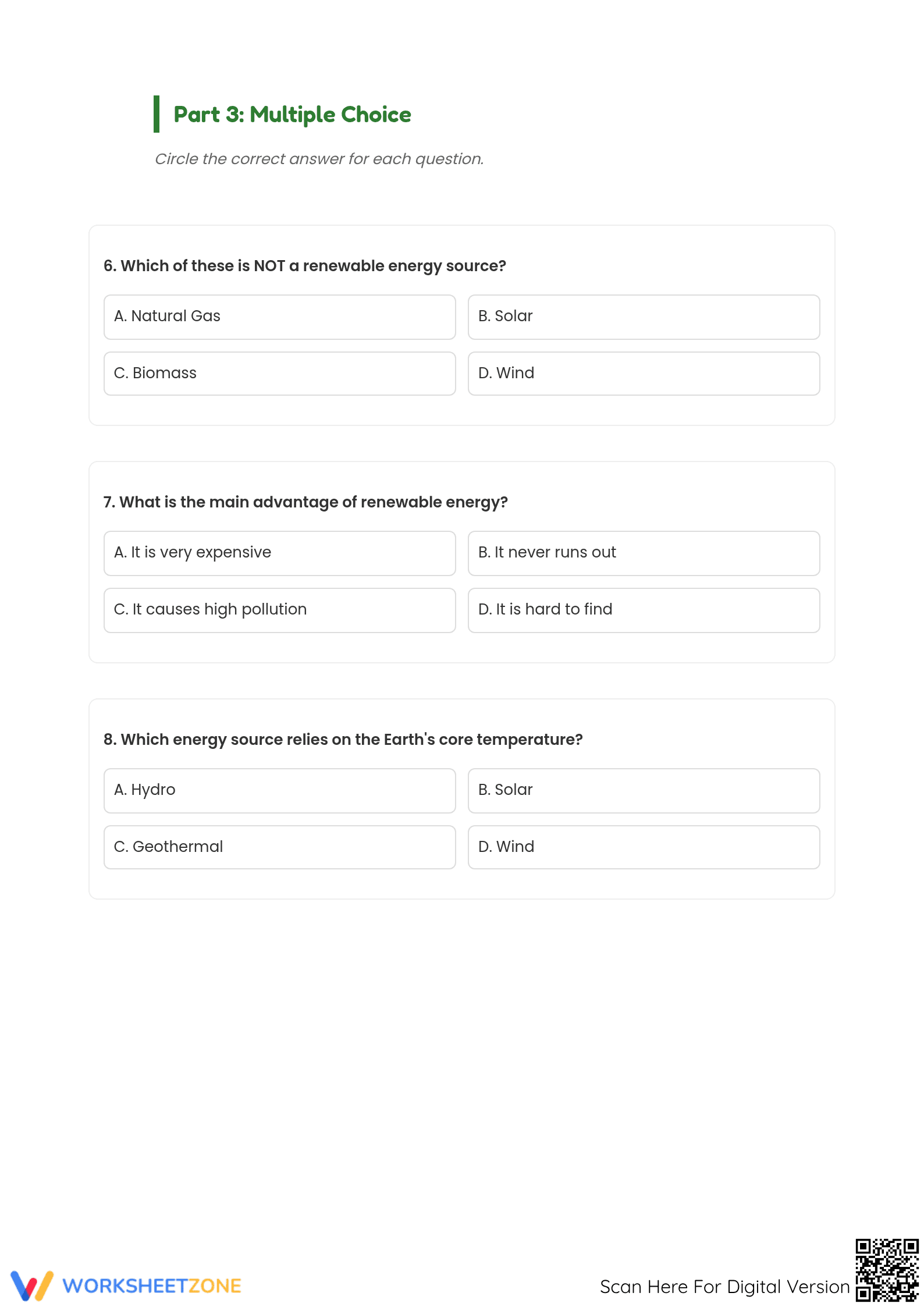
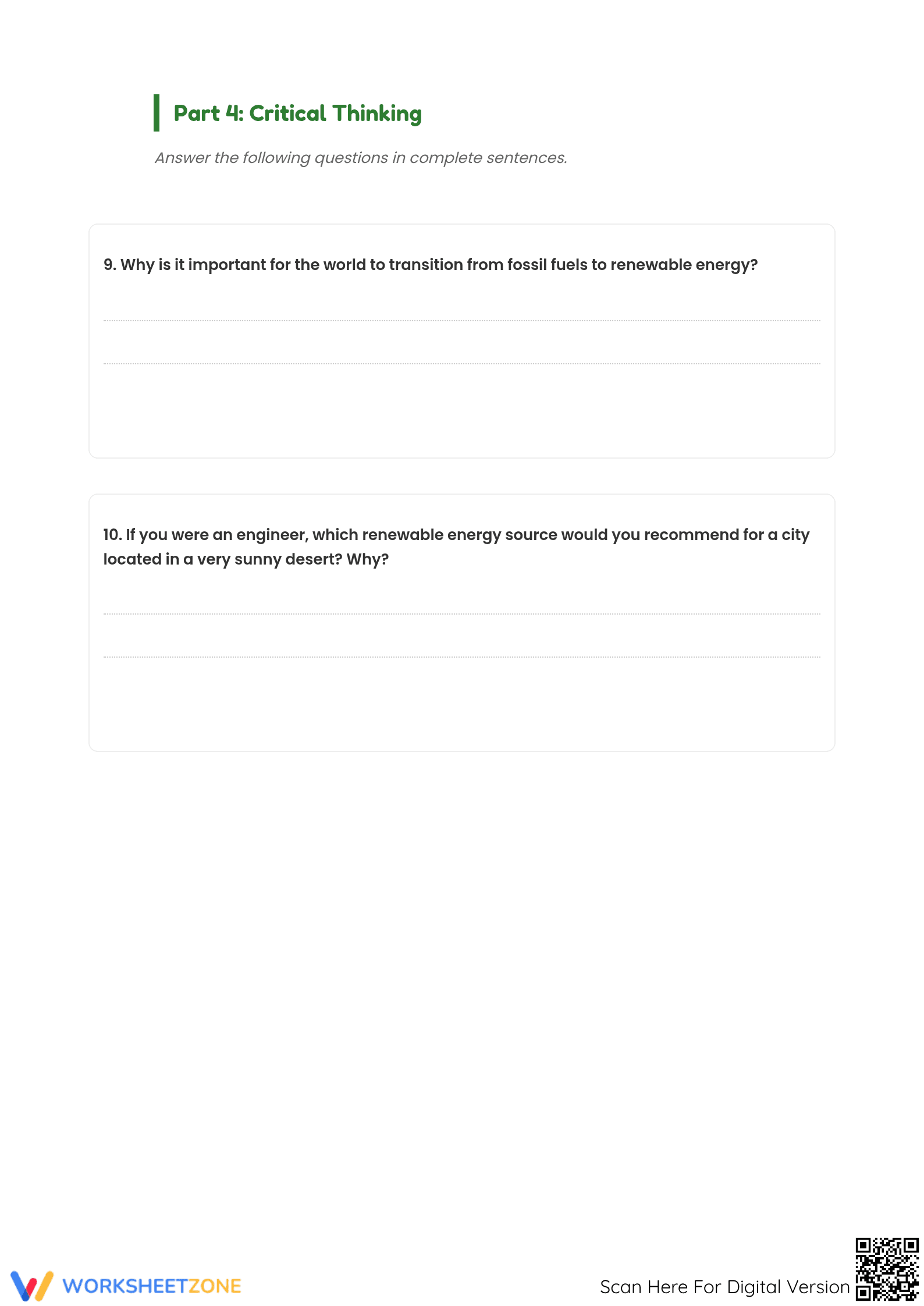
This Grade 7 science worksheet provides a clear, visual introduction to renewable energy sources. Students explore the fundamental definitions of solar, wind, water, biomass, and geothermal energy. By connecting natural processes to human utility, this resource helps learners distinguish between sustainable and finite resources while building a strong foundation for environmental science and earth systems.
At a Glance
- Grade: 7 · Subject: Science
- Standard:
MS-ESS3-1— Explain how Earth's mineral and energy resources are distributed and used- Skill Focus: Renewable energy identification
- Format: 1 page · 5 definitions · Answer key included · PDF
- Best For: Introductory lesson or science notebooking
- Time: 15–20 minutes
The worksheet features high-quality illustrations paired with concise definitions for five major renewable energy types. It includes solar, wind, water (hydroelectric), biomass, and geothermal energy. The layout is designed for readability, making it an excellent reference sheet or the basis for a matching activity. A digital version is also accessible via the included QR code.
The zero-prep workflow for this resource is designed for maximum efficiency. First, print the single-page PDF (30 seconds). Next, distribute the handout to students as a primary reference or a guided note-taking tool (1 minute). Finally, review the five energy types as a whole class or use the definitions for a quick formative exit ticket (5 minutes). Total teacher preparation time is under 2 minutes.
This resource aligns with MS-ESS3-1, focusing on the identification of energy resources. It also supports MS-PS3-5 by introducing how energy is transferred from natural sources into usable electricity. Both standard codes can be copied directly into lesson plans, IEP goals, or district curriculum mapping tools.
Use this worksheet during the "Explain" phase of a 5E lesson model to provide formal definitions after an initial inquiry activity. It also serves as a formative assessment tool; ask students to flip the page over and sketch one example of how a specific energy type is used in their local community. Expected completion time is 15 to 20 minutes.
This resource is ideal for middle school science students, including English Language Learners who benefit from the visual cues and clear, non-complex sentence structures. It pairs naturally with a classroom anchor chart on the carbon cycle or a direct instruction lesson on sustainable technology.
According to the RAND AIRS 2024 report, high-quality visual aids in science education significantly improve the retention of complex environmental concepts among middle school learners. This worksheet targets the MS-ESS3-1 standard, which requires students to understand the distribution and nature of Earth's energy resources. By providing clear definitions for solar, wind, water, biomass, and geothermal energy, the resource facilitates the plain-English skill of identifying sustainable energy sources and their origins. Research from Fisher & Frey (2014) emphasizes that scaffolded informational texts, like this infographic-style handout, support the gradual release of responsibility by providing a stable reference point for independent inquiry. Educators can use this tool to bridge the gap between abstract energy concepts and tangible environmental impacts. The inclusion of a QR code for digital access ensures that the material remains accessible in various instructional settings, supporting diverse classroom needs and technological integration.


