


























Views
Plays

Grade 3 Relative Pronouns — Printable No-Prep Worksheet
Paste this activity's link or code into your existing LMS (Google Classroom, Canvas, Teams, Schoology, Moodle, etc.).
Students can open and work on the activity right away, with no student login required.
You'll still be able to track student progress and results from your teacher account.
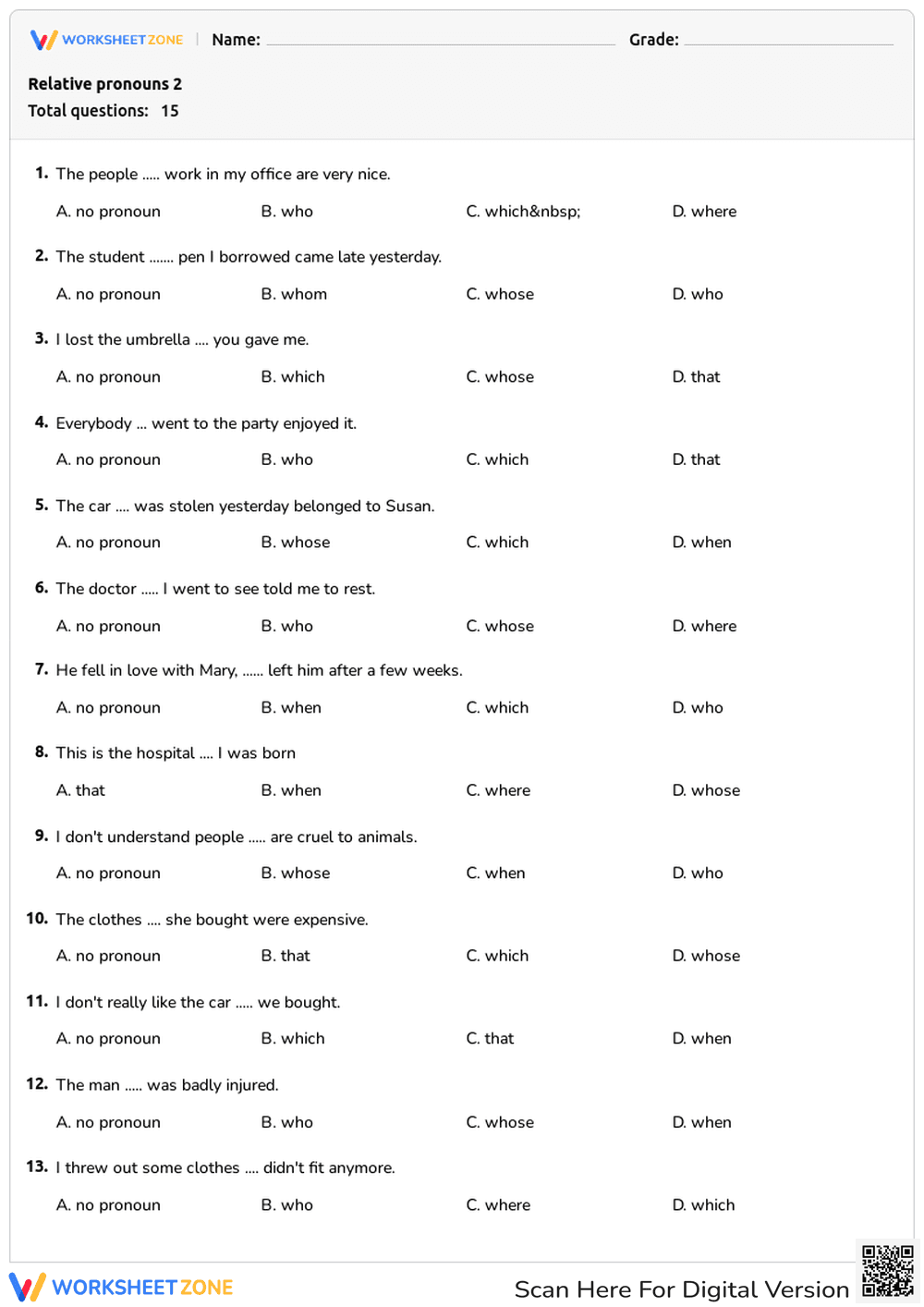
This Grade 3 grammar worksheet helps students master relative pronouns by selecting the correct word to complete each sentence. By practicing with words like who, which, whose, and where, learners will improve their sentence structure and reading comprehension skills.
At a Glance
- Grade: 3 · Subject: ELA
- Standard:
CCSS.ELA-LITERACY.L.3.1— Use pronouns correctly in sentences- Skill Focus: Relative Pronouns
- Format: 2 pages · 15 problems · Answer key included · PDF
- Best For: Independent practice
- Time: 10–15 minutes
What's Inside
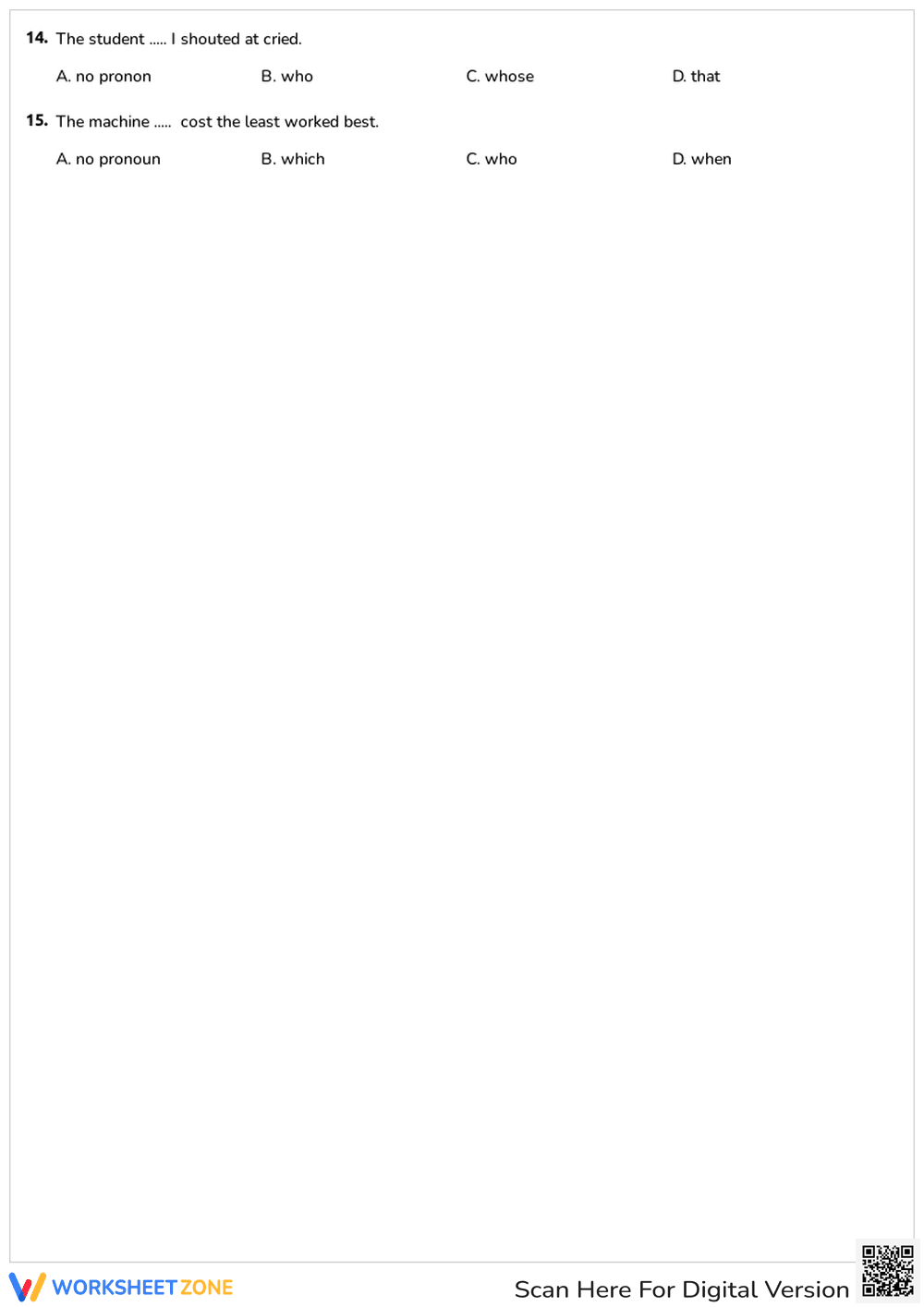
This two-page resource features 15 multiple-choice questions focused entirely on relative pronouns. Students read a sentence with a missing word and choose the correct pronoun from four options. The straightforward layout minimizes distractions, and a complete answer key is included to make grading fast and accurate.
Zero-Prep Workflow
- Print (1 minute): Simply download the PDF and print a class set. No special materials or cutting required.
- Distribute (1 minute): Hand out the two-page worksheet as a quick warm-up, center activity, or homework assignment.
- Review (3 minutes): Use the included answer key to quickly check student work or go over the answers together as a class.
Total teacher prep time is under two minutes, making this an ideal resource for emergency sub plans.
Standards Alignment
Aligned to CCSS.ELA-LITERACY.L.3.1: Demonstrate command of the conventions of standard English grammar and usage when writing or speaking. It also builds foundational skills for later grades where relative pronouns are explicitly tested. Both standard codes can be copied directly into lesson plans, IEP goals, or district curriculum mapping tools.
How to Use It
- Morning Work or Bell Ringer: Assign the first page as students enter the classroom to activate prior knowledge before a grammar lesson.
- Formative Assessment: Use the full 15-question quiz after direct instruction to gauge understanding. Observe whether students struggle specifically with "who" versus "whom" or "which" versus "that" to guide your next mini-lesson.
Expected completion time is 10 to 15 minutes.
Who It's For
This worksheet is designed for Grade 3 students, but it also serves as an excellent review for Grade 4 and Grade 5 students who need extra support with sentence mechanics. It pairs perfectly with a direct instruction lesson on complex sentences or a classroom anchor chart detailing the rules for different relative pronouns.
Mastering grammar conventions, specifically the accurate use of relative pronouns, is a critical step in developing reading fluency and writing complexity for young learners. According to Fisher & Frey (2014), explicit grammar instruction combined with targeted, independent practice significantly improves students' ability to construct meaningful sentences and comprehend complex informational texts. This worksheet directly supports CCSS.ELA-LITERACY.L.3.1 by requiring students to use pronouns correctly in sentences, bridging the gap between basic vocabulary and advanced syntax. By isolating this specific grammatical skill in a structured multiple-choice format, educators can quickly identify common misconceptions—such as confusing 'who' with 'which'—and provide immediate, targeted feedback. Consistent, focused practice with these foundational language mechanics ensures that learners can successfully transition from simple sentence structures to the more advanced, descriptive writing expected in upper elementary grades and beyond.


