


























Views
Plays

Grade 2 Reflexive Pronouns — Printable No-Prep Worksheet
Paste this activity's link or code into your existing LMS (Google Classroom, Canvas, Teams, Schoology, Moodle, etc.).
Students can open and work on the activity right away, with no student login required.
You'll still be able to track student progress and results from your teacher account.
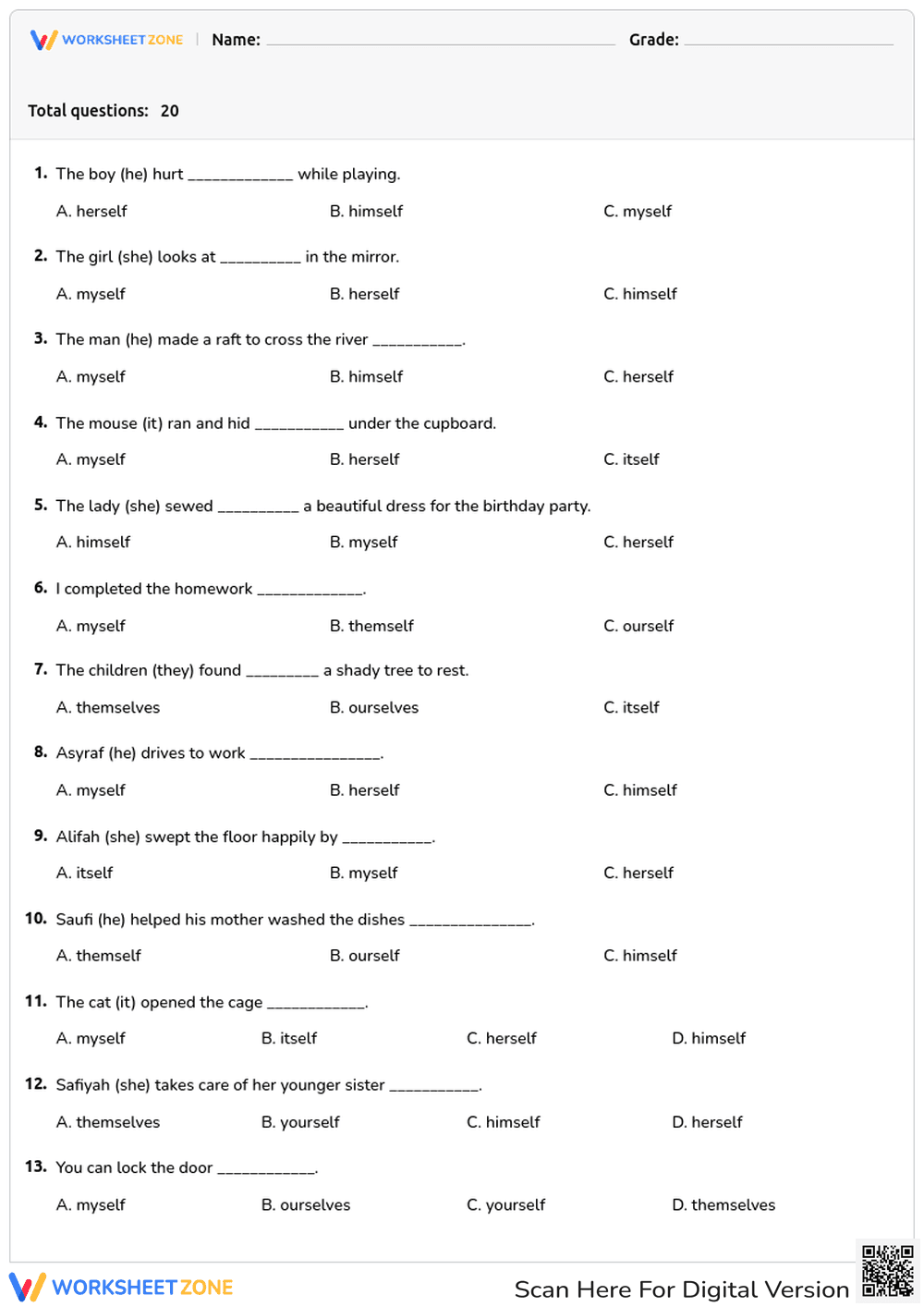
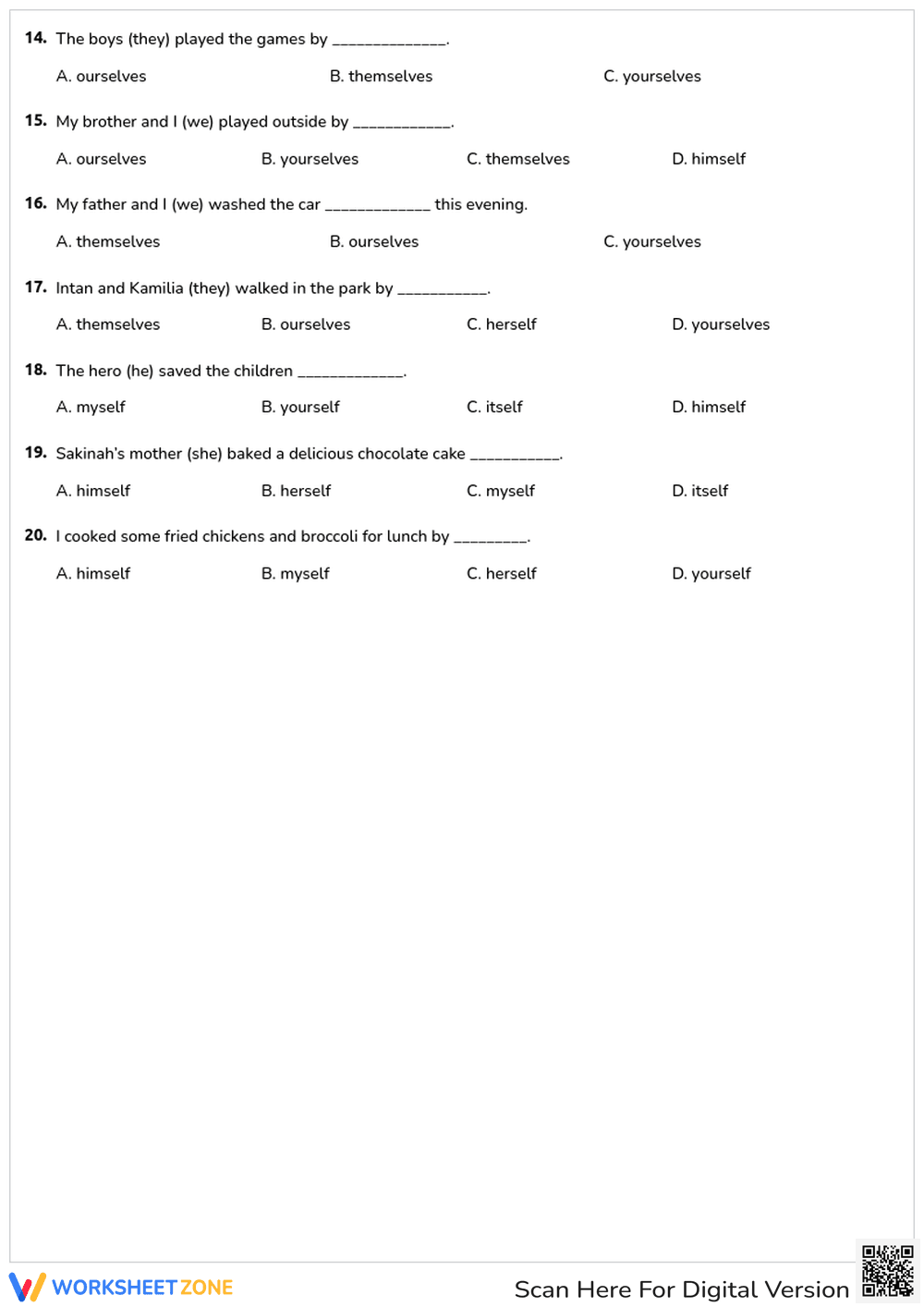
Reflexive pronouns are essential for Grade 2 students to master as they begin writing more complex sentences. This worksheet provides 20 targeted multiple-choice questions designed to help learners identify and apply the correct reflexive pronoun based on a given subject. By practicing these specific parts of speech, students improve their overall grammatical accuracy and sentence structure.
At a Glance
- Grade: 2 · Subject: ELA
- Standard:
CCSS.ELA-LITERACY.L.2.1.C— Use reflexive pronouns correctly in sentences to match the subject.- Skill Focus: Reflexive Pronouns
- Format: 2 pages · 20 problems · Answer key included · PDF
- Best For: Independent grammar practice and formative assessment
- Time: 15–20 minutes
What's Inside
This resource consists of two pages featuring 20 distinct multiple-choice items. Each question provides a sentence with a blank and includes the corresponding personal pronoun in parentheses (e.g., "he", "she", "it") to guide the student toward the correct reflexive choice. This structural support ensures that students focus on the relationship between the subject and the reflexive pronoun. A comprehensive answer key is provided for efficient checking.
Zero-Prep Workflow
- Print: Generate the two-page PDF in less than 1 minute.
- Distribute: Hand out the worksheets to the class in approximately 30 seconds.
- Review: Because the instructions are self-explanatory and include parenthetical hints, students can work independently. Reviewing the 20 answers as a whole class takes roughly 5 minutes.
This streamlined process makes the worksheet an ideal choice for emergency sub plans or busy morning work routines.
Standards Alignment
This worksheet aligns with CCSS.ELA-LITERACY.L.2.1.C, which requires students to use reflexive pronouns such as myself, ourselves, and themselves. It also supports general pronoun-antecedent agreement skills found in Grade 1 and Grade 3 frameworks. Both standard codes can be copied directly into lesson plans, IEP goals, or district curriculum mapping tools.
How to Use It
Use this worksheet as a formative assessment after a direct instruction lesson on pronouns. It is also an excellent choice for a "Do Now" activity or a quick exit ticket to gauge student understanding of the "self" and "selves" suffixes. Expected completion time is 15–20 minutes. Observe if students are correctly identifying the plural forms (ourselves vs. themselves) to determine if further instruction on plural subjects is needed.
Who It's For
This resource is ideal for Grade 2 general education students, but it also serves as a valuable tool for Grade 3 review or ESL/ELL students who are learning English pronoun structures. It pairs naturally with a pronoun anchor chart or a short reading passage where students can highlight reflexive pronouns in context.
According to Fisher & Frey (2014), the gradual release of responsibility model is most effective when students are provided with clear, scaffolded practice opportunities that bridge the gap between guided instruction and independent mastery. This reflexive pronouns worksheet applies this principle by providing 20 structured tasks that use parenthetical subject cues to support student decision-making. Mastery of CCSS.ELA-LITERACY.L.2.1.C is a critical milestone in early elementary grammar, as it allows students to express actions where the subject and object are the same, a concept that often requires explicit repetition to internalize. Research from the NAEP indicates that students who demonstrate strong command of pronoun-antecedent agreement in the primary grades are significantly more likely to succeed in complex narrative writing tasks in later years. This printable resource provides the high-repetition, low-stakes environment necessary for students to build the linguistic confidence required for fluent written expression.


