


























Views
Downloads
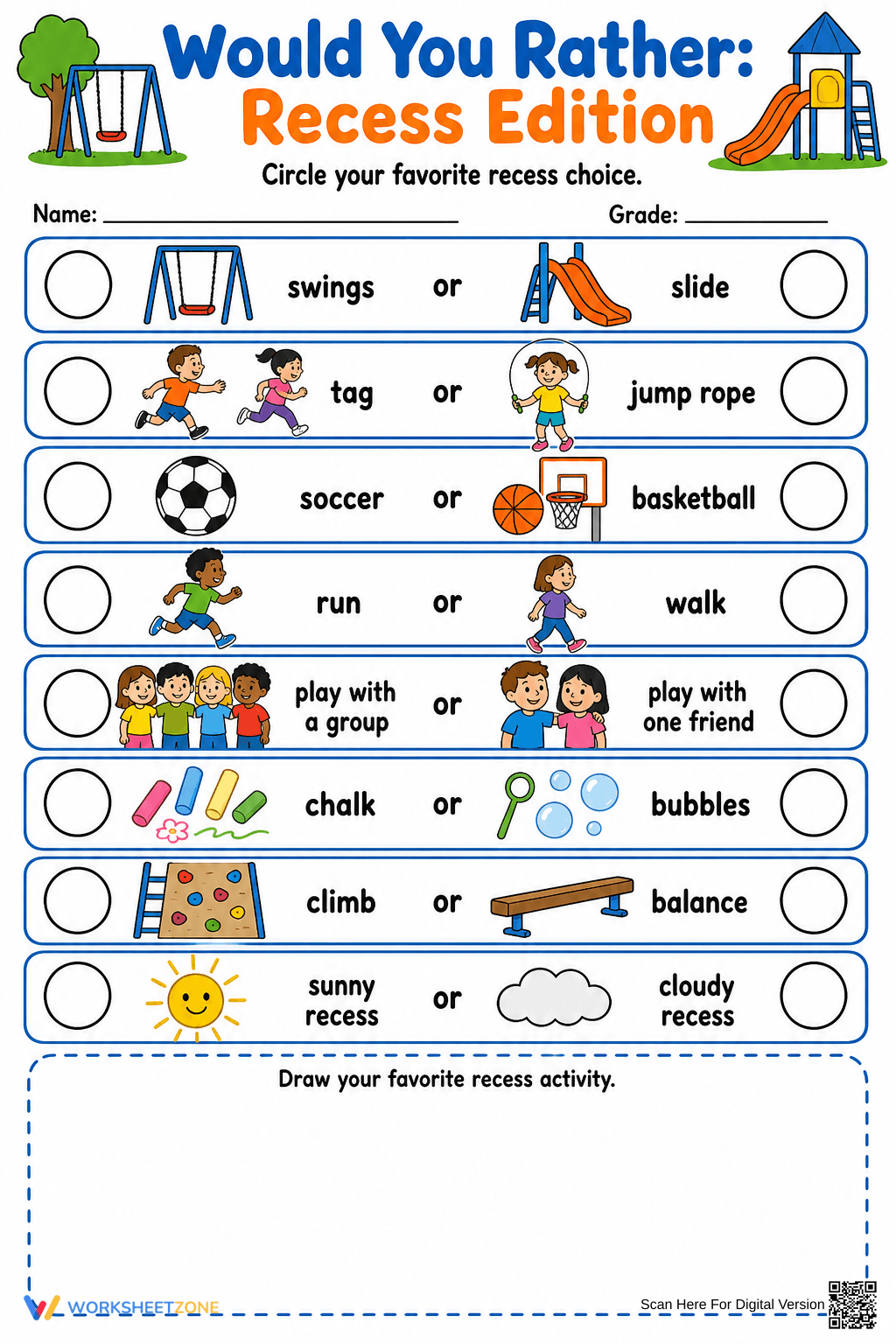

Recess Would You Rather — Printable Grade 1 Worksheet
Paste this activity's link or code into your existing LMS (Google Classroom, Canvas, Teams, Schoology, Moodle, etc.).
Students can open and work on the activity right away, with no student login required.
You'll still be able to track student progress and results from your teacher account.
This Grade 1 Recess Would You Rather worksheet helps students practice expressing personal preferences and participating in collaborative conversations. By choosing between playground activities, learners build the confidence to share opinions and justify their reasoning with peers. This activity serves as a foundational step toward structured argumentative writing and oral language skills.
At a Glance
- Grade: 1 · Subject: ELA
- Standard:
CCSS.ELA-LITERACY.SL.1.1— Participate in collaborative conversations with diverse partners about topics and texts- Skill Focus: Oral communication and opinion sharing
- Format: 1 page · 9 problems · Answer key included · PDF
- Best For: Morning meeting icebreaker or sub plan
- Time: 10–15 minutes
The resource features a clean, playground-themed layout with eight distinct choice pairs. Each pair includes high-quality icons and large text labels for activities like swings or slide and soccer or basketball. At the bottom, a dedicated drawing box allows students to illustrate their own favorite recess activity, providing a creative outlet for self-expression and fine motor practice.
- Print (30 seconds): Simply send the PDF to your printer; no special settings or double-sided printing required.
- Distribute (1 minute): Hand out the single-page sheet to students during morning meeting or as a transition activity.
- Review (5 minutes): Facilitate a quick four corners activity based on the choices to encourage peer interaction and verbal justification.
Total teacher preparation time is under two minutes, making this an ideal solution for unexpected schedule changes or substitute folders.
This worksheet is aligned with CCSS.ELA-LITERACY.SL.1.1, which requires students to participate in collaborative conversations with diverse partners about grade 1 topics and texts with peers and adults in small and larger groups. It specifically supports sub-standard A by encouraging students to follow agreed-upon rules for discussions. Both standard codes can be copied directly into lesson plans, IEP goals, or district curriculum mapping tools.
Use this worksheet as a formative assessment tool during the first week of school to observe student social dynamics and oral language proficiency. It also works well as a pre-writing brainstorm for an opinion paragraph. Observe how students explain their choices to a partner to gauge their ability to provide supporting reasons for their preferences during the 15-minute activity.
This resource is designed for early elementary students in Grades K–1, including English Language Learners (ELLs) who benefit from the heavy visual scaffolding provided by the icons. It pairs naturally with an anchor chart about Accountable Talk or a read-aloud book about playground friendship and inclusion.
According to research by Fisher & Frey (2014), providing students with structured opportunities for oral language practice is essential for developing literacy and social-emotional competence. This worksheet utilizes the Would You Rather format to lower the affective filter, allowing students to engage in low-stakes decision-making that mirrors real-world social interactions. By focusing on the familiar context of recess, the activity ensures that all students, regardless of academic background, have the prior knowledge necessary to participate. The inclusion of visual icons supports vocabulary acquisition for the primary standard CCSS.ELA-LITERACY.SL.1.1, facilitating inclusive classroom discussions. This approach aligns with evidence-based practices for early childhood education, emphasizing the transition from visual recognition to verbal articulation. Educators can use the resulting drawings and choices to inform future instructional groupings based on shared interests.


