




























Views
Downloads


Ready Winter-to-Spring Word Search | Grades 6–7 Science

Paste this activity's link or code into your existing LMS (Google Classroom, Canvas, Teams, Schoology, Moodle, etc.).
Students can open and work on the activity right away, with no student login required.
You'll still be able to track student progress and results from your teacher account.
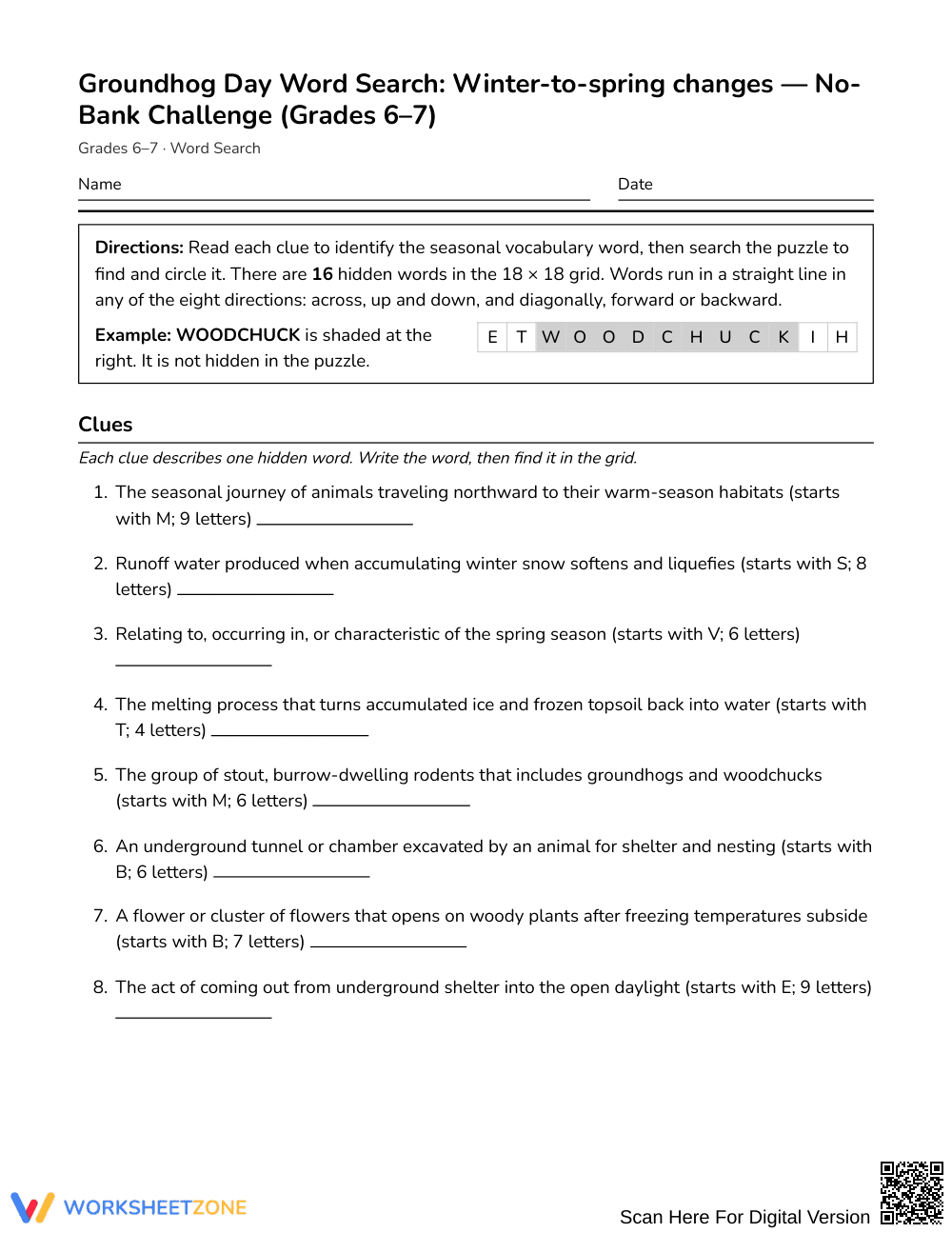
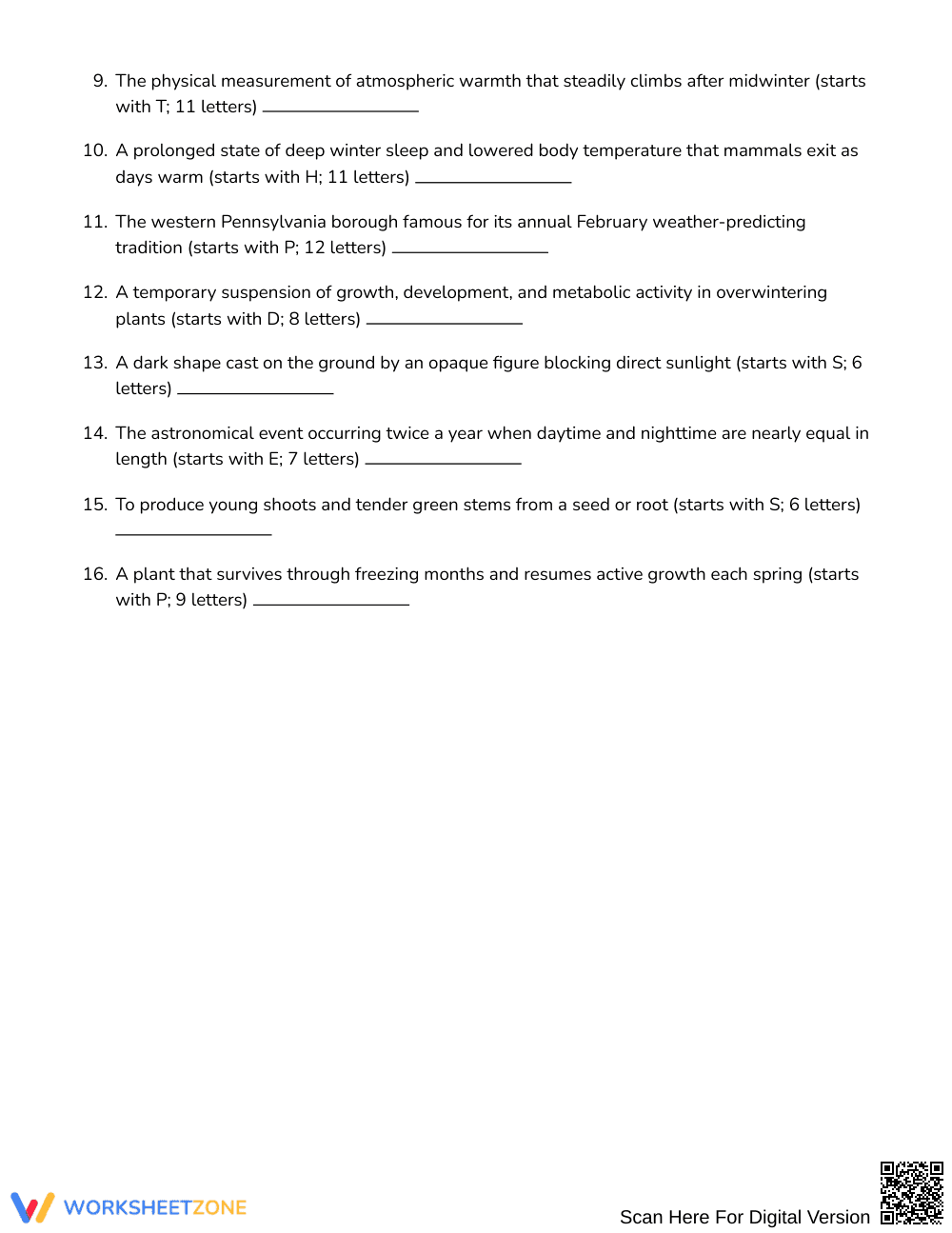
This seasonal science word search reinforces student understanding of winter-to-spring changes through targeted vocabulary retrieval. Designed for middle school learners in Grades 6–7, the activity prompts students to read scientific definitions, deduce 16 essential seasonal terms, and locate them within the puzzle matrix without relying on a pre-printed word list.
At a Glance
- Grade: Grades 6–7 · Subject: Science
- Standard: Not standards-assessed — vocabulary enrichment for seasonal earth and life science concepts
- Skill Focus: Winter-to-spring environmental changes and biological adaptations
- Format: 3 pages · 16 words · Complete answer key included · Printable PDF
- Best For: Groundhog Day seasonal science vocabulary reinforcement
- Time: 20–30 minutes
What's Inside
This 3-page printable resource includes an 18-by-18 letter grid, 16 clues spanning earth and biological sciences, and a 4-page answer key documenting complete word placements. Rather than copying terms from a standard word bank, students must read content-rich clue descriptions—covering concepts such as dormancy, vernal equinox, and migration—to deduce each term independently before searching the puzzle.
Puzzle Structure and Mechanics
The activity challenges learners through focused puzzle dynamics designed to build deductive reasoning alongside vocabulary retention:
- 18 x 18 Letter Matrix: The expansive letter grid embeds 16 target terms across dense letter arrangements to encourage systematic scanning.
- Eight Search Directions: Hidden terms run in all eight possible directions: north, northeast, east, southeast, south, southwest, west, and northwest, including reverse and diagonal placements.
- Clue-Driven No-Bank Challenge: Omitting a visual word bank requires students to actively retrieve conceptual knowledge from memory based on rigorous scientific definitions.
Standards Alignment
This resource serves as targeted vocabulary enrichment and is not aligned to an official state or national curriculum standard. Instead, it provides supplemental scientific language practice that supports broader middle school units on seasons, animal behavioral adaptations, and seasonal cycles.
How to Use It
Deploy this word search directly after introducing seasonal transitions or as a thematic Groundhog Day learning station. As an opening activity or post-lecture synthesis, students can work individually or in collaborative pairs to decode the clues. During the activity, conduct formative observations by checking whether students struggle with astronomical terms like equinox versus biological terms like dormancy; this quick check highlights which concepts require remediation. Expect completion within 20 to 30 minutes.
Who It's For
This puzzle is tailored for general education science classrooms in Grades 6–7 seeking engaging vocabulary reinforcement. For students needing additional support, teachers may supply the first letter of each hidden term as a scaffold, while advanced learners can be challenged to use each discovered word in an explanatory scientific paragraph. Pair this activity directly with an instructional unit on Earth's orbit and seasonal climatic shifts.
Developing robust scientific vocabulary requires active cognitive processing rather than passive word recognition. According to Fisher & Frey (2014), meaningful vocabulary acquisition accelerates when secondary students engage in intentional retrieval practice that links contextual definitions directly to domain-specific terminology. This 16-word seasonal science puzzle operationalizes retrieval practice by withholding the standard word bank, requiring middle school learners in Grades 6–7 to process academic descriptions of winter-to-spring biological and physical changes before conducting spatial visual searches across an 18-by-18 letter grid. By identifying phenomena such as photoperiod shifts, dormancy emergence, and vernal equinox conditions, students deepen semantic networks connecting seasonal astronomy with ecological responses. Educators can utilize this rigorous vocabulary enrichment exercise during February transition units to consolidate foundational concepts while systematically evaluating student mastery of essential seasonal science definitions in an engaging, self-directed instructional format.


