




























Views
Downloads

Ready Utility Jobs Word Search | Grades 6–7 Social Studies

Paste this activity's link or code into your existing LMS (Google Classroom, Canvas, Teams, Schoology, Moodle, etc.).
Students can open and work on the activity right away, with no student login required.
You'll still be able to track student progress and results from your teacher account.
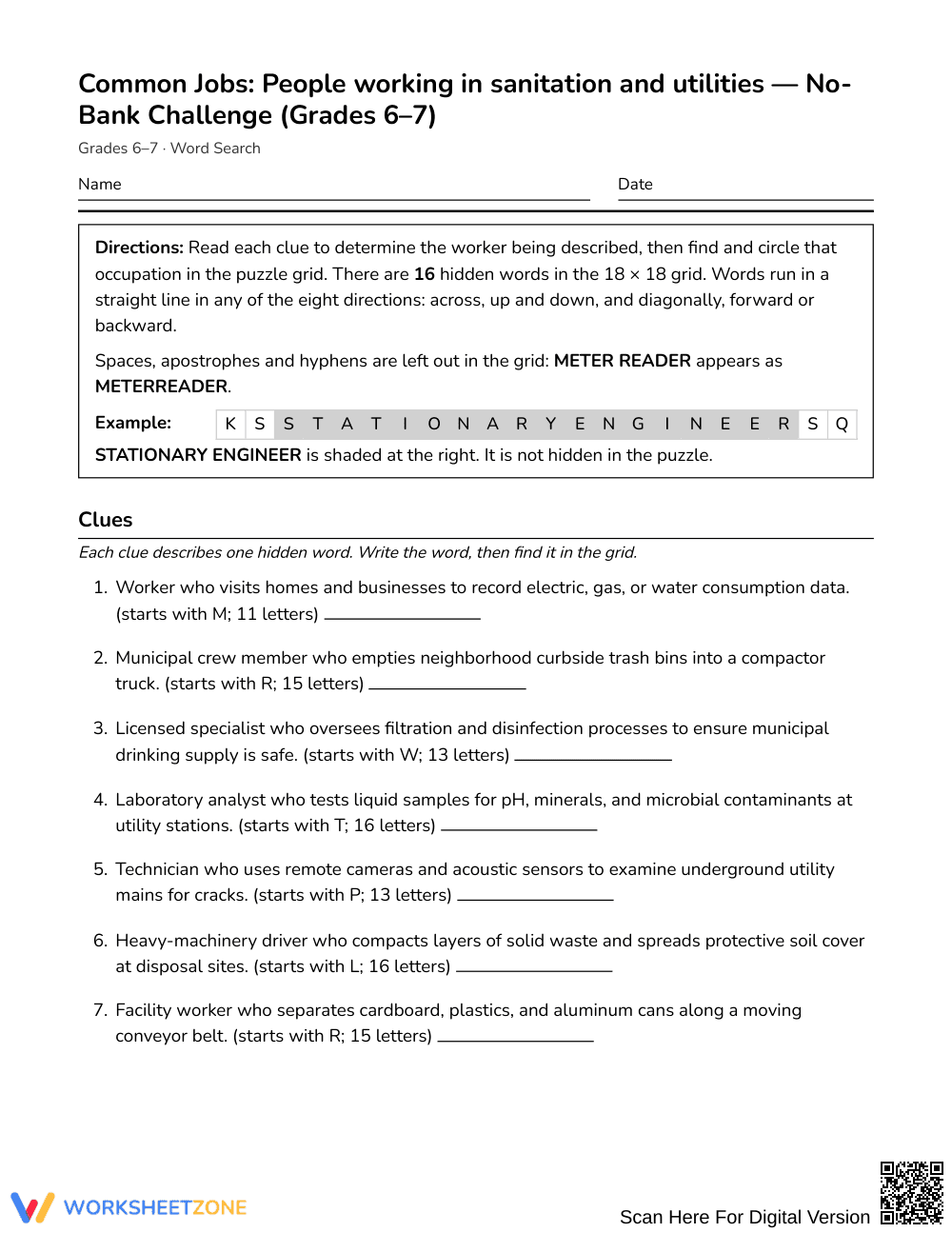
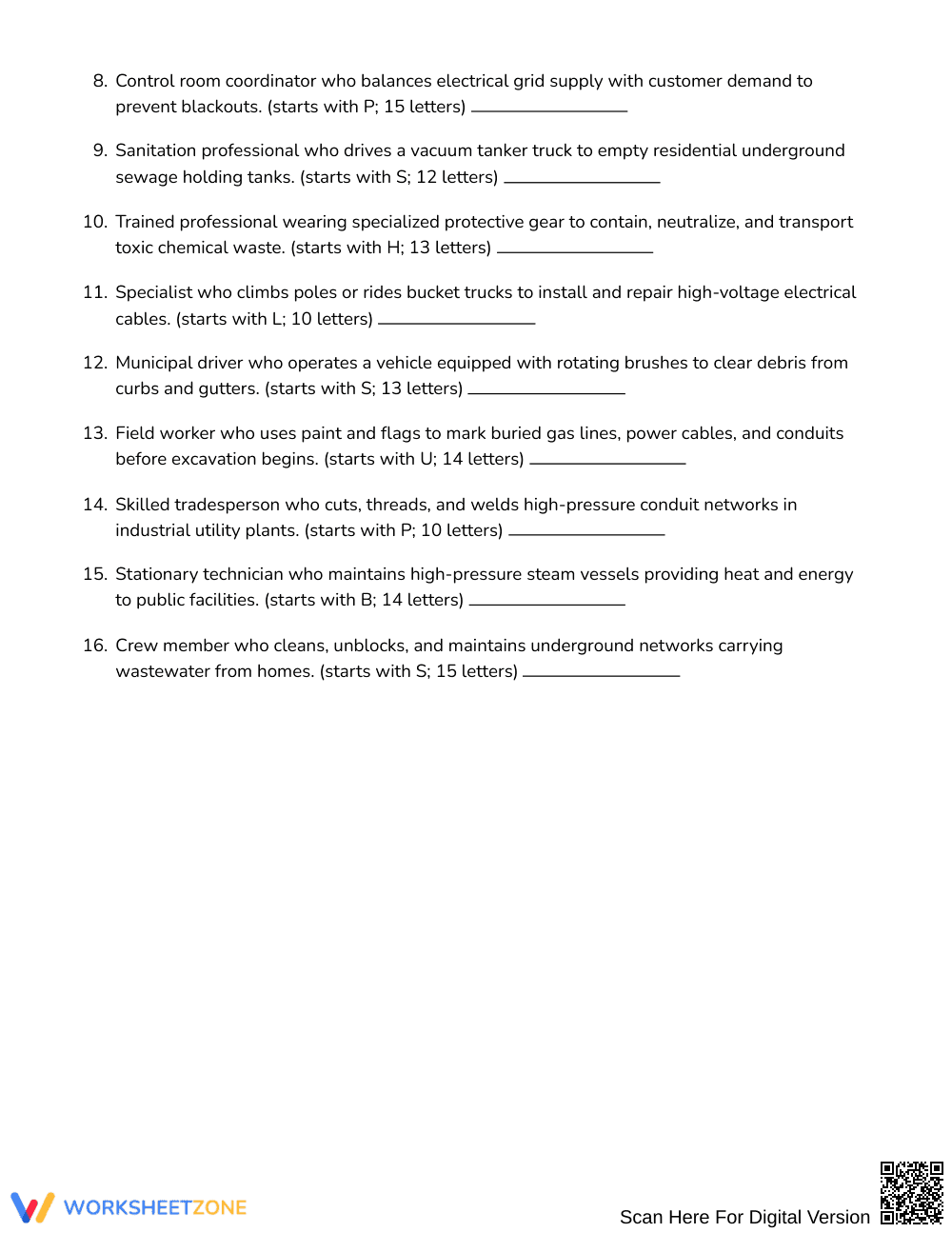
This social studies word search reinforces career awareness by challenging students to identify essential community workers in sanitation and public utilities. Middle school learners read 16 detailed job descriptions, deduce the matching occupations, and locate each hidden term within the puzzle grid, building key civil infrastructure vocabulary and understanding municipal operations.
At a Glance
- Grade: Grades 6–7 · Subject: Social Studies
- Standard: Not standards-assessed — vocabulary enrichment
- Skill Focus: Sanitation and utility careers
- Format: 3 pages · 16 words · Answer key included · PDF
- Best For: Community helpers unit vocabulary review
- Time: 25–35 minutes
What's Inside
This 3-page printable activity delivers a rigorous no-word-bank puzzle challenge paired with a 4-page answer key. Rather than scanning for a provided list of terms, students must read 16 technical occupational clues to deduce workers such as lineworkers, water operators, and pipefitters before searching the grid. The four-page solution reference provides clear coordinate overlays for rapid checking.
Puzzle Mechanics
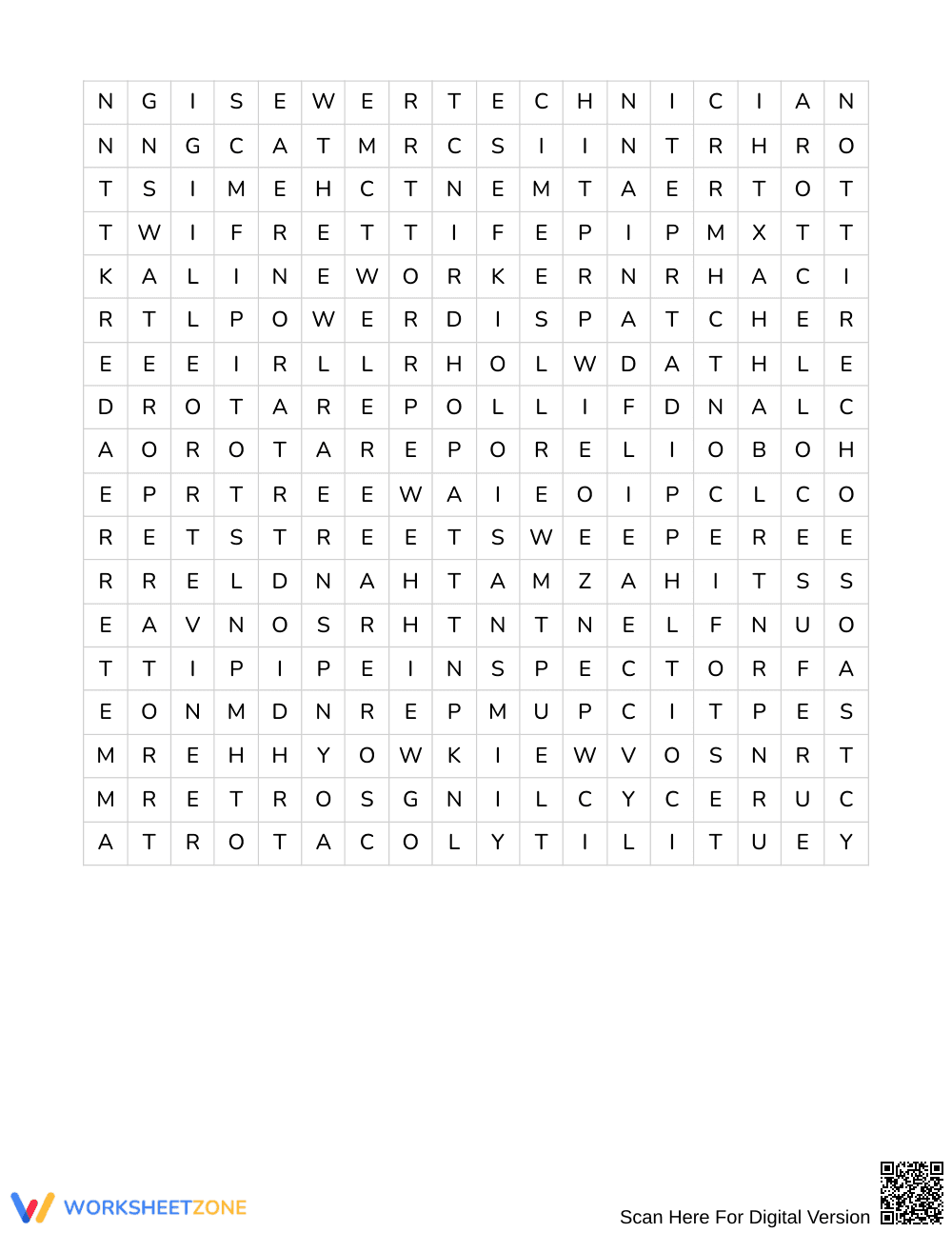
The activity centers on a dense 18 x 18 letter grid engineered for advanced search strategies. Because there is no word bank, students must rely entirely on 16 descriptive occupational clues to determine each target career before hunting for letters. Target words run in all eight compass directions: north, northeast, east, southeast, south, southwest, west, and northwest. This multidirectional arrangement requires thorough scanning across rows, columns, and diagonal lines, demanding focused visual tracking and active recall without pre-disclosed spellings.
Standards Alignment
This resource serves as targeted vocabulary enrichment and is not aligned to a formal state or national content standard. It reinforces social studies terminology within community helper and public utility units, helping middle school students develop career literacy and municipal system awareness through contextual clue analysis.
How to Use It
Deploy this word search during or after direct instruction on municipal infrastructure and community helpers. As an introductory exploration, assign the clue sheet first so student pairs discuss worker responsibilities before searching the grid. Alternatively, use it as an engaging mid-unit formative assessment: observe whether learners can deduce terms like treatment chemist or utility locator directly from operational definitions before scanning. Typical student completion time ranges from 25 to 35 minutes.
Who It's For
This activity is designed for Grades 6–7 social studies students studying public service careers, urban infrastructure, or civic economics. To support struggling readers, highlight key nouns within the clues or provide partial first-letter prompts. Pair this word search directly with an informational text or multimedia overview of municipal water and electrical grid operations to deepen conceptual context.
Integrating career-focused vocabulary enrichment into middle school social studies builds critical background knowledge regarding civic infrastructure and public service roles. When students analyze contextual definitions to identify sanitation and utility occupations, they practice active retrieval and domain-specific language acquisition. According to Fisher & Frey (2014), intentional exposure to disciplinary vocabulary through contextual problem-solving and structured clue analysis strengthens conceptual retention more effectively than rote memorization. This no-bank puzzle format requires learners to deduce target careers, including wastewater management and power distribution personnel, before engaging in visual search across an 18 x 18 grid. By linking municipal utility responsibilities to concrete professional titles, the activity deepens civic awareness and supports reading comprehension across informational texts. Educational research affirms that structured vocabulary tasks with embedded definitions enable early adolescents to establish meaningful cognitive connections between classroom content and real-world community infrastructure systems.


