




























Views
Downloads




Ready Union vs Intersection Worksheet | Grade 9 Algebra I

Paste this activity's link or code into your existing LMS (Google Classroom, Canvas, Teams, Schoology, Moodle, etc.).
Students can open and work on the activity right away, with no student login required.
You'll still be able to track student progress and results from your teacher account.
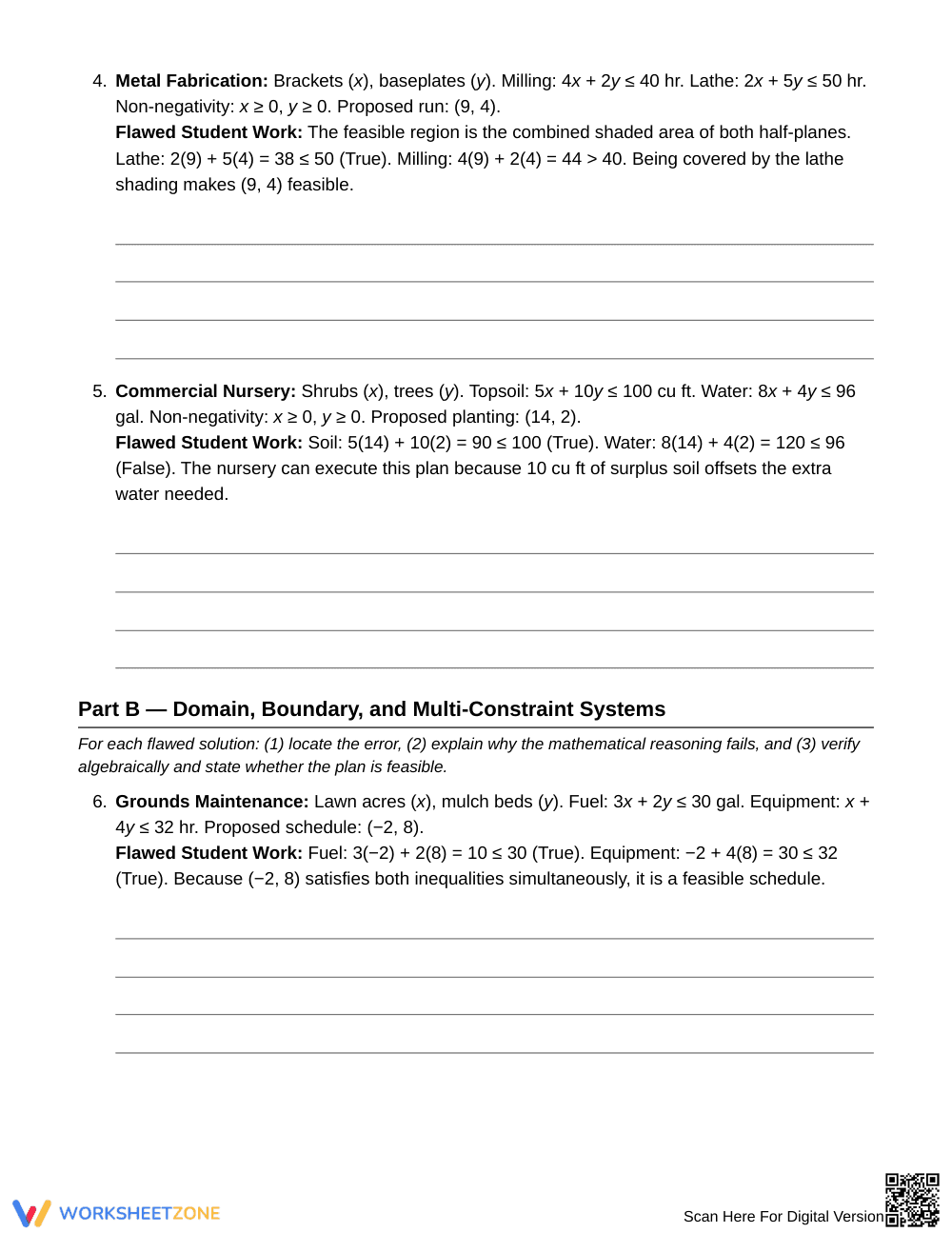
This Algebra I worksheet helps ninth-grade students resolve union-versus-intersection misconceptions in systems of linear inequalities. Through structured error analysis, learners determine whether proposed coordinate pairs satisfy multiple constraints simultaneously. Students explain why excess capacity in one resource cannot offset a deficit in another, building conceptual mastery of feasible regions.
At a Glance
- Grade: 9 · Subject: Algebra I
- Standard: Graph linear inequalities and identify solutions satisfying all constraints simultaneously
- Skill Focus: Correct Union-versus-Intersection Errors
- Format: 5 pages · 10 problems · Answer key included · PDF
- Best For: Error analysis and intervention practice
- Time: 40–50 minutes
What's Inside
The 5-page printable document includes a reference summary of core mathematical principles, a fully worked error repair model, and 10 detailed mathematical critique tasks. A comprehensive 3-page answer key provides step-by-step algebraic verifications and explicit rationales for why flawed student responses fail, allowing teachers to assess conceptual understanding rapidly.
Skill Progression
- Guided practice: A reference box outlines feasible regions beside a modeled repair showing how to locate union errors, explain contextual failures, and verify algebraically.
- Supported practice: Part A features 5 two-variable capacity problems where students identify invalid resource trade-offs, evaluate expressions, and reject infeasible coordinates.
- Independent practice: Part B presents 5 multi-constraint problems involving strict boundaries and negative inputs where students evaluate flawed majority-rule logic independently.
This progression uses the gradual-release framework to move students from explicit teacher modeling to independent mathematical evaluation.
Standards Alignment
This worksheet aligns with high school algebra standards where students graph solutions to linear inequalities as half-planes and determine solution sets of systems as the intersection of regions. Students also apply non-negativity and boundary rules to real-world contexts. Both standard codes can be copied directly into lesson plans, IEP goals, or district curriculum mapping tools.
How to Use It
Implement this resource after direct instruction on graphing systems of linear inequalities. During guided practice, complete the modeled repair collectively before assigning Part A in pairs and Part B independently. As a formative assessment check, monitor whether students evaluate non-negativity conditions and strict inequalities accurately or mistakenly declare points on dashed boundary lines feasible. The entire problem set takes approximately 40 to 50 minutes to complete.
Who It's For
This worksheet serves Grade 9 Algebra I students needing targeted practice with systems of inequalities and compound logic. It is especially effective for intervention groups confusing disjunction and conjunction. Pair this assignment with a visual anchor chart illustrating overlapping shaded half-planes to reinforce intersection concepts.
Mastering systems of linear inequalities requires ninth-grade students to differentiate clearly between union and intersection when interpreting feasible regions. Rather than merely computing coordinates, learners must recognize that valid solutions demand the simultaneous satisfaction of all system constraints. According to Fisher & Frey (2014), structured error analysis accelerates mathematical reasoning by requiring students to articulate why an incorrect procedure fails and how conceptual rules govern valid solutions. In this resource, students analyze ten authentic student mistakes, identifying how surplus in one constraint fails to offset a deficit in another resource. By debugging flawed claims involving domain boundaries, strict inequalities, and multi-constraint systems, learners transition from procedural computation to rigorous conceptual evaluation. This focused practice solidifies algebraic reasoning and prevents persistent misconceptions in linear programming, ensuring students develop durable problem-solving competencies across secondary mathematics curricula.


