































Ready U.S. States Word Search | Grades 7–8 Social Studies

Paste this activity's link or code into your existing LMS (Google Classroom, Canvas, Teams, Schoology, Moodle, etc.).
Students can open and work on the activity right away, with no student login required.
You'll still be able to track student progress and results from your teacher account.
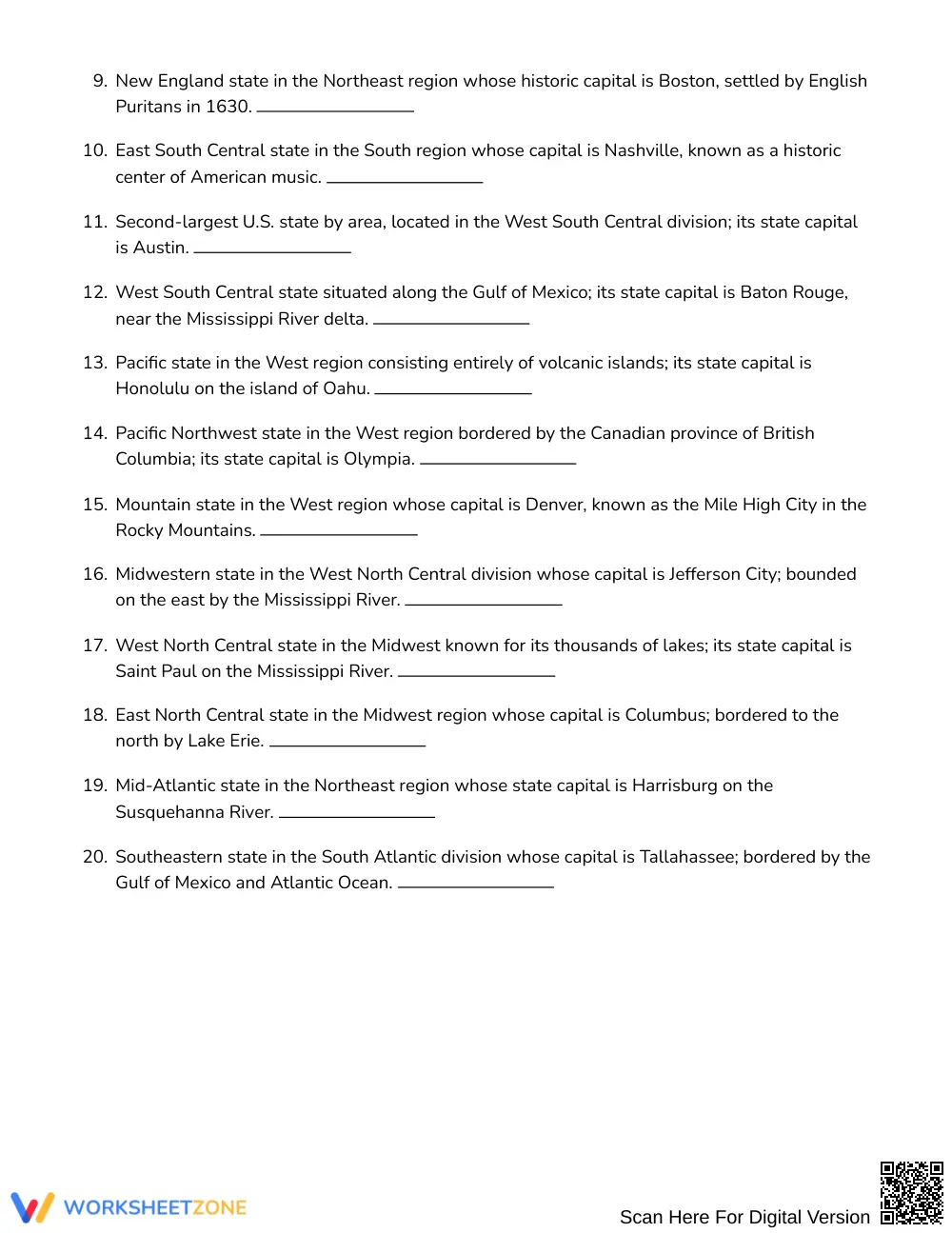
This Grades 7–8 social studies word search reinforces U.S. geography knowledge by challenging students to connect state names with their capitals, regional divisions, and geographic boundaries. Learners read factual clues detailing twenty distinct states, identify each state, and locate the twenty hidden state names inside a full-size grid to demonstrate cumulative spatial and regional mastery.
At a Glance
- Grade: Grades 7–8 · Subject: Social Studies
- Standard: Not standards-assessed — vocabulary enrichment and regional review
- Skill Focus: U.S. states, capitals, and regional geography cumulative review
- Format: 3 student pages · 20 hidden words · 4-page answer key included · PDF
- Best For: Cumulative geography vocabulary review, partner stations, and fast-finisher reinforcement
- Time: 20–30 minutes
What's Inside
This 3-page printable geography resource features a 20-word search puzzle built on a 20 by 20 letter grid alongside twenty substantive regional clues. Each clue presents vital geographic data, including state capitals, regional divisions such as Mountain or New England, and bordering waterways or nations. The resource provides a shuffled word bank for reference and a 4-page answer key that highlights exact word placements for rapid grading.
Puzzle Mechanics and Structure
The activity organizes 20 target state names across a challenging 20 by 20 letter matrix. Target terms run in all eight possible directions: North, Northeast, East, Southeast, South, Southwest, West, and Northwest, requiring close visual scanning. Students solve clues referencing capitals and regional locations to determine the target states, locating multiword entries without spaces to complete the search.
Standards Alignment
This educational activity serves as targeted vocabulary enrichment and cumulative content reinforcement rather than direct standard-assessed instruction. It supports secondary social studies curricula by developing mental maps of United States regions, state capital associations, and geographical spatial relationships without formal standards testing.
How to Use It
Deploy this word search during a dedicated review station after completing a unit on United States regions, or assign it as an independent fast-finisher activity following direct geography instruction. For formative assessment, observe whether students identify states directly from the regional clues before referencing the shuffled word bank, noting which geographic divisions require reteaching. Most seventh and eighth graders finish the 20-word puzzle in 20 to 30 minutes.
Who It's For
This activity is designed for Grades 7–8 social studies students reviewing United States geography. Teachers can differentiate by having emerging learners reference an atlas or desk map while advanced students identify target states using solely the capital clues before beginning the word search. Pair this activity naturally with a blank United States physical map for hands-on labeling practice.
Academic research highlights the value of retrieval practice and structured vocabulary tasks in strengthening long-term geographic literacy. According to Fisher & Frey (2014), purposeful word reinforcement and contextual clues consolidate disciplinary knowledge by prompting middle school learners to retrieve prior concepts across interconnected informational domains. This non-standardized cumulative review requires students in Grades 7–8 to analyze regional descriptions, recall state capitals, and visually locate twenty hidden state names across an intricate letter grid. Integrating factual geographical identifiers with spatial puzzle search mechanics encourages students to synthesize cardinal directions, regional groupings, and civic knowledge efficiently. By engaging with clues highlighting waterways, neighboring borders, and capital cities, learners actively transfer isolated facts into coherent mental schema. Teachers can effectively utilize this puzzle activity as an engaging formative checkpoint that supports secondary social studies instruction while fostering enduring spatial recall across diverse classroom settings.


