




























Views
Downloads

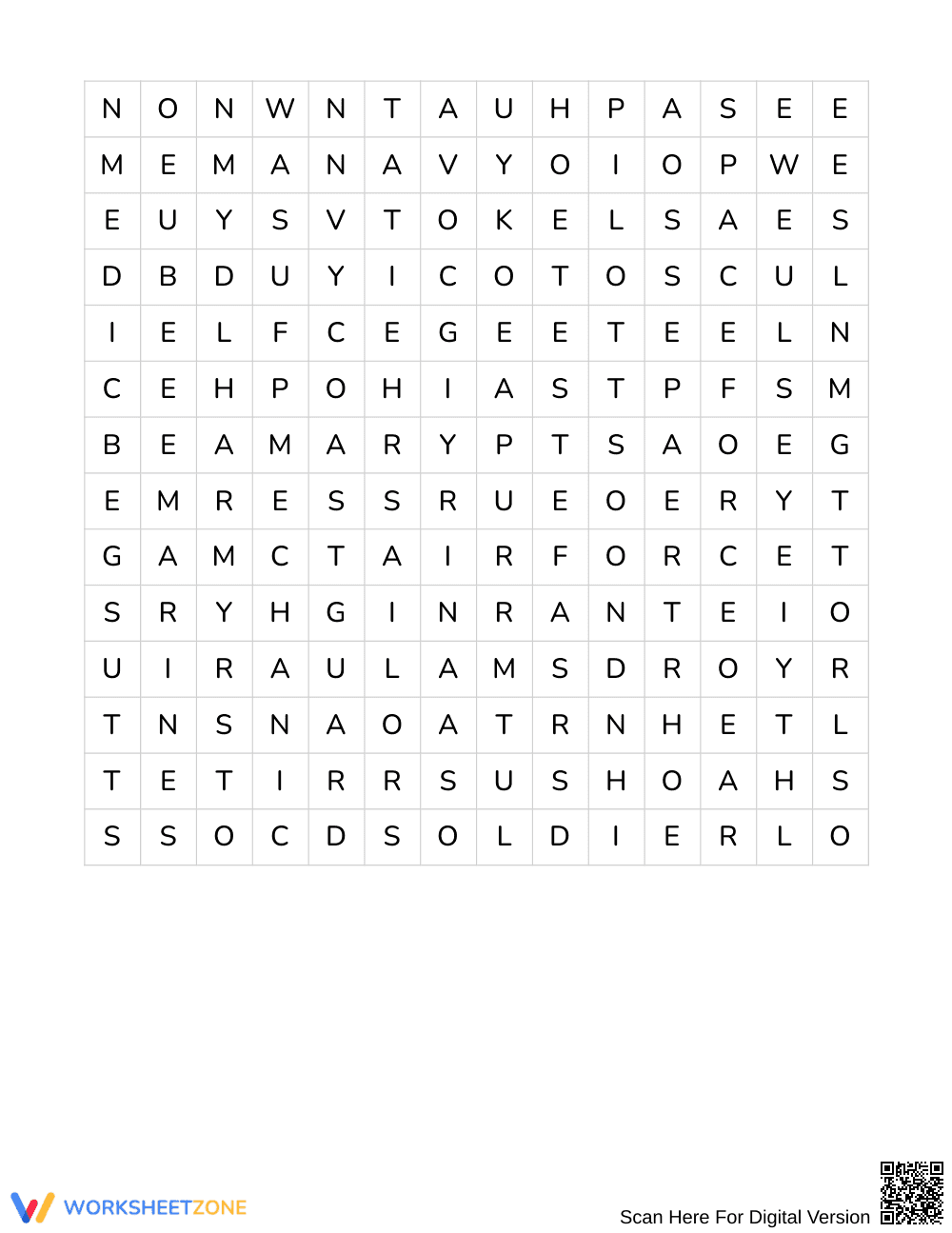

Ready U.S. Military Word Search | Grades 3–4 Social Studies

Paste this activity's link or code into your existing LMS (Google Classroom, Canvas, Teams, Schoology, Moodle, etc.).
Students can open and work on the activity right away, with no student login required.
You'll still be able to track student progress and results from your teacher account.
This civics and government word search introduces elementary learners to the six branches of the United States armed forces and key service member roles. Students identify twelve essential military terms across a clear grid, reinforcing domain-specific vocabulary and category relationships during Veterans Day lessons or dedicated social studies units.
At a Glance
- Grade: Grades 3–4 · Subject: Social Studies
- Standard: Not standards-assessed — vocabulary enrichment
- Skill Focus: U.S. military branch names and roles
- Format: 2 pages · 12 words · Answer key included · PDF
- Best For: Veterans Day civics enrichment
- Time: 15–25 minutes
What's Inside
The activity provides a clean, two-page printable format featuring a letter grid alongside an organized category bank. Rather than an unorganized alphabetical list, the twelve target terms are categorized into official service branches and distinct military professions. A comprehensive answer key highlights exact letter placements across all puzzle rows, enabling rapid verification and self-checking.
Puzzle Layout and Search Mechanics
The word search is arranged in a 14 by 14 grid designed specifically for Grades 3–4 readers. All 12 hidden terms run in three accessible directions: horizontally forward (East), diagonally downward (Southeast), and vertically downward (South). No backward or upward configurations are included, preserving readability while developing pattern-recognition skills. The word bank groups terms under two thematic headers: Branches of Service (Army, Navy, Air Force, Marines, Coast Guard, Space Force) and Service Roles (Soldier, Sailor, Pilot, Medic, Mechanic, Navigator).
Standards Alignment
This activity is designed strictly for vocabulary enrichment and is not aligned to a formal state or national content standard. It supports foundational civics instruction by familiarizing intermediate elementary students with historical and modern institutions of national defense without the pressure of standardized assessment benchmarks.
How to Use It
Deploy this word search during an introductory Veterans Day civics lesson or as a follow-up activity after direct instruction on national defense institutions. For an engaging launch, prompt students to locate the six service branches first before identifying the individual job roles. As a formative assessment observation, circulate while students search and ask them to match each role to the environment where that specialist serves. Most learners complete the full twelve-word puzzle in 15 to 25 minutes.
Who It's For
This resource is tailored for Grades 3–4 students exploring community helpers, national holidays, and federal government roles. For emerging readers or multilingual learners, teachers can highlight the first letter of each hidden term as a visual scaffold. Pair this puzzle with an informational read-aloud about military careers or an interactive civics anchor chart highlighting modern defense branches.
Vocabulary enrichment tools support foundational content knowledge by strengthening orthographic mapping and thematic association. According to Fisher & Frey (2014), intentional word exposure within structured thematic categories reinforces domain-specific terminology far more effectively than isolated memorization lists. When Grades 3–4 students engage with structured word searches focusing on U.S. military branch names and roles, they actively analyze letter sequences while reinforcing conceptual links between military branches and specialized operational responsibilities. Categorizing terms such as Army, Navy, and Space Force alongside specific occupations like medic, navigator, and pilot allows intermediate elementary learners to build mental models of public service. Because this print-and-go activity focuses on accessible directional alignments across a 14 by 14 letter grid, students build persistence and visual discrimination without cognitive overload. This targeted balance between content familiarity and accessible puzzle architecture makes the resource an effective supplemental tool for elementary civics instruction.


