




























Views
Downloads
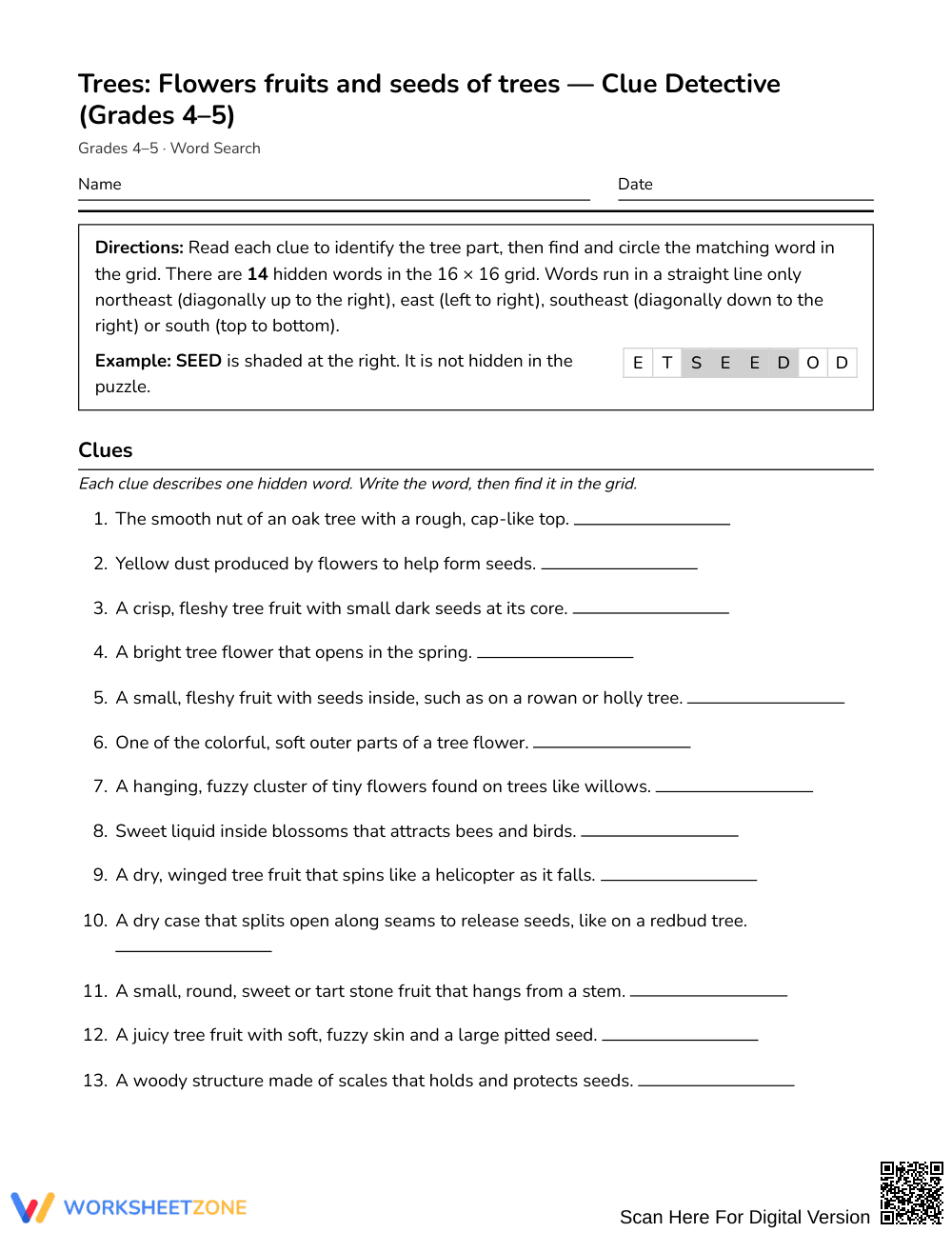


Ready Tree Flowers & Seeds Word Search | Grades 4–5 Science

Paste this activity's link or code into your existing LMS (Google Classroom, Canvas, Teams, Schoology, Moodle, etc.).
Students can open and work on the activity right away, with no student login required.
You'll still be able to track student progress and results from your teacher account.
This science word search helps upper elementary students master key botanical terminology regarding the flowers, fruits, and seeds of trees. By connecting concise definitions to hidden vocabulary terms, students reinforce biology concepts while building scientific literacy. The activity strengthens botanical recognition through active clue solving across an engaging puzzle layout.
At a Glance
- Grade: Grades 4–5 · Subject: Science
- Standard: Not standards-assessed — vocabulary enrichment
- Skill Focus: Botanical terminology for the flowers, fruits, and seeds of trees
- Format: 2 student pages · 14 words · Full answer key included · PDF
- Best For: Science vocabulary review, early finishers, and reinforcement
- Time: 20–30 minutes
The printable set includes a two-page student activity featuring 14 distinct vocabulary terms paired with descriptive botanical clues. Rather than relying on a simple list, students read functional definitions—such as identifying a winged samara, a fuzzy catkin, or a woody pinecone—before locating each term. A full three-page answer key provides clear solution paths for fast verification.
The activity centers on a 16 by 16 letter grid designed to reinforce plant biology terms. Words are hidden running in four specific directions: northeast, east, southeast, and south. Students examine a shuffled word bank alongside 14 clue statements, reading each definition to determine the correct tree part before locating and circling the target term within the letter matrix.
This resource serves as supplemental vocabulary enrichment and is not directly aligned to an individual state or national standard. It supports foundational life science units by deepening student familiarity with plant reproduction and seed dispersal mechanisms.
Use this puzzle after direct instruction on plant reproduction to consolidate unit vocabulary, or assign it during independent station rotations. During work time, observe whether students read the clue before searching or simply hunt for letter patterns; prompt learners to explain what structures like a samara or catkin do. Most students complete the activity within 20 to 30 minutes.
This resource is designed for Grades 4–5 science students exploring biology, plant structures, and forest ecology. It offers approachable vocabulary scaffolding for multilingual learners and general education classrooms alike. Pair this puzzle with an outdoor tree observation walk or a botanical diagram showing angiosperm and gymnosperm reproduction.
Direct vocabulary instruction in domain-specific science terms is essential for reading comprehension and conceptual mastery in upper elementary grades. According to research synthesized by Fisher & Frey (2014), intentional word exposure coupled with functional definitions enables students to build robust semantic networks, shifting terminology from passive recognition to active academic discourse. This word search engages Grades 4–5 learners by prompting them to read precise biological clues before identifying 14 specialized terms related to tree flowers, fruits, and seeds within a 16 by 16 puzzle grid. By requiring students to process definitions for complex botanical structures such as catkins, samaras, and cones rather than merely matching identical letter strings, the task reinforces botanical concepts and aids memory retention. Integrating interactive terminology tasks into life science units ensures that diverse learners develop the foundational vocabulary necessary for complex informational texts and scientific inquiry.


