


























Views
Downloads




Ready Tabulated Rates Change Worksheet | Grade 12 Calculus
Paste this activity's link or code into your existing LMS (Google Classroom, Canvas, Teams, Schoology, Moodle, etc.).
Students can open and work on the activity right away, with no student login required.
You'll still be able to track student progress and results from your teacher account.
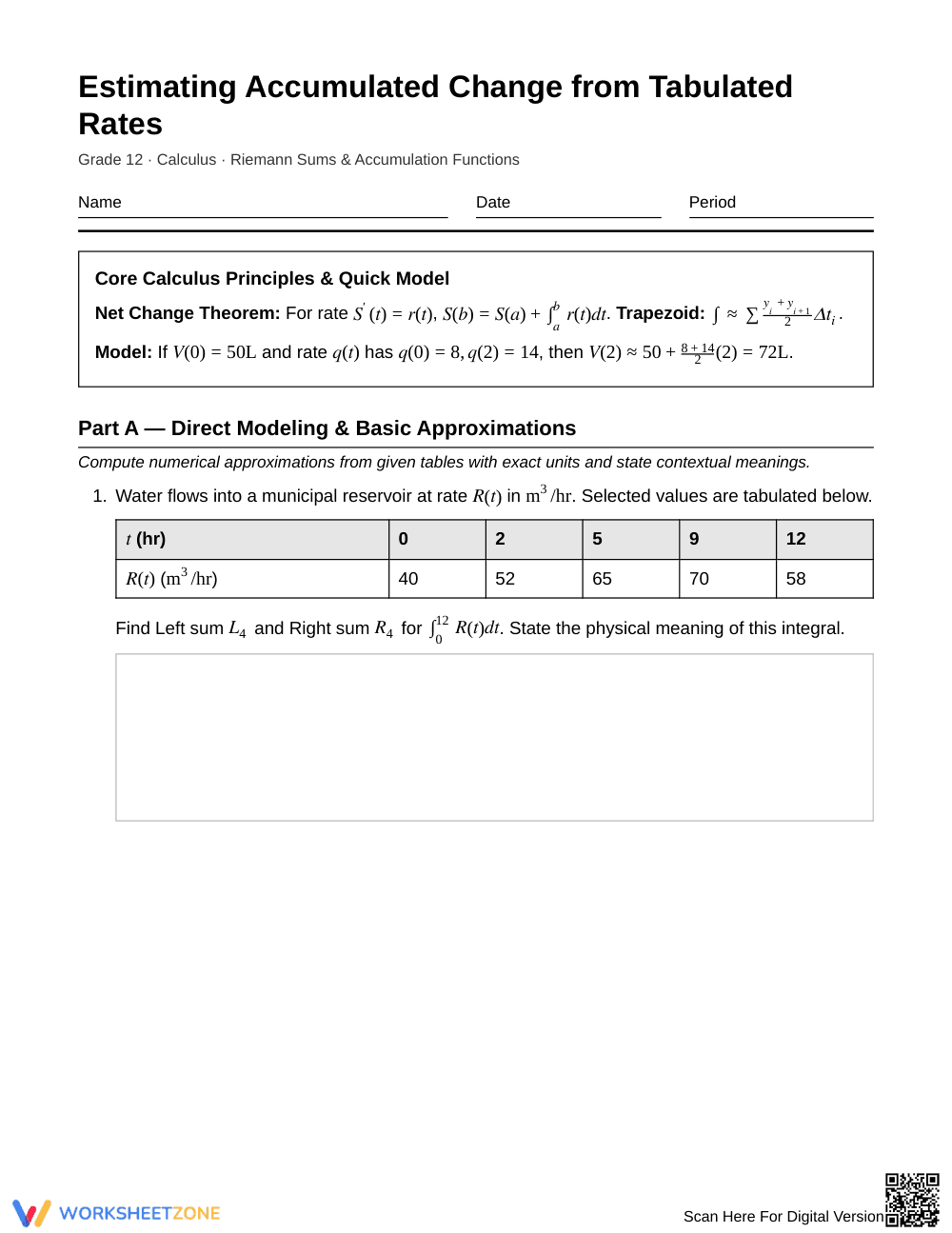
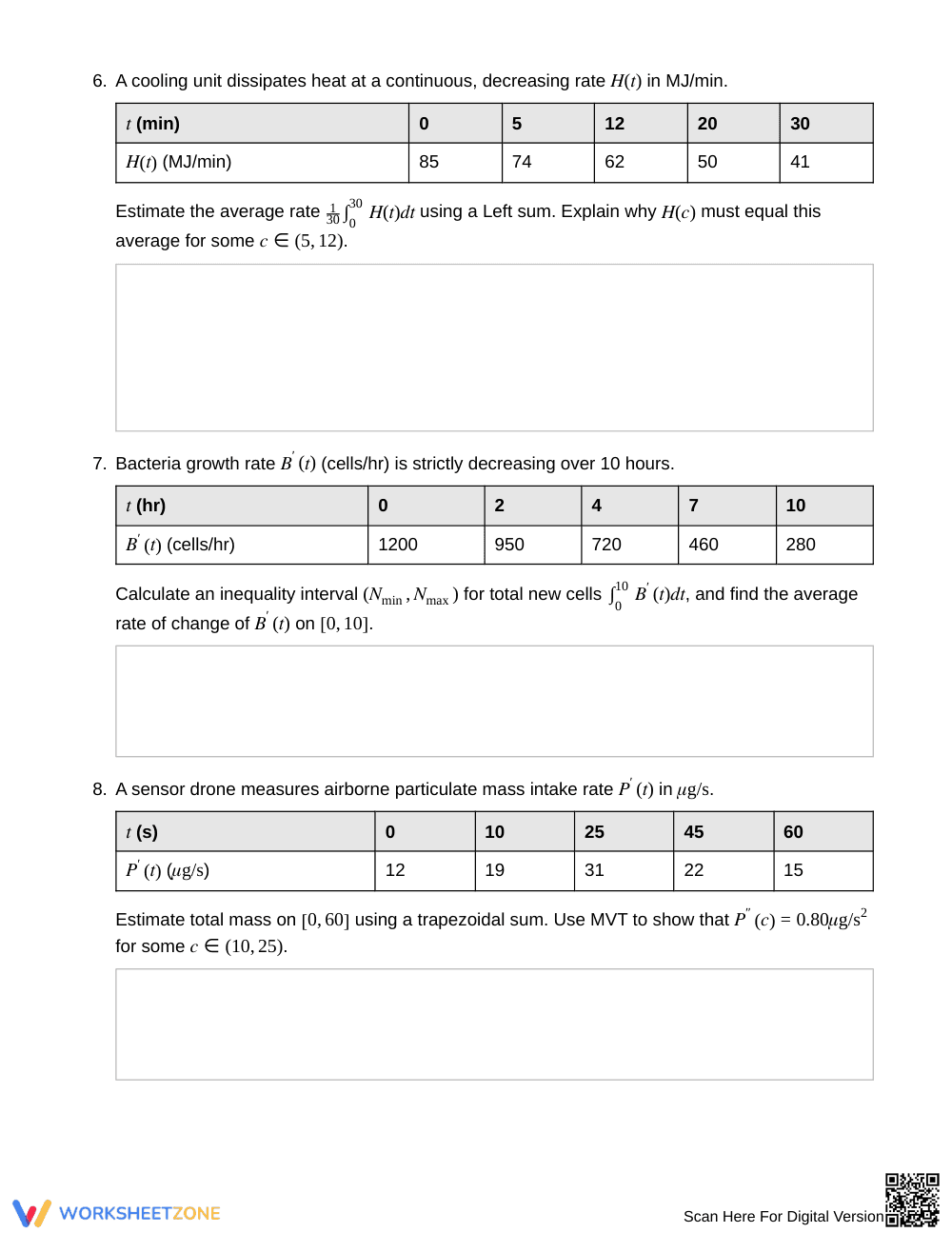
This Grade 12 calculus worksheet equips high school seniors with rigorous analytical techniques to estimate accumulated change from tabulated rates. Students compute Left, Right, Midpoint, and Trapezoidal Riemann sums over non-uniform partitions, connect numerical rate data to total change using the Net Change Theorem, and justify concavity overestimates and bounds across realistic STEM scenarios.
At a Glance
- Grade: 12 · Subject: Calculus
- Standard: Calculus Integration Standard — Approximate definite integrals and accumulated change using Riemann sums from tabulated values
- Skill Focus: Estimate Change from Tabulated Rates
- Format: 5 pages · 10 structured problems · Full answer key included · Printable PDF
- Best For: High school AP Calculus exam preparation and skill review
- Time: 45–60 minutes
The 5-page worksheet includes 10 multi-part analytical problems arranged in three distinct sections, accompanied by a comprehensive 3-page worked answer key. A reference box opens the set with the Net Change Theorem formula and a worked trapezoidal model. Tasks feature unequal subintervals, unit analysis requirements, error interval derivations, and Mean Value Theorem applications across contextual data tables.
Skill Progression
- Guided practice: Problems 1–2 build foundational computation with four-subinterval left, right, and trapezoidal sums, emphasizing correct metric units and contextual physical meanings under explicit worked model support.
- Supported practice: Problems 3–8 advance into unequal partition intervals, initial value integrations, concavity over/underestimate justifications, strict bounding intervals, and average value proofs using the Mean Value Theorem.
- Independent practice: Problems 9–10 require autonomous decision modeling, where students integrate rate inflows against constant outflows to evaluate basin volume thresholds and aircraft fuel safety reserves.
This structured sequence reflects the gradual-release model, shifting students from modeled numerical procedures to multi-step analytical reasoning and real-world boundary decisions.
Standards Alignment
This resource aligns with upper-level secondary calculus standards governing numerical approximations of definite integrals and accumulation functions. Students apply Riemann sums to approximate integrals from tables with unequal step sizes, interpret the integral as net accumulated change, and analyze bounding errors. Both standard codes can be copied directly into lesson plans, IEP goals, or district curriculum mapping tools.
How to Use It
Deploy this worksheet after direct instruction on trapezoidal approximations and the Net Change Theorem to solidify rate table literacy. For formative assessment, examine whether students calculate variable subinterval widths individually rather than assuming uniform step sizes. Expect completion in 45 to 60 minutes during in-class partner workshops, calculus test review, or as homework.
Who It's For
This resource serves Grade 12 AP Calculus AB/BC and dual-enrollment college calculus students preparing for free-response table prompts. Scaffold struggling learners by pairing the worksheet with a rate-versus-accumulation anchor chart highlighting interval differences. Advanced learners can explore higher-order concavity justifications and continuity arguments.
According to EdReports 2024, secondary mathematics mastery requires balancing procedural fluency with deep conceptual modeling and contextual justification. This Grade 12 worksheet targets the essential calculus skill of estimating accumulated change from tabulated rates, requiring learners to translate discrete physical measurements into definite integral approximations. Students evaluate real-world rates of change across varied time intervals, directly connecting numerical rate accumulation to physical quantities such as reservoir volumes, electrical power consumption, and chemical mass transfer. By examining concavity, calculating upper and lower bounding intervals, and verifying intermediate rate values via the Mean Value Theorem, students move beyond rote arithmetic toward robust mathematical argumentation. The inclusion of complete step-by-step solutions facilitates targeted formative evaluation and immediate corrective feedback, reinforcing the rigorous analytical standards prioritized in modern STEM college-readiness frameworks and national advanced placement calculus examinations.


