































Ready Stage Lighting & Sound Word Search | Grades 6–7 ELA

Paste this activity's link or code into your existing LMS (Google Classroom, Canvas, Teams, Schoology, Moodle, etc.).
Students can open and work on the activity right away, with no student login required.
You'll still be able to track student progress and results from your teacher account.
This technical theater word search expands vocabulary mastery across stage lighting and sound concepts through active retrieval. Built for Grades 6–7 ELA and performing arts units, students analyze descriptive operational clues to deduce terms before locating them in the grid. The puzzle strengthens content-area literacy without relying on passive word lists.
At a Glance
- Grade: Grades 6–7 · Subject: English Language Arts (ELA)
- Standard: Not standards-assessed — vocabulary enrichment
- Skill Focus: Stage lighting and sound production terminology
- Format: 3 pages · 16 words · Complete 4-page answer key included · PDF
- Best For: Introductory technical theater vocabulary enrichment and review
- Time: 25–35 minutes of independent puzzle work
What's Inside
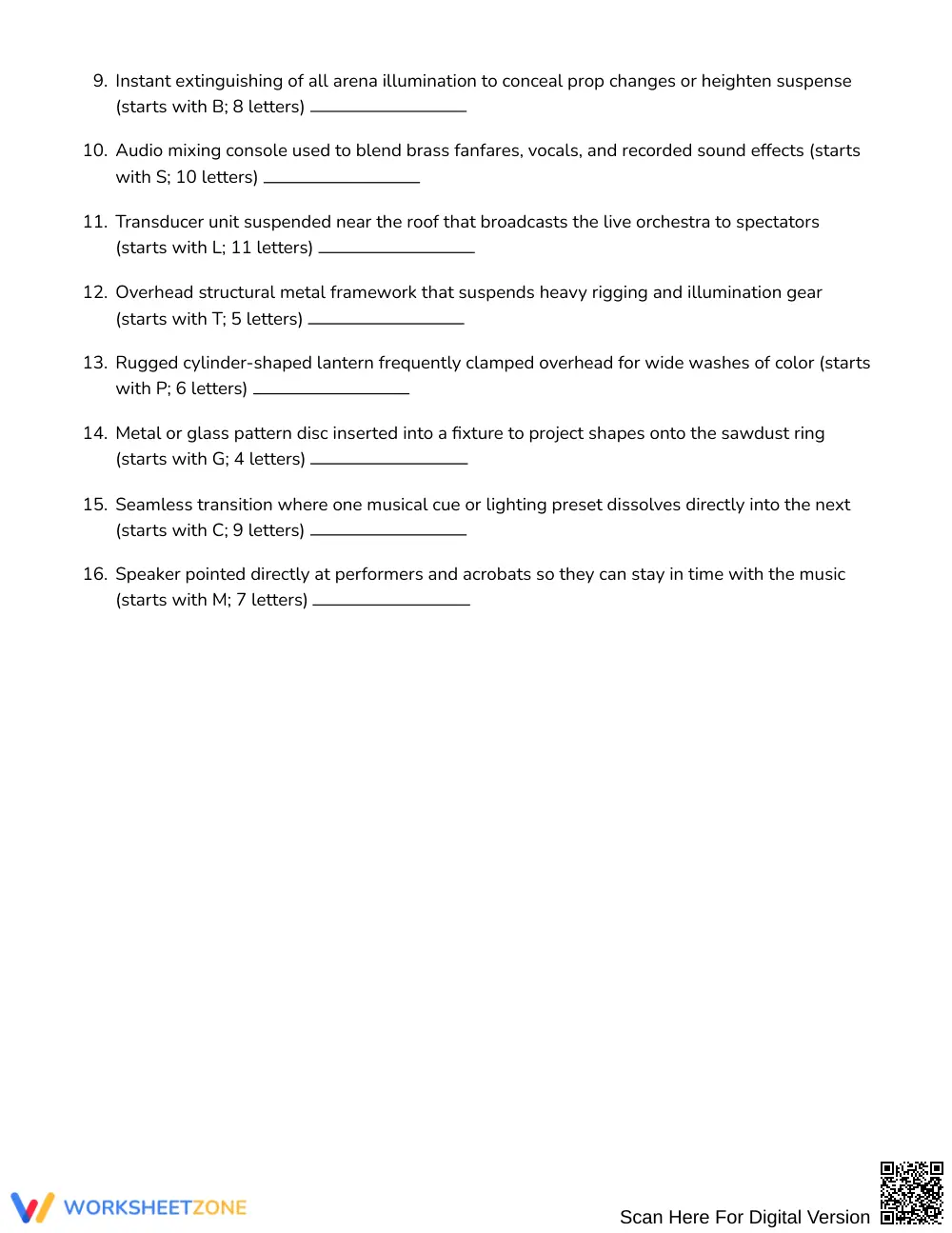
This 3-page printable resource challenges students to find 16 words embedded in an extensive letter matrix. Instead of providing a standard word bank, the activity features 16 technical clues defining arena and stage equipment like gobos, dimmers, and faders. Students deduce each term before searching, while a comprehensive 4-page answer key provides complete letter-by-letter solutions.
Puzzle Mechanics
This activity uses a no-bank challenge format structured around specific puzzle mechanics:
- Grid Dimensions: An 18 x 18 letter matrix provides 324 letters for focused scanning.
- Search Trajectories: Words run in all 8 directions: north, northeast, east, southeast, south, southwest, west, and northwest.
- Clue-Driven Solving: With no word bank provided, learners solve 16 technical clues to identify terms before locating them.
Standards Alignment
This activity provides targeted vocabulary enrichment and is not aligned to a specific standard. It reinforces domain-specific terminology and informational reading comprehension within theater arts and media production units.
How to Use It
Introduce this puzzle before direct instruction as a collaborative discovery task where partner pairs hypothesize equipment functions from clues. Alternatively, assign it after direct instruction as an independent vocabulary review. During independent work, observe whether students identify gear accurately from functional clues or confuse audio and lighting components. Students complete the puzzle in 25 to 35 minutes.
Who It's For
This resource serves Grades 6–7 students in English Language Arts, drama, and stagecraft classes. Provide struggling readers with an equipment visual guide, while challenging early finishers to draft circuit diagrams for the terms. Pair this activity with an informational passage on theater production crews.
Designed for Grades 6–7 learners, this technical theater word search strengthens domain-specific vocabulary acquisition across stage lighting and sound engineering concepts without formal standard assessment constraints. While unaligned to a specific standardized code, the no-bank architecture supports deep informational text comprehension by replacing passive word searches with active clue-based term retrieval. According to Fisher & Frey (2014), intentional exposure to specialized academic vocabulary within purposeful, contextualized learning tasks significantly strengthens long-term concept retention and verbal fluency. By analyzing functional operational descriptions for equipment such as soundboards, dimmers, spotlights, and gobos, middle school students actively build content-area literacy prior to locating 16 target words across an 18 x 18 letter grid. This dual-demand structure bridges performing arts terminology and reading comprehension, establishing durable cognitive schema for live event production environments, multimedia arts studies, and complex informational reading texts.


