































Ready Sincere Apology Word Search | Grades 4–5 Behavior

Paste this activity's link or code into your existing LMS (Google Classroom, Canvas, Teams, Schoology, Moodle, etc.).
Students can open and work on the activity right away, with no student login required.
You'll still be able to track student progress and results from your teacher account.
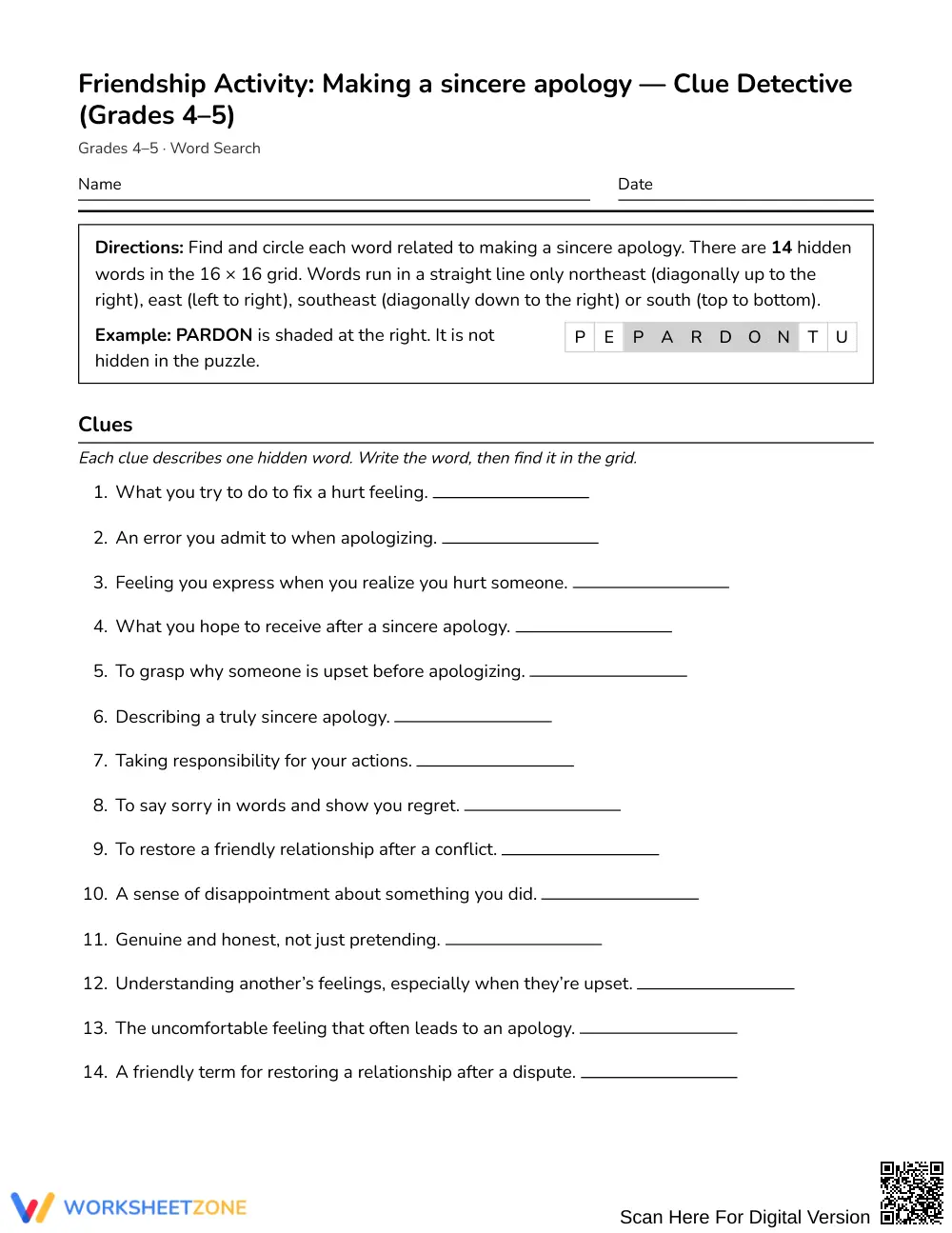
This social-emotional learning word search reinforces key concepts for making a sincere apology across Grades 4–5 classrooms. Students engage with foundational relationship-repair vocabulary through targeted clue-solving and letter-tracking tasks. Completing the puzzle helps learners understand accountability, empathy, and constructive communication when resolving everyday peer conflicts.
At a Glance
- Grade: Grades 4–5 · Subject: Behavior Worksheets
- Standard: Not standards-assessed — vocabulary enrichment
- Skill Focus: Making a sincere apology
- Format: 2 pages · 14 words · Answer key included · PDF
- Best For: Restorative conflict resolution and calm-down corners
- Time: 15–25 minutes
What's Inside
This printable 2-page activity combines vocabulary definitions with word-finding practice. Page one presents the puzzle challenge accompanied by contextual definitions for all 14 target words, including terms such as accountability, reconciliation, and empathy. The resource includes a complete 3-page answer key showing exact letter locations and highlighted answer paths to enable fast, accurate student self-checking.
Puzzle Mechanics and Structure
The activity centers on a 16 × 16 letter grid containing 14 hidden vocabulary terms. Target words run in four distinct directional orientations: northeast, east, southeast, and south. Rather than relying solely on a basic list, students work with a shuffled word bank paired with descriptive clues, requiring them to connect emotional meanings with specific apology terms before tracking the letters across the grid.
Standards Alignment
This activity provides targeted vocabulary enrichment focused on social-emotional competence and personal accountability. It is not aligned to an academic content standard. Instead, the material supports proactive behavior reflection, character education, and restorative practices by equipping students with the precise relational language necessary to navigate peer conflict and offer genuine amends.
How to Use It
Introduce this word search after direct instruction on conflict resolution or during a restorative reflection conference following a peer dispute. Alternatively, place it in an independent calm-down center where dysregulated students can quietly re-center while reflecting on emotional ownership. Formative tip: note which clue definitions students pause on to identify abstract concepts, such as accountability, that require small-group clarification. Most students complete the activity within 15 to 25 minutes.
Who It's For
Designed for upper elementary learners in Grades 4–5, this printable resource serves general education classrooms, school counseling offices, and social-emotional intervention groups. Accommodate developing readers by reading the clue definitions aloud in pairs before searching the grid. For a comprehensive social skills unit, pair this activity with an anchor chart outlining the four steps of an authentic apology.
According to Fisher & Frey (2014), purposeful vocabulary acquisition directly enhances students' ability to articulate complex social interactions and resolve interpersonal conflicts. By embedding 14 specific behavioral terms—such as empathy, remorse, and reconciliation—within an accessible 16 by 16 puzzle format, this resource promotes both cognitive focus and emotional literacy. Structured word-search tasks encourage focused letter scanning across northeast, east, southeast, and south orientations while reinforcing the semantic meaning of sincere apologies through paired definitional clues. When students acquire precise language for taking responsibility, they demonstrate improved self-regulation during peer mediation sessions. Integrating focused vocabulary tools into behavioral interventions bridges the gap between acknowledging mistakes and actively repairing relationships, ensuring upper elementary learners in Grades 4–5 cultivate lasting restorative habits.


