































Ready Simplification Repair Worksheet | Grade 10 English II

Paste this activity's link or code into your existing LMS (Google Classroom, Canvas, Teams, Schoology, Moodle, etc.).
Students can open and work on the activity right away, with no student login required.
You'll still be able to track student progress and results from your teacher account.
This Grade 10 informative writing worksheet equips students to recognize and repair misleading simplifications in complex texts. Using authentic museum exhibit constraints, learners analyze oversimplified claims, articulate technical trade-offs, and draft nuanced analytical explanations that balance accessibility mandates against artifact preservation standards.
At a Glance
- Grade: 10 · Subject: English II
- Standard:
W.9-10.2— Write informative texts examining complex ideas through accurate analysis and domain vocabulary- Skill Focus: Repair Misleading Simplifications
- Format: 6 pages · 10 problems · Answer key included · PDF
- Best For: Informative writing revision and text synthesis
- Time: 45–60 minutes
What's Inside
This 6-page resource includes a technical source dossier, a flawed student draft, 10 analytical tasks, and a 3-page answer key. Students examine spatial, acoustic, and conservation thresholds while using built-in scaffolds like domain vocabulary banks, synthesis tables, and sentence frames.
Skill Progression
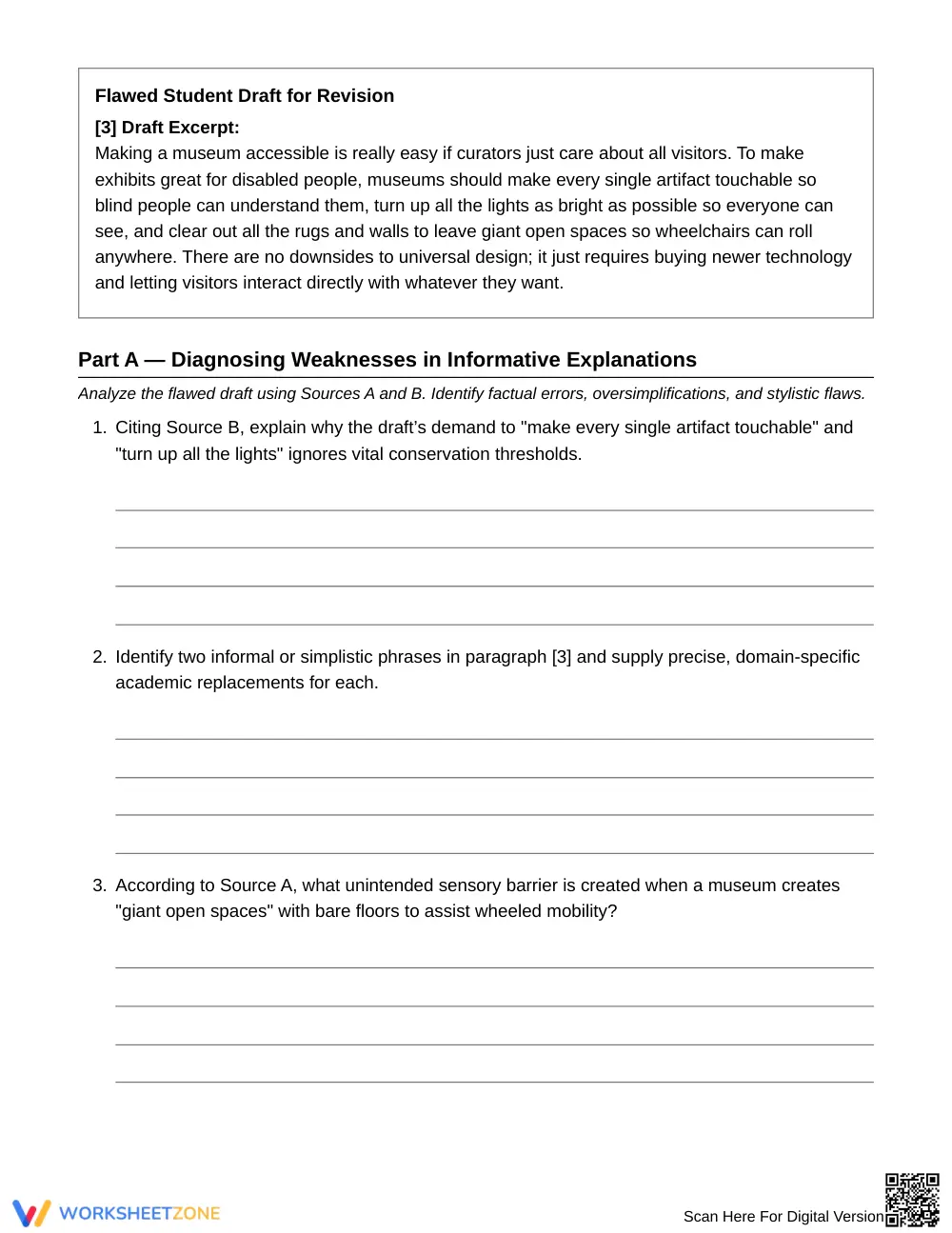
- Guided practice (Tasks 1–3): Students diagnose weaknesses in the flawed draft, identifying missing conservation limits and acoustic reverberation risks.
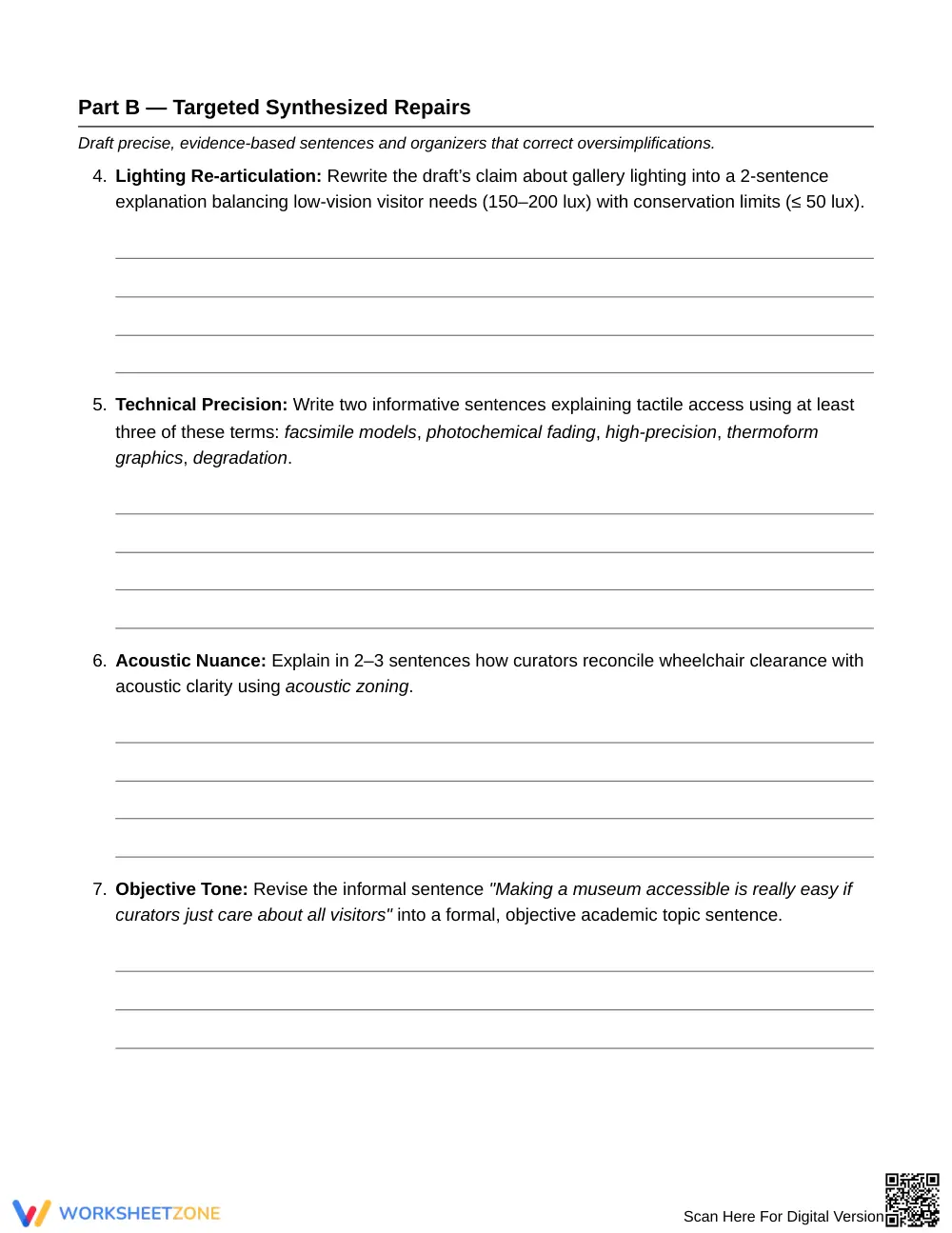
- Supported practice (Tasks 4–8): Learners write targeted revisions using domain vocabulary, balance light and acoustic tensions, and complete a synthesis matrix.
- Independent practice (Tasks 9–10): Students write an informative essay balancing competing design constraints and complete a four-criterion analytical self-evaluation.
This sequence implements gradual release, moving writers from error diagnosis to independent technical synthesis.
Standards Alignment
This resource aligns to W.9-10.2, examining complex ideas through accurate selection and analysis of technical content. It also supports standard RI.9-10.1 through text-based evidence citations. Both standard codes can be copied directly into lesson plans, IEP goals, or district curriculum mapping tools.
How to Use It
Assign this worksheet during the revision phase of an informative writing unit after direct instruction on managing complexity. Alternatively, use Parts A and B for targeted mid-unit formative assessment. Watch whether students explain causal trade-offs rather than simply swapping single words. Expected completion is 45 to 60 minutes.
Who It's For
Ideal for Grade 10 English II students practicing expository writing, this activity supports struggling writers with structured matrices while challenging advanced students. Pair this worksheet with a direct instruction lesson on objective syntax or an anchor chart of transition stems.
Fisher & Frey (2014) demonstrate that secondary students develop sophisticated disciplinary literacy when analytical tasks scaffold the transition from receptive critique to productive text generation. This Grade 10 English II instructional worksheet targets standard W.9-10.2, requiring students to repair misleading simplifications by articulating competing physical and environmental constraints in informational texts. Rather than allowing sweeping generalizations, the 10 structured tasks prompt learners to incorporate domain-specific vocabulary and balance contradictory technical needs such as tactile accessibility and artifact preservation. According to research on the gradual release of responsibility, guiding students through diagnostic analysis before independent synthesis yields measurable gains in expository clarity and syntactic complexity. By integrating text-based evidence synthesis, structural matrices, and objective self-evaluation criteria, this 6-page resource ensures high school writers master the analytical nuances necessary to explain multifaceted real-world systems with academic precision.


