
































Ready Signed Integral vs Area Worksheet | Grade 12 Calculus

Paste this activity's link or code into your existing LMS (Google Classroom, Canvas, Teams, Schoology, Moodle, etc.).
Students can open and work on the activity right away, with no student login required.
You'll still be able to track student progress and results from your teacher account.
This Grade 12 calculus activity helps students master the distinction between net signed integration and total geometric area. Students evaluate definite integrals, resolve crossing curves, and solve rate applications involving displacement and volume accumulation. By contrasting algebraic integration with absolute value area, learners eliminate common conceptual errors.
At a Glance
- Grade: 12 · Subject: Calculus
- Standard:
Calculus Applications— Distinguish net signed accumulation from total geometric area using definite integrals on closed intervals- Skill Focus: Signed Integral Versus Geometric Area
- Format: 5 pages · 16 problems · 2-page answer key included · PDF
- Best For: Advanced Placement Calculus practice and unit exam review
- Time: 45 to 60 instructional minutes
What's Inside
This 5-page printable resource includes 16 calculus problems across three sections, paired with a 2-page answer key. The worksheet opens with a reference rule box defining net signed accumulation versus geometric area with absolute value notation. Students analyze graphic representations, evaluate algebraic integrals, and solve contextual applications including particle kinematics, fluid inflow, and business profit.
Skill Progression
- Guided practice (Part 1, 4 problems): Short-answer conceptual prompts require students to explain signed versus geometric area and interpret velocity integrals.
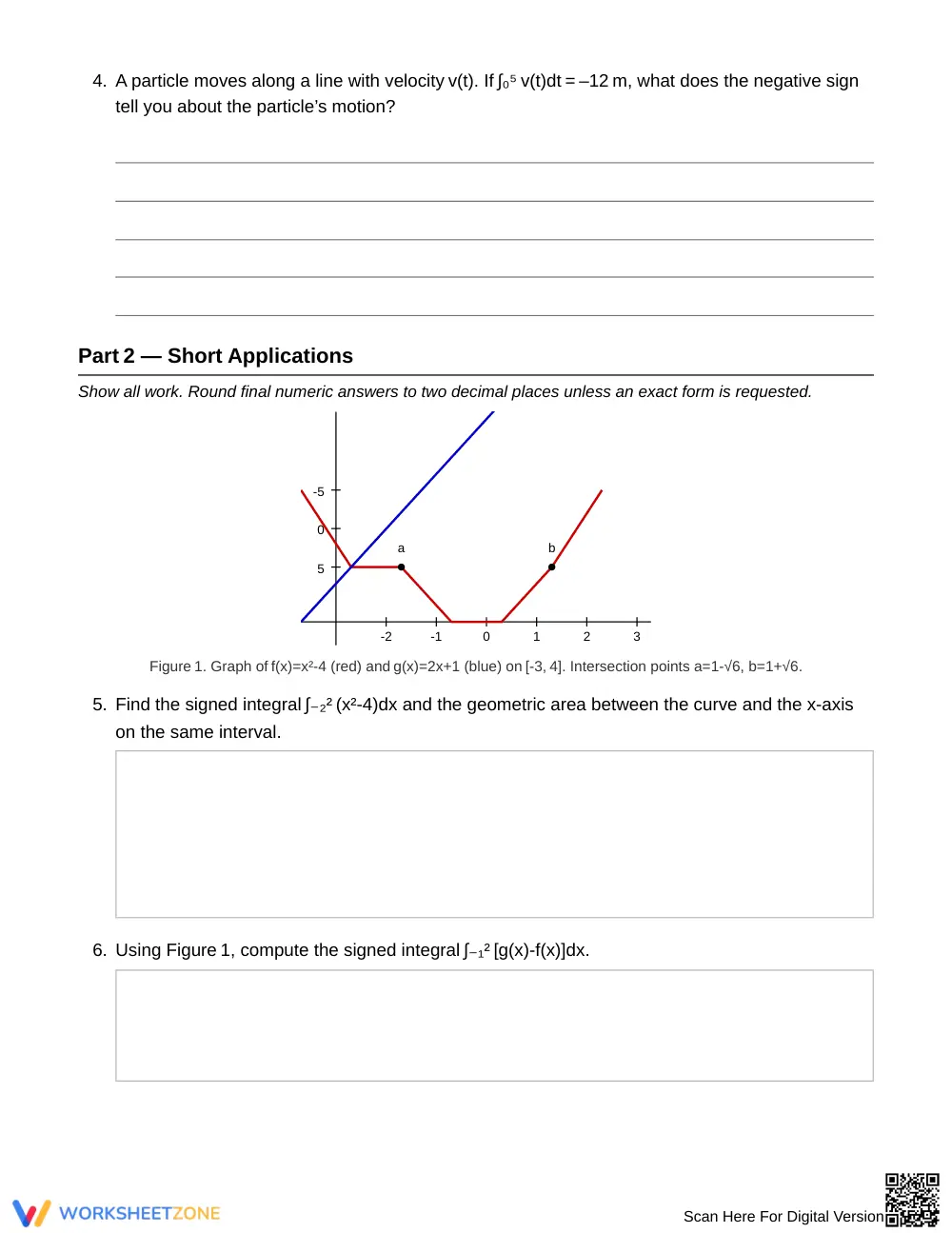
- Supported practice (Part 2, 8 problems): Computational tasks use graphs, polynomial, trigonometric, and exponential functions to calculate signed integrals and geometric bounded areas.
- Independent practice (Part 3, 4 problems): Multi-step transfer applications require students to model real-world rates, including particle acceleration and fluid inflow.
This sequence implements the gradual-release framework (I Do, We Do, You Do) to build procedural fluency from conceptual foundations.
Standards Alignment
This resource aligns with calculus standards for definite integrals: `Definite Integrals and Area Accumulation`. Students calculate net area, determine total geometric area using absolute values, and split intervals at intersections. Both standard codes can be copied directly into lesson plans, IEP goals, or district curriculum mapping tools.
How to Use It
Use this worksheet after direct instruction on definite integrals and before unit assessments. During class, observe whether students split intervals at intersection points when computing geometric area between curves, as missed intersections indicate confusion between net displacement and total distance. Expected completion time is 45 to 60 minutes.
Who It's For
Designed for Grade 12 Calculus students, this resource supports diverse learners through structural rule definitions and multi-step transfer problems. Pair this practice with an interactive Riemann sum visualization or an integration anchor chart.
Definite integral analysis requires students to distinguish between net signed accumulation and total geometric area bounded by curves. According to Fisher & Frey (2014), structured instructional progressions that guide students from conceptual explanations through graphical representations to independent transfer problems significantly enhance mathematical retention and analytical fluency. This Grade 12 Calculus worksheet provides 16 focused problems designed around Definite Integrals and Area Accumulation, challenging students to calculate signed definite integrals, establish split intervals at function intersections, and interpret net displacement versus total distance traveled in applied velocity scenarios. A dedicated reference rule box defines absolute value area calculations, scaffolding student reasoning before they tackle complex multi-step physics and business applications. Supported by an exhaustive 2-page answer key, this resource gives educators a reliable tool for diagnosing misconceptions and strengthening student mastery across integral calculus curricula.


