




























Views
Downloads




Ready Scientific Notation Roles Worksheet | Grade 8 Math

Paste this activity's link or code into your existing LMS (Google Classroom, Canvas, Teams, Schoology, Moodle, etc.).
Students can open and work on the activity right away, with no student login required.
You'll still be able to track student progress and results from your teacher account.
Master the distinct mathematical functions of scientific notation with this focused practice worksheet. Grade 8 students analyze the structural roles of coefficients and powers of ten across 16 rigorous items. Learners evaluate magnitude, adjust non-standard expressions, compare real-world measurements, and write mathematical justifications to build complete procedural fluency.
At a Glance
- Grade: 8 · Subject: Math
- Standard: Grade 8 Expressions and Equations — Compare numbers written in scientific notation and estimate quantities.
- Skill Focus: Coefficient and Power-of-Ten Roles
- Format: 4 pages · 16 problems · Answer key included · PDF
- Best For: Independent practice and conceptual review
- Time: 40–50 minutes
This four-page instructional resource includes a concise reference box outlining core mathematical principles, followed by multiple-choice concept checks, real-world calculation items, and extended mathematical justifications. A full two-page answer key provides step-by-step solutions, unit conversions, and algebraic proofs to support rapid grading and error analysis.
Skill Progression
- Guided Practice (Part A): 4 conceptual multiple-choice items evaluate student understanding of coefficient boundaries, magnitude scaling, and non-standard notation identification.
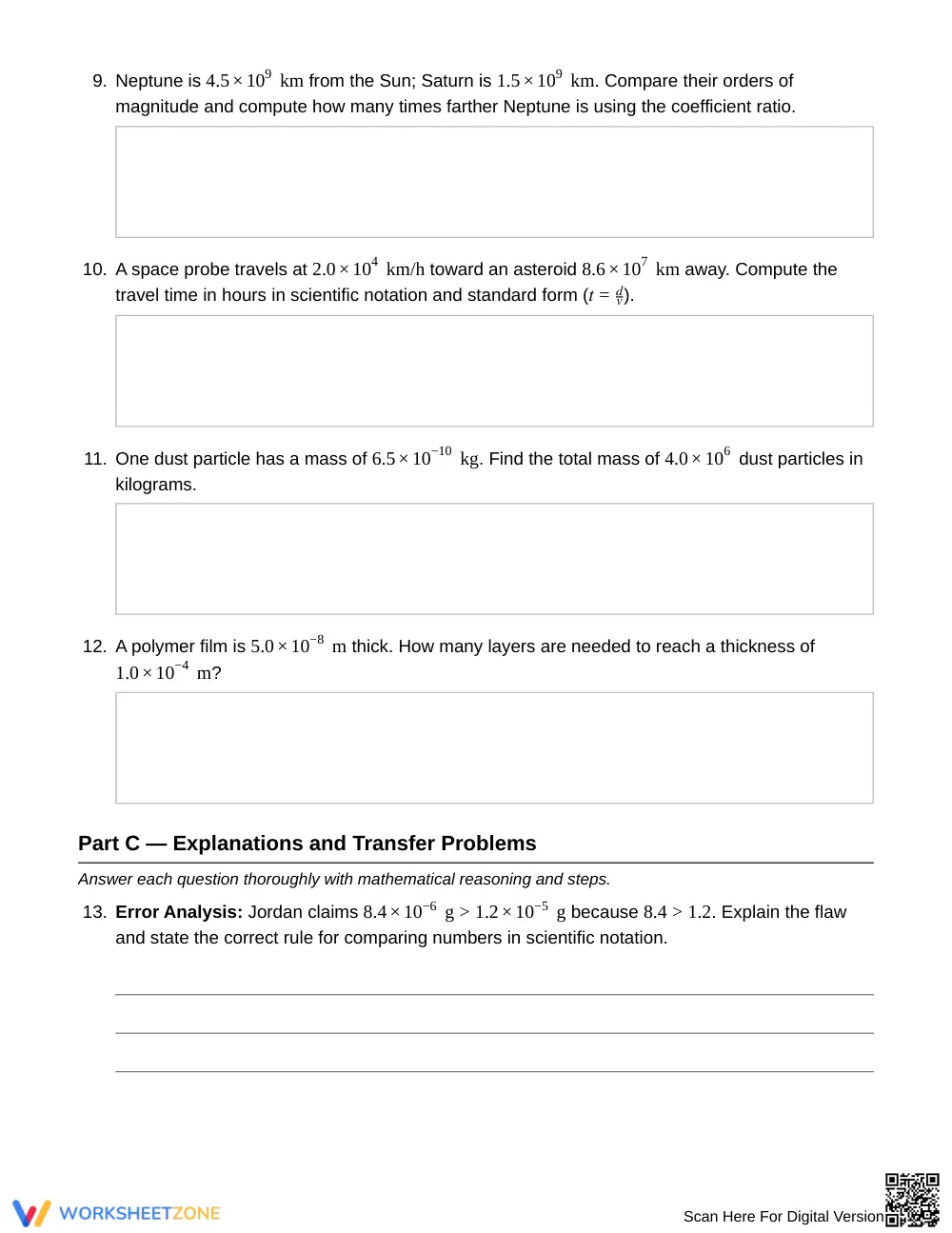
- Supported Practice (Part B): 8 applied multi-step word problems require students to calculate ratios, convert metric units, order small masses, and compute travel times.
- Independent Practice (Part C): 4 higher-order tasks challenge learners with error analysis, mental estimation strategies, unit transfer proofs, and formal inequality verifications.
This intentional structure follows an I Do, We Do, You Do gradual-release model that scaffolds student reasoning from foundational definitions to rigorous analytical proof.
Standards Alignment
This worksheet aligns directly with Grade 8 standards in Expressions and Equations requiring students to express very large or very small quantities using scientific notation and compare relative orders of magnitude. Students practice dividing coefficient and base-ten values to determine how many times larger one quantity is than another. These foundational objectives prepare learners for high school physics, chemistry, and advanced algebra coursework. Curriculum coordinators and classroom teachers can integrate these items directly into standard-based lesson plans, IEP goals, or district pacing guides.
How to Use It
Implement this worksheet after direct instruction on the properties of integer exponents and place value notation. Use Part A as a mid-lesson formative check to verify that students do not confuse coefficient size with overall magnitude before transitioning to independent problem-solving in Part B and Part C. Allocate 40 to 50 minutes for full completion, or divide the sections across two class periods for targeted intervention.
Who It's For
This resource serves general education Grade 8 math students, pre-algebra intervention groups, and physical science classes encountering scientific measurement. Pair this worksheet with an order-of-magnitude anchor chart or a hands-on metric scale sorting activity to reinforce visual comprehension.
Scientific notation instruction requires students to separate coefficient magnitude from exponential scale to prevent common misconceptions about number size. According to Fisher & Frey (2014), structured gradual-release frameworks significantly enhance student retention when transitioning from conceptual multiple-choice diagnostics to multi-step quantitative applications. This Grade 8 worksheet operationalizes that pedagogical approach across 16 targeted tasks. Students examine numbers in scientific notation, compute multiplicative comparisons across vastly different scales, and articulate written justifications. By decomposing complex division problems into coefficient operations and exponent subtraction, learners develop robust mental estimation strategies. The accompanying two-page answer key details complete mathematical reasoning, supporting targeted teacher feedback and self-directed student correction. Incorporating these structured exercises strengthens core algebraic foundations across middle school mathematics curricula.


