





























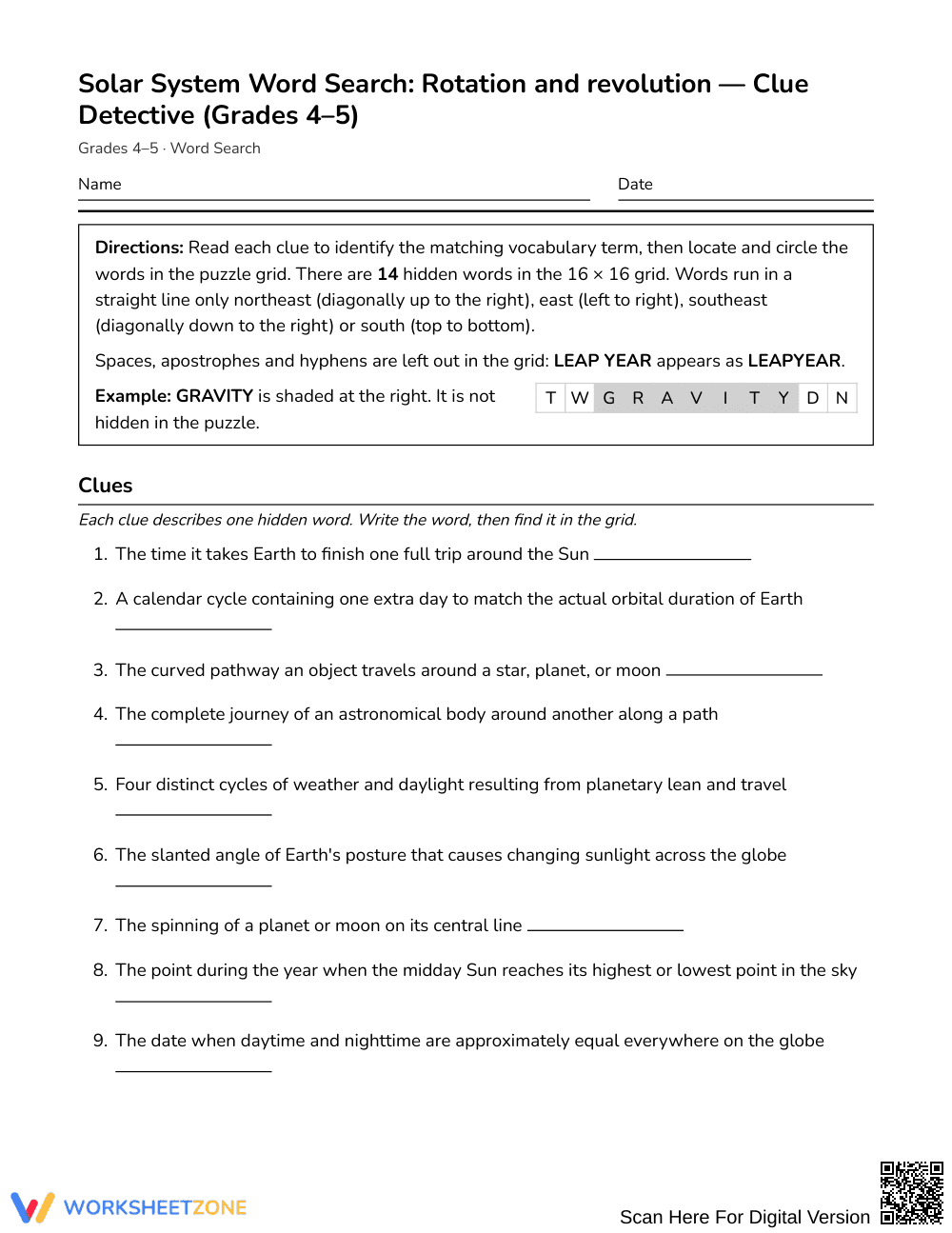


Ready Rotation & Revolution Word Search | Grades 4–5 Science

Paste this activity's link or code into your existing LMS (Google Classroom, Canvas, Teams, Schoology, Moodle, etc.).
Students can open and work on the activity right away, with no student login required.
You'll still be able to track student progress and results from your teacher account.
This Grades 4–5 science word search reinforces foundational Earth and space astronomy terms, specifically Earth's rotation and revolution. Students read descriptive conceptual clues to identify 14 target vocabulary terms before finding them in the letter grid. The activity builds celestial vocabulary retention and conceptual understanding of planetary motion, day-night cycles, and seasonal changes.
At a Glance
- Grade: Grades 4–5 · Subject: Science
- Standard: Not standards-assessed — vocabulary enrichment
- Skill Focus: Rotation and revolution
- Format: 3 pages · 14 words · Answer key included · PDF
- Best For: Vocabulary enrichment and science review
- Time: 20–30 minutes
What's Inside
The 3-page printable includes a Clue Detective activity featuring 14 planetary vocabulary terms, a 16 by 16 letter puzzle grid, and a full 3-page answer key. Instead of a simple word list, the activity challenges students with descriptive clues covering core topics such as axial tilt, solstices, and orbital periods, requiring students to retrieve definitions before searching.
Puzzle Mechanics
Students read 14 definition-based clues to deduce the corresponding astronomy terms, referencing a shuffled word bank for verification. Once identified, learners locate each term hidden within a 16 by 16 character grid. Hidden words run across four distinct directional paths: northeast, east, southeast, and south, offering an engaging spatial challenge without reverse-reading frustration.
Standards Alignment
This activity is designed for vocabulary enrichment and is not formally aligned to an assessed standard code. It strengthens science literacy by reinforcing tier-three academic vocabulary related to Earth's tilt, orbital pathways, and seasonal patterns, complementing upper elementary astronomy and Earth science curriculum units.
How to Use It
Introduce this word search after direct instruction on Earth's movements as an engaging mid-unit review, or assign it during independent station rotations. For a quick formative check, review student clue responses before they begin searching the grid to verify definitional comprehension. The complete activity takes approximately 20 to 30 minutes to finish.
Who It's For
This resource is suited for upper elementary learners in Grades 4–5 studying planetary cycles and space systems. The clue-driven format supports general education classes, ELL students needing contextual vocabulary exposure, and early finishers. Pair this word search directly with a hands-on globe and flashlight demonstration modeling planetary rotation and illumination.
Building domain-specific vocabulary is an essential component of elementary science comprehension, particularly when distinguishing related conceptual pairs such as planetary rotation and revolution. According to Fisher & Frey (2014), intentional vocabulary acquisition requires active semantic retrieval and structured opportunities to connect content definitions to academic terms. This Clue Detective word search supports semantic processing by requiring students in Grades 4–5 to interpret descriptive astronomical clues before locating the 14 vocabulary terms within the 16 by 16 puzzle matrix. By combining definitional retrieval with directional word recognition across four pathways, the activity reinforces retention of critical Earth systems terminology without cognitive overload. Science educators can implement this puzzle during post-instruction consolidation or small-group review to solidify conceptual understanding of day-night cycles, orbital paths, and seasonal axial tilt through structured, evidence-based lexical practice in upper elementary science classrooms.


